

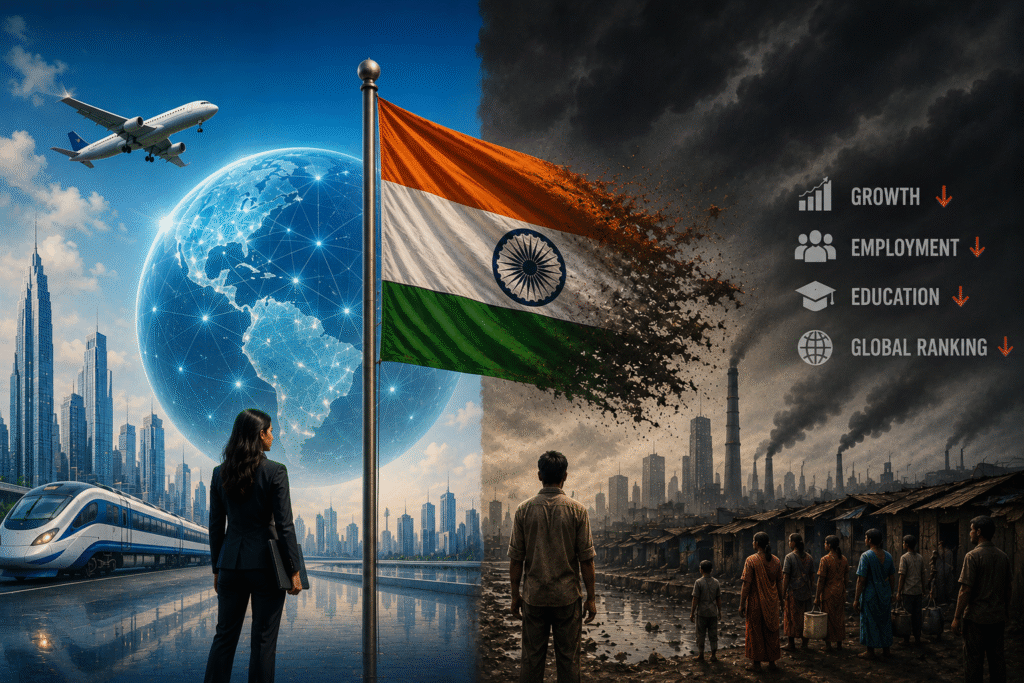
For more than a decade, India has projected itself as an emerging global power and a prospective Vishwaguru—a civilisational leader capable of shaping international discourse through democratic values, economic dynamism and strategic influence. Its expanding economy, diplomatic outreach and leadership in multilateral forums have undoubtedly enhanced its international profile. Yet the country’s aspirations increasingly confront a difficult reality: global credibility is measured not by rhetoric or symbolism but by the strength of institutions, human development and democratic governance.
A growing disconnect between India’s global narrative and internationally recognised indicators has begun to raise uncomfortable questions. While economic growth remains relatively robust and diplomatic engagements continue apace, key benchmarks of governance, civil liberties and social development reveal structural weaknesses that diminish India’s soft power and global standing.
What the Global Indices Reveal
A range of respected international indices presents a more nuanced assessment of India’s progress than official narratives often suggest.
The 2026 World Press Freedom Index published by Reporters Without Borders places India at 157th among 180 countries, slipping from 151st the previous year. The report cites concerns over violence against journalists, increasing media concentration and political pressures that constrain independent reporting. For a democracy that prides itself on a vibrant public sphere, such findings inevitably affect international perceptions.
The United Nations Development Programme’s 2025 Human Development Report ranks India 130th out of 193 countries, with a Human Development Index (HDI) score of 0.685. Although the country continues to improve gradually, it remains in the medium human development category and trails many comparable economies in education, healthcare and living standards.
Equally troubling is India’s performance in the 2025 Global Hunger Index, where it ranks 102nd among 123 countries and continues to fall within the “serious” hunger category. Persistent child stunting and wasting underscore the contradiction between rapid economic expansion and uneven social outcomes.
Governance indicators tell a similar story. Transparency International’s 2025 Corruption Perceptions Index places India 91st among 182 countries, pointing to continuing concerns about public-sector integrity and accountability. Meanwhile, the Heritage Foundation’s 2026 Index of Economic Freedom ranks India 132nd out of 184 economies, categorising it as “mostly unfree” because of regulatory complexities, bureaucratic obstacles and substantial state intervention.
The Henley Passport Index offers another practical measure of global standing. The relatively modest mobility enjoyed by Indian passport holders compared with citizens of leading economies reflects not merely visa policies but broader perceptions of trust, stability and international confidence.
Viewed together, these indicators do not suggest isolated shortcomings. Rather, they point to persistent structural challenges that continue to limit India’s ability to convert economic potential into durable global influence.
Beyond Ceremonial Recognition
International honours conferred upon political leaders and highly publicised diplomatic events often generate significant domestic attention. However, such symbolic recognition cannot substitute for measurable national progress.
State decorations and ceremonial accolades frequently accompany bilateral engagements or strategic partnerships, but their long-term significance ultimately depends on whether they translate into tangible outcomes—greater investment, technological collaboration, expanded trade or improved quality of life for ordinary citizens.
Similarly, India’s active participation in forums such as the G20, BRICS and platforms representing the Global South has strengthened its diplomatic visibility. Yet visibility alone does not guarantee influence. External developments, including trade disputes, regional tensions and growing international concerns regarding democratic governance, have complicated India’s projection as a consistent advocate of liberal democratic values.
Global opinion surveys likewise reflect a mixed picture. While India enjoys considerable goodwill across many countries, favourable perceptions are often tempered by concerns surrounding civil liberties, human rights, institutional independence and social cohesion. Soft power ultimately rests not only on economic success but also on the credibility of domestic institutions.
The Foundations of Global Influence
The erosion of international standing cannot be attributed to any single factor. Instead, it reflects the cumulative effect of several interrelated challenges.
A free and independent media remains fundamental to democratic legitimacy. Perceptions of pressure on journalists and increasing concentration of media ownership inevitably weaken international confidence in institutional independence.
Persistent deficiencies in nutrition, healthcare, education and social equity constrain the development of human capital—the most enduring source of national strength. Economic growth alone cannot compensate for inadequate investment in people.
Regulatory uncertainty, bureaucratic complexity and concerns about corruption continue to impede economic competitiveness despite India’s expanding digital economy and entrepreneurial ecosystem. International investors seek not only market size but also transparent governance, predictable regulation and strong institutions.
Diplomatically, India’s increasingly assertive foreign policy has expanded its strategic reach. Yet perceptions of domestic polarisation and majoritarian politics have occasionally complicated its relationships within South Asia and beyond. International observers have also expressed concern over what some reports describe as democratic backsliding, making it more difficult for India to present itself as a universal democratic model.
Although India’s projected economic growth of around six per cent remains among the strongest globally, economic performance alone cannot sustain international leadership. Lasting influence requires institutional credibility, inclusive development and consistent adherence to democratic norms.
Restoring Credibility Through Reform
India possesses undeniable strengths: a youthful population, technological innovation, entrepreneurial energy and a long democratic tradition. These remain powerful assets capable of supporting genuine global leadership. However, transforming potential into sustained influence requires greater emphasis on substantive reform rather than image management.
Strengthening legal protections for press freedom and safeguarding institutional independence would reinforce both domestic confidence and international credibility. Greater investment in healthcare, education and nutrition would improve human development outcomes while enhancing productivity and long-term economic resilience.
Meaningful economic reforms that reduce regulatory burdens, improve transparency and combat corruption would increase investor confidence and strengthen India’s position in global competitiveness rankings.
Diplomatically, a consistent commitment to the rule of law, minority rights, regional stability and multilateral cooperation would lend greater authenticity to India’s leadership claims. Genuine soft power is built not through branding campaigns but through institutions that command respect at home and abroad.
Greater transparency in governance, stronger engagement with civil society and a willingness to address critical assessments rather than dismiss them would further enhance India’s international reputation.
Leadership Must Be Earned
India stands at an important moment in its national journey. Its economic scale, demographic advantage and geopolitical importance ensure that it will remain a significant global actor. Yet international leadership is not secured by declarations alone. It is earned through institutional excellence, inclusive development and democratic resilience.
The world’s most influential nations command respect because their achievements are visible in the everyday lives of their citizens and reflected in the strength of their institutions. Global rankings, despite their imperfections, serve as useful reminders that credibility depends on measurable progress rather than carefully crafted narratives.
If India aspires to become a genuine global leader, it must bridge the widening gap between ambition and performance. The path to lasting influence lies not in projecting greatness, but in building it—through stronger institutions, deeper reforms and a steadfast commitment to democratic values. Only then will India’s global aspirations rest on foundations strong enough to command enduring international respect.

~Hasnain Naqvi is a former member of the history faculty at St. Xavier’s College, Mumbai….
The opinions expressed here are solely those of the author.