
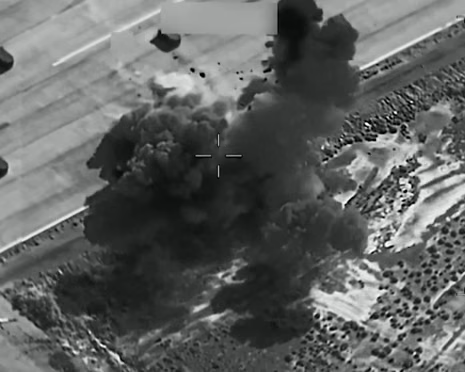
(Photo) Courtesy : The Guardian
NEW DELHI: In response to fresh US strikes on Iran, Tehran announced it had targeted American Patriot missile systems, ammunition depots and drone infrastructure across the Gulf, marking one of its largest retaliatory offensives since the conflict erupted in February.
The retaliatory attacks came hours after US forces struck Iranian missile systems, air defence sites and small speedboats operated by the Islamic Revolutionary Guard Corps (IRGC) at several locations around the Strait of Hormuz.
While explosions were heard in Iran’s southern port city of Bandar Abbas, officials said that the nearby Qeshm Island also came under attack.
In its statement announcing the coordinated missile and drone strikes on US bases and facilities in Kuwait, Bahrain, Qatar, Oman and Jordan, the IRGC said, “In response to the continued criminal American aggression against areas in the south of the country, the Islamic Republic of Iran’s army, hours ago, targeted the Patriot system, ammunition depot, and radar site of the terrorist American army in Kuwait with its destructive drones.”
Warning Washington against further military action, Tehran added: “The consequences of such movements and insecurity in the region will be borne by the American-Zionist enemy, and if these attacks are repeated, we will respond more severely.”
Elsewhere in the Gulf, Iranian aerospace forces carried out what it described as a “heavy attack” on US aircraft carrier support and refuelling platforms at the port of Duqm in Oman.
The forces also struck the US military base at Sheikh Isa in Bahrain, while also targeting communications systems and radar installations.
The IRGC further claimed responsibility for ballistic missile strikes on the Al Udeid Air Base in Qatar, saying the attack destroyed a fighter jet maintenance centre and a command-and-control facility.
Meanwhile, Iranian missiles and drones set fuel tanks and ammunition depots on fire at Jordan’s Prince Hassan Air Base.
US LAUNCHES FRESH STRIKES
On Sunday, the US Central Command (CENTCOM) said American forces struck dozens of targets using fighter aircraft, naval vessels, one-way attack drones and unmanned sea drones.
According to CENTCOM, the operation targeted Iranian air defence systems, coastal radar installations, missile and drone capabilities, as well as small naval boats.
The US military said the strikes were intended to further degrade Iran’s ability to threaten civilian shipping transiting the Strait of Hormuz.
CENTCOM spokesperson Tim Hawkins told CNN that US aircraft also intercepted and destroyed an Iranian cruise missile and a one-way attack drone.
Speaking to Reuters, US President Donald Trump said of the latest operations: “We’re beating them up.”
CONFLICT SPREADS ACROSS GULF
The latest exchange of strikes has significantly widened the regional conflict.
Iran’s attacks extended to Qatar, a country that has acted as a mediator in ceasefire negotiations and had not been targeted since April.
The United Arab Emirates said its air defence systems engaged Iranian missiles and drones, while Bahrain reported intercepting multiple aerial attacks.
Jordan confirmed missile strikes, Oman reported drone attacks, and Kuwait’s military said one worker was injured after an oil drilling platform was struck.
Qatar said three people, including a child, were injured by falling debris and held Iran “fully legally responsible” for the attack.
Oman summoned Iran’s ambassador to protest drone strikes on two regions, while the US Embassy advised American citizens in Duqm and Musandam to shelter in place.
HORMUZ TENSIONS DEEPEN
The renewed fighting has further raised tensions around the Strait of Hormuz.
Iran recently established the Persian Gulf Strait Authority and has sought to regulate shipping along the strategic waterway, warning vessels against sailing without its authorisation.
On Sunday, the authority said transit through the strait was currently impossible because of “recent illegal movements of the United States military forces in the region.”
The US rejected Iran’s assertion, maintaining that maritime traffic continued to move. “Iran does not control the strait. Traffic is flowing,” US officials said.
The US Navy-led Joint Maritime Information Center advised commercial vessels that, despite the severe security threat, an expanded southern route near Oman remained open for two-way navigation.
CEASEFIRE PROSPECTS DIM
The latest barrage of attacks has cast fresh doubt on the interim US-Iran agreement signed last month to reopen the Strait of Hormuz and pursue further negotiations.
Iran’s Foreign Ministry condemned what it called “aggressive” American attacks over the weekend and accused Washington of exerting “overt and covert” pressure on Oman, resulting in the failure of talks in Muscat aimed at managing navigation through the strait.
Iranian Parliament Speaker Mohammad Baqer Qalibaf also struck a defiant tone, posting on X: “The era of one-sided deals is OVER. We told you: keep your word or pay the price. Reality is knocking.”

We are a multimedia news network. Website : www.7xnews.com Based in New Delhi (India)
Youtube : umakantlakheraspeaks@gmail.com