

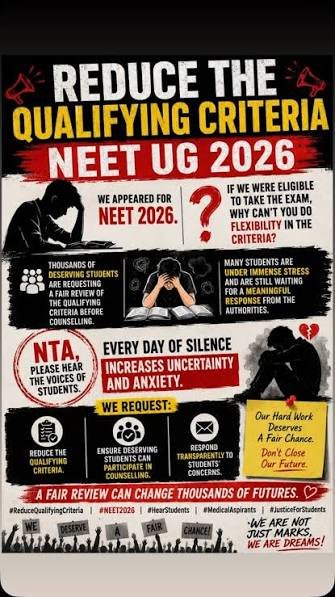
Every May, lakhs of eighteen-year-olds sit down for NEET carrying more than a pen and an admit card. They carry years of 5 a.m. wake-ups, coaching-class debt their families quietly absorbed, and a single unshakeable belief: that if they worked hard enough, the exam would be fair to them.
That belief has now been shaken twice.
For students across the country, the repeated controversy over paper leaks has stopped being a story about a compromised exam paper. It has become a story about whether they can still trust the system meant to decide their futures.
“It is very sad that our education system has such a big loophole,” one student said. “We study day and night for these exams. All we ask for is a fair and transparent system where our hard work is respected.”
It’s a simple ask. And yet, as students, academics, and a law student who has studied the case closely all point out, simple asks are exactly what the system keeps failing to deliver.
Dr. Sant Prakash, an Assistant Professor at the University of Delhi and who was himself a part of the Anna Hazare movement, has watched student protest movements rise and fall for years. This one, he says, is different — not because of the anger behind it, but because of what it achieved.
“Vacancies exist, but unfilled or repeated paper leaks are preventing deserving candidates from securing jobs,” he said, pointing to a deeper malaise: rising contractual employment, murky education policy, and inequalities that keep widening every year.
What struck him most was the discipline of the protest itself. He calls it one of the most successful student-led movements in recent memory the first education protest to force an Education Minister’s resignation. “The protest demonstrated the strength of youth power,”he said. “Students remained positive, united, and determined throughout the movement, showing that young people can bring about meaningful political and institutional change.”
For every statistic about a leaked paper, there is a family that took out a loan for coaching classes, and a student who is still paying for it — sometimes literally.
Dr. Ranu Tomar, Assistant Professor-II at the Amity School of Communication, Amity University Noida, doesn’t mince words about who bears the brunt of this failure. *”This directly hits a large number of aspirants who come from middle-class families bearing loans for preparatory coaching classes,” she said. She points to a grim reality rarely discussed in policy debates: cases of student suicide linked to the despair that follows a leak. *”Nobody acknowledges the hard work of medical aspirants and the high hopes tied to their desired results.”
Her sharpest criticism is reserved for those who exploit the system. “The corrupt people involved in paper leaks treat it as a money-making, ruthless technique,”* she said, warning that the fallout doesn’t stop at one exam cycle it feeds a “quack culture” that erodes trust in the medical profession itself. Her prescription is direct: leadership with *”vision and honesty rather than those who want to fill their pockets at the cost of students’ dreams,” and an exam process that is “secured and leak-proof, technically and manually as well.”
Dr. Tarun Kumar, Assistant Professor at SGTB Khalsa College, Delhi University, frames the issue in institutional terms: a leak isn’t just an embarrassment, it’s a wound to the very idea of merit. “Paper leaks seriously compromise merit-based selection, undermine the credibility of institutions, and put massive stress on aspirants and their families, both psychologically and financially,” he said. His solution starts with accountability at the top. Recruitment bodies, he argues, need to be staffed by “the ablest and most committed staff members” and those found complicit in leaks, directly or indirectly, deserve “the harshest punishment.”
Perhaps the most piercing analysis comes from Kajal Yadav, a second-year student at Campus Law Centre, University of Delhi, who sees the NEET crisis through a legal lens most commentators miss entirely.
“NEET is not merely a competitive exam; it is the gateway to a constitutional right, exercised through a fair and equal process guaranteed by Article 14,” she said. A leak, in her framing, turns what should be a neutral filter into “a lottery favouring whoever had access to money, coaching networks, or corrupt intermediaries.”
Dr. Rubaid Ashfaq, Associate Professor at the Amity School of Communication, widens the lens further arguing that high-stakes exams must be treated as critical national infrastructure, not one-off logistical events.
“The recurring controversies surrounding NEET have created a deep trust deficit in one of India’s most important merit-based examinations,” he said, calling for robust digital security, independent audits, real-time monitoring, and looking ahead “AI-driven anomaly detection and forensic auditing to identify irregularities proactively.”
The debate over paper leaks is no longer just about exam security it is about restoring faith in India’s education system. Students, teachers and experts agree that stronger reforms, greater transparency and strict accountability are essential to protect merit. Their message is clear: every aspirant deserves an examination system where success is determined by hard work, not by the failures of the system.

Aspiring multimedia journalist. Dedicated to uncovering underreported community issues and transforming complex data into compelling human stories.

