

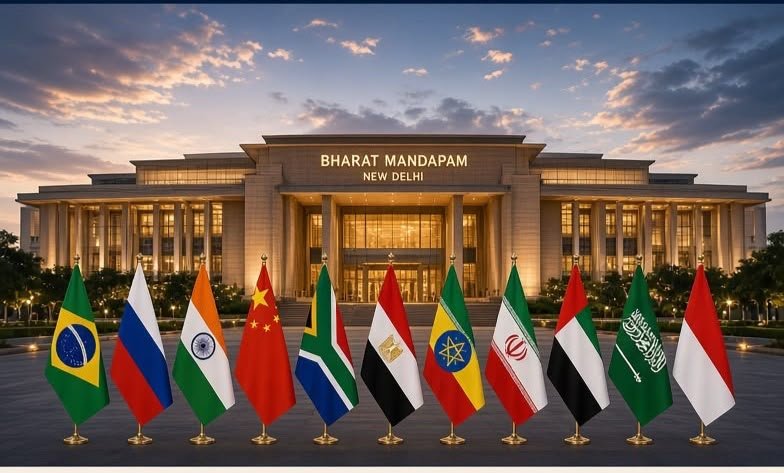
Two decades after its inception, BRICS has moved beyond aspirational rhetoric to deliver a substantive, consensus-driven blueprint for a multipolar world order. The New Delhi Declaration, adopted unanimously on 12 September 2026 at the 18th BRICS Summit, articulates a collective vision that is unapologetically non-Western yet carefully calibrated to avoid an overtly anti-Western posture.
Condemning Coercion, Defending Multilateralism
At the heart of the declaration lies a robust repudiation of unilateral coercive measures—economic sanctions, secondary sanctions, and trade restrictions imposed outside the UN Security Council framework. The text explicitly states that such measures violate international law and disproportionately harm the poor, deepen the digital divide, and exacerbate environmental challenges in targeted states. While no country is named, the language is a clear response to the wave of protectionist tariffs and financial restrictions unleashed by major Western economies since 2025.
The declaration reaffirms BRICS’s commitment to reforming the UN, IMF, World Bank, and WTO to better reflect contemporary economic realities and amplify the voice of the Global South. China and Russia, as permanent Security Council members, explicitly endorse greater roles for Brazil and India within the UN system—a diplomatic nod to New Delhi’s chairmanship priorities.
Terrorism, Kashmir, and India’s Diplomatic Win
In a significant diplomatic victory for India, the declaration condemns “in the strongest terms” the 22 April 2025 terrorist attack in Jammu and Kashmir’s Pahalgam, which killed 26 people. The text also denounces cross-border movement of terrorists, terrorism financing, and safe havens—language that aligns closely with India’s longstanding position on Pakistan-based militancy.
This consensus is notable given BRICS’s requirement for unanimity and the presence of China, which has at times diverged from India on UN designations of Pakistan-linked terrorists. The declaration further calls for zero tolerance on terrorism, rejects double standards, and urges early adoption of the UN Comprehensive Convention on International Terrorism.
West Asia: Balancing Iran, UAE, and Gaza
Perhaps the most delicate negotiation concerned the escalating conflict in West Asia, where Iran and the UAE found themselves on opposing sides. After intensive back-channel talks that lasted until 4 am, Indian diplomats brokered language that expresses “deep concern” over the region’s tensions without naming specific aggressors.
The declaration condemns deliberate attacks on civilian infrastructure and peaceful nuclear facilities under IAEA safeguards—a reference to recent strikes that have raised proliferation concerns. On Gaza, BRICS strongly backs a two-state solution within the 1967 borders, calls for unhindered humanitarian access, opposes forced displacement of Palestinians, and reaffirms support for UNRWA. The text also notes the International Court of Justice’s provisional measures in South Africa’s case against Israel, underscoring the bloc’s alignment with Global South legal activism.
Local Currencies, Not a BRICS Coin
Contrary to speculation about a unified BRICS currency, the declaration focuses on pragmatic financial integration: faster, cheaper cross-border payments and deeper use of local currencies for trade settlement. The BRICS Payment Task Force is studying interoperability among national payment and messaging systems, while the New Development Bank is encouraged to expand local-currency financing.
India’s proposal for a BRICS Risk Lab at GIFT City in Gujarat received backing, as did technical work on a New Investment Platform—both incremental but tangible steps toward financial de-dollarisation without the political baggage of a single currency.
A Non-Western, Not Anti-West, Posture
Prime Minister Narendra Modi’s closing remark that “BRICS is non-Western, but not anti-West” encapsulates the summit’s strategic ambiguity. The declaration avoids naming adversaries, instead framing BRICS as a constructive counterweight to unilateralism and a champion of multilateral reform. This posture allows the bloc to court Emerging Markets and Developing Countries (EMDCs) as partners without triggering a full-scale geopolitical rupture with Washington or Brussels.
Yet the subtext is clear: BRICS now represents a coherent pole in a fragmenting world order, one that offers an alternative governance model rooted in sovereign equality, consensus, and development-oriented cooperation.
The Indian Imprint
As chair, India secured several institutional wins: a BRICS repository for Digital Public Infrastructure, a Training Hub Network for health with NIMHANS as the coordinating centre, and an India Centre for BRICS Industrial Competencies to support Industry 4.0 adoption. These initiatives embed India’s domestic expertise into the bloc’s architecture, enhancing New Delhi’s soft power across the Global South.
Verdict: Aspiration Realised
The New Delhi Declaration demonstrates that BRICS has matured from an investment-bank acronym into a geopolitical force capable of producing consensus on contentious issues—from terrorism to trade to West Asia’s wars. While it stops short of announcing retaliatory mechanisms or a common currency, its strength lies in what it achieves collectively: a unified Global South voice that challenges unilateral coercion, defends multilateralism, and advances a development-first agenda.
Two decades on, BRICS is no longer merely an aspiration. It is a reality—with New Delhi as its latest architect.

~Hasnain Naqvi is a former member of the history faculty at St. Xavier’s College, Mumbai….
The opinions expressed here are solely those of the author.

