
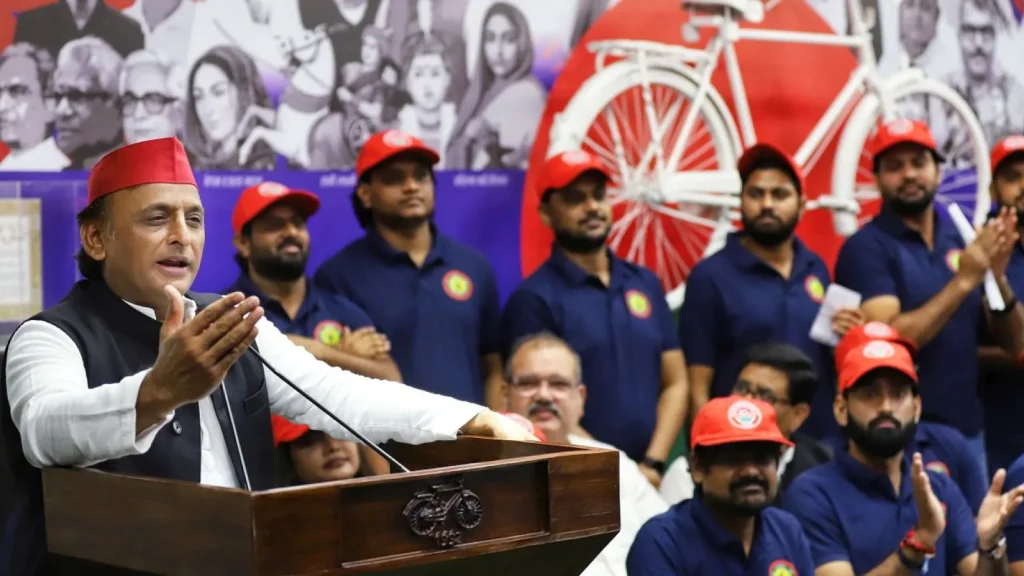
NEW DELHI: For decades, the Samajwadi Party has been instantly recognisable by two colours — red and green. Its leaders in red caps, often riding the party’s bicycle symbol, became one of the defining visual signatures of Uttar Pradesh politics.
Now, ahead of the 2027 Assembly election, party president Akhilesh Yadav is adding a new colour to that political palette: blue.
Akhilesh Yadav has introduced blue T-shirt and jeans as the new uniform for members of the Samajwadi Chhatra Sabha, the party’s student wing. The choice is anything but incidental. Yadav has explicitly linked blue with BR Ambedkar, the Constitution, the Bahujan movement, social justice and resistance to injustice.
The message is clear: the SP wants to talk to voters beyond its traditional Yadav-Muslim support base, particularly to Dalits.
The Battle For The Dalit Vote
Uttar Pradesh’s Dalit electorate has historically been at the heart of BSP chief Mayawati’s political power. The BSP transformed Dalit identity into an electoral force and, for years, the party’s blue flag and Mayawati’s politics were almost inseparable.
But the BSP’s electoral decline has created a political vacuum in Dalit voter space.
The 2024 Lok Sabha election was a particularly significant moment. The SP won 37 seats in Uttar Pradesh, while the BSP failed to win a single seat. The result strengthened Akhilesh’s argument that his PDA — Pichhde (Backwards), Dalit, Alpsankhyak (Minorities) — coalition, where ‘P’ now also stands for Pandits, could become the alternative social coalition to the BJP’s electoral machinery.
The challenge, however, is not simply to win Dalit votes. It is to persuade Dalit voters that the SP can represent their political aspirations without erasing their distinct social identity.
That is where the colour blue becomes important.
For a party that has historically worn red, adopting blue amounts to a symbolic attempt to enter a political space traditionally occupied by the BSP.
‘PDA’ formulation has been central to Akhilesh Yadav’s post-2022 political strategy. It seeks to combine backward castes, Dalits and minorities into a broad social coalition.
There is an important detail in the new uniform: the red cap remains.
That makes the symbolism even more interesting.
Akhilesh is not abandoning the SP’s old identity; he is attempting to add one more layer to it.
The red cap has a long association with socialist politics. The SP itself was founded by Mulayam Singh Yadav in 1992, but the party’s familiar red-and-green colours and the red cap evolved over time rather than appearing fully formed at the moment of its creation.
Mulayam Singh suggested that the Yuvjan Sabha (SP’s youth wing) wear red caps in 1998. The red cap became increasingly prominent over the following years and, particularly after Akhilesh Yadav took control of the party, became a powerful visual marker of the SP.
The party’s red has traditionally been associated with socialist politics and workers, while green has been linked to farmers.
Under Akhilesh, however, the ‘lal topi’ became more than a party accessory. It became a political identity.
And then Prime Minister Narendra Modi turned it into an election issue.
In December 2021, just before the last Uttar Pradesh Assembly election, PM Modi launched a sharp attack on the SP’s red caps during a rally in Gorakhpur.
The idea is also an acknowledgement of a fundamental electoral reality: Yadav and Muslim votes alone cannot take the SP back to power in Uttar Pradesh.
Yadavs are about 10% of the UP electorate, Muslims are a 20% strong bloc. Dalits are the next hefty bloc of 20%. Akhilesh Yadav has set his eyes there.
The SP had already begun experimenting with Dalit outreach before the 2022 election, including the formation of its Baba Sahib Vahini aimed particularly at Dalits outside the Jatav community, which are Mayawati’s core base. At the time, Akhilesh also sought to bring together what he called the Samajwadi and Ambedkarwadi streams of politics.
The blue uniform takes that strategy a step further.
It attempts to give the ‘D’ in ‘PDA’ a visible identity.
While Akhilesh Yadav is seen dressed traditionally in white kurta-pyjama with the red Samajwadi cap, for the youth wing he has presented the jeans-and-T-shirt combination as a symbol of younger generation.
Apart from being caste arithmetic, it is also an attempt at political rebranding.
There is an important detail in the new uniform: the red cap remains.
That makes the symbolism even more interesting.
Akhilesh is not abandoning the SP’s old identity; he is attempting to add one more layer to it.
The red cap has a long association with socialist politics. The SP itself was founded by Mulayam Singh Yadav in 1992, but the party’s familiar red-and-green colours and the red cap evolved over time rather than appearing fully formed at the moment of its creation.
Mulayam Singh suggested that the Yuvjan Sabha (SP’s youth wing) wear red caps in 1998. The red cap became increasingly prominent over the following years and, particularly after Akhilesh Yadav took control of the party, became a powerful visual marker of the SP.
The party’s red has traditionally been associated with socialist politics and workers, while green has been linked to farmers.
Under Akhilesh, however, the ‘lal topi’ became more than a party accessory. It became a political identity.
And then Prime Minister Narendra Modi turned it into an election issue.
In December 2021, just before the last Uttar Pradesh Assembly election, PM Modi launched a sharp attack on the SP’s red caps during a rally in Gorakhpur.
He called those wearing the ‘lal topi’ a “red alert” for Uttar Pradesh, linking the SP to corruption, crime, illegal occupation and what he alleged was leniency towards terrorists.
The attack was meant to turn the SP’s strongest visual symbol into a warning sign.
Akhilesh, however, tried to reverse the symbolism.
He declared that the red cap was a “red alert” for the BJP, citing unemployment, inflation, farmers’ problems and other issues as the real warning signs for the ruling party. He also framed red as a colour of revolution and change.
The SP even used the attack in its campaign music. One of its songs, “Ye Lal Rang Ki Topiya”, sought to turn PM Modi’s jibe into a socialist rallying cry, while another campaign song invoked the red cap and the bicycle as symbols of political change.
So, in 2021-22, Akhilesh’s instinct was to embrace the red and fight over its meaning.
Five years later, while he is keeping red, he is also adding blue to his electoral scheme.
The timing is significant because the decline of the BSP has altered the competitive landscape of Uttar Pradesh.

We are a multimedia news network. Website : www.7xnews.com Based in New Delhi (India)
Youtube : umakantlakheraspeaks@gmail.com