
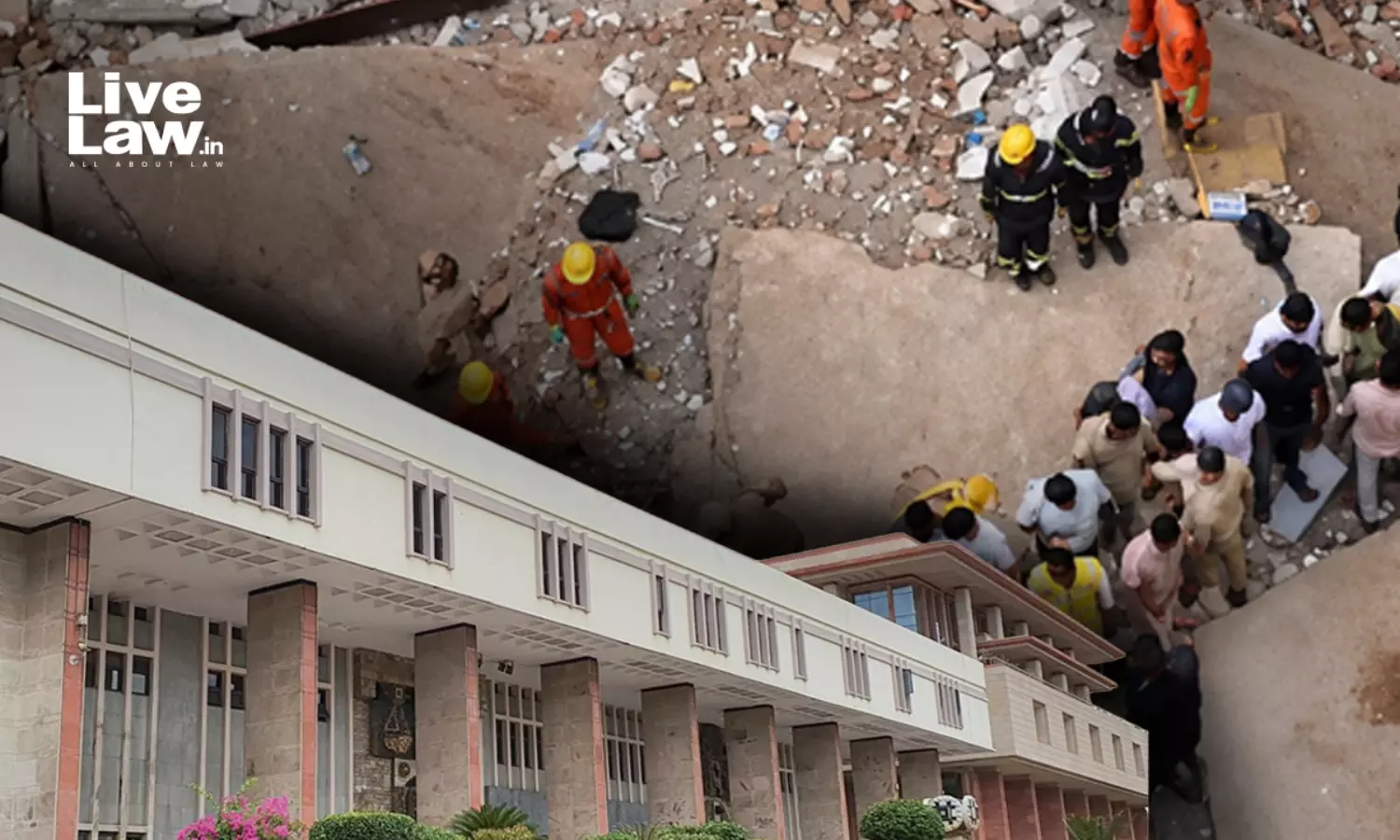
NEW DELHI: The building next to the PG accommodation that collapsed and killed seven people in Delhi’s Satya Niketan locality will be demolished on Wednesday after civic officials found it unsafe, Chief Minister Rekha Gupta said on Tuesday.
Gupta also announced Rs 5 lakh in financial aid for people injured in the building collapse and said the Delhi government would bear their entire treatment cost. She met the wounded earlier in the day and handed over cheques to their families at AIIMS Trauma Centre.
Meanwhile, the collapse of the Satya Niketan building has sharpened focus on research warning that a large share of the capital’s buildings could be vulnerable in a magnitude 6.0 earthquake.
The concern is far bigger than a single building.
A recent study has estimated that nearly 38 per cent of Delhi-NCR’s approximately 8.9 million buildings could be vulnerable in a magnitude 5.0 earthquake scenario along major active faults in the region.
That translates to more than 33 lakh buildings potentially at risk, underlining the enormous scale of Delhi’s earthquake vulnerability.
Delhi lies in Seismic Zone IV, the second-highest earthquake hazard category in India.
The capital is vulnerable not only to earthquakes originating from local faults but also to powerful seismic events in the Himalayan region.
Scientists have warned that Delhi’s complex geology, proximity to active faults and enormous population make it particularly vulnerable to a major earthquake.
The Satya Niketan collapse has exposed some of the very vulnerabilities that could turn an earthquake into a large-scale urban disaster.
Authorities are now considering structural audits and new safety measures for public-use buildings and PG accommodation.
That concern becomes even more serious when viewed against Delhi’s enormous and complicated building stock.
A research paper by scientists from National Center for Seismology, published in Environmental Earth Sciences in 2026 estimated that Delhi-NCT could have around 8.9 million buildings and found that about 38 per cent of buildings could be vulnerable under a moderate earthquake scenario along major faults in the region.
The study, conducted by Rajat Pasricha, Kapil Mohan, and O P Mishra, specifically modelled potential damage from a magnitude 6.0 earthquake scenario and highlighted high population density, old structures and complex local geology as major risk factors.
This does not mean 38 per cent of Delhi’s buildings would necessarily collapse.
Earthquake damage depends on the location, depth and characteristics of a quake, local soil conditions and the quality and design of individual buildings. But the findings underline the scale of Delhi’s vulnerability.
Delhi’s challenge is therefore not simply predicting the next earthquake. It is preparing the city before one arrives.

We are a multimedia news network. Website : www.7xnews.com Based in New Delhi (India)
Youtube : umakantlakheraspeaks@gmail.com