

A Miscalculated Doctrine of Decapitation
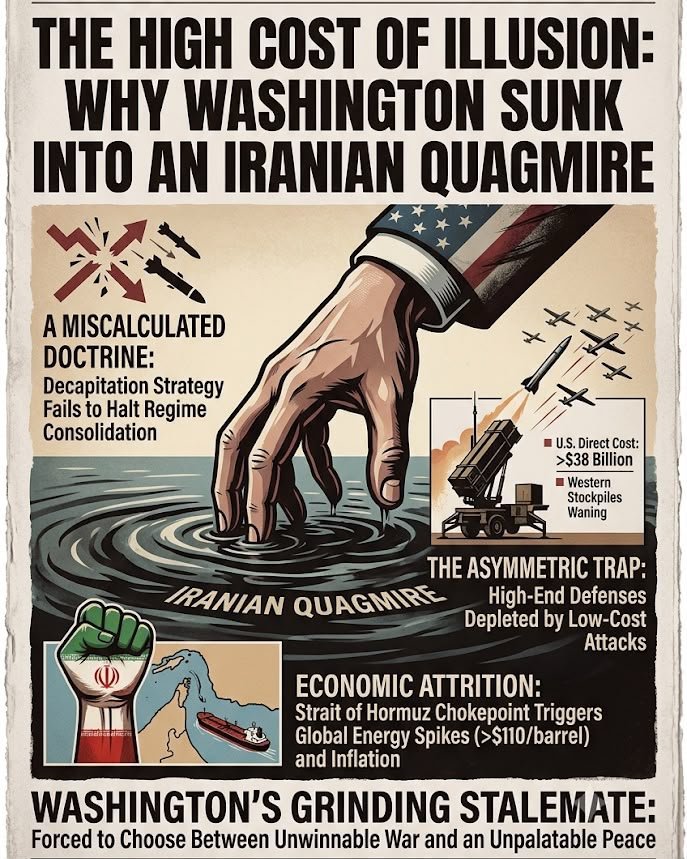
More than 200 days after a joint U.S.-Israeli offensive shattered decades of shadow warfare, Middle Eastern geopolitics stand radically transformed. What Washington planned as a decisive campaign to dismantle Tehran’s missile architecture and force regime change has instead rigidified into an agonizing stalemate. The initial coalition strategy—relying on swift decapitation and preemptive air power—collided head-on with an Iranian counter-doctrine rooted in asymmetric endurance, regional proxies, and economic leverage. Even the loss of Supreme Leader Ali Khamenei failed to induce systemic collapse; power simply consolidated around a younger, unyielding hardline cadre under Mojtaba Khamenei.
The Asymmetric Trap
Washington now finds itself caught in a punishing mathematical equation. Direct U.S. military expenditures have surpassed $38 billion, pushing broader regional operational costs toward $113 billion. The core issue is logistical attrition: multi-million-dollar Patriot and THAAD interceptors are being steadily drained to neutralize swarms of cheap, mass-produced Shahed drones and domestic ballistic missiles. This dynamic renders any traditional notion of military victory illusory, forcing Western forces to pay an astronomical price merely to hold a tenuous defense.
Economic Attrition and Regional Realignment
Beyond the battlefield, the conflict has evolved into a global war of economic attrition. By tightening its grip on the Strait of Hormuz—a key choke point handling a fifth of global petroleum supply—Tehran triggered soaring energy prices and worldwide inflation. Simultaneously, the strategic alignment that Washington relied upon is crumbling. Gulf allies, alarmed by unchecked preemptive doctrines, are increasingly prioritizing domestic stability over coalition goals, effectively halting the expansion of the Abraham Accords. Internationally, Tehran has converted its survival into diplomatic momentum, securing seats on major UN bodies despite fierce American opposition.
The Reality of an Unpalatable Peace
Washington is left with two deeply flawed options: continue an unwinnable campaign of logistical depletion, or accept an unpalatable peace that leaves Iran’s regional missile architecture and maritime dominance intact. What began as a confident projection of Western kinetic power has ultimately exposed its structural limits—demonstrating that decentralized asymmetric warfare can neutralize top-tier military superiority and permanently reshape regional security.

~Hasnain Naqvi is a former member of the history faculty at St. Xavier’s College, Mumbai….
The opinions expressed here are solely those of the author.