

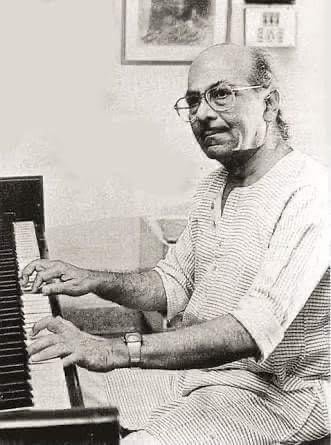
On his birth anniversary on November 19, a tribute to ‘Salilda’—the composer, poet, and playwright whose timeless melodies reshaped Indian cinema across languages.
Few artists in Indian cultural history have bridged the worlds of mass activism, literature, and orchestral innovation as effortlessly as Salil Chowdhury (November 19, 1922 – September 5, 1995). Affectionately known as ‘Salilda’ to generations of admirers and peers, he was not merely a celebrated film composer and arranger, but also an acclaimed Bengali poet and playwright. Proficient in instruments ranging from the flute and the esraj to the piano, Chowdhury possessed a rare musical vocabulary that seamlessly fused Indian folk traditions with Western classical counterpoint.
Early Roots: Tea Gardens and Western Symphonies
Born on November 19, 1922, in Gazipur village in the South 24 Parganas district of the erstwhile Bengal Presidency (now in West Bengal), Chowdhury spent his formative years amidst the lush tea gardens of Assam. His artistic sensibilities were shaped early at home: he grew up listening to his father’s extensive collection of Western classical records while watching him stage plays with tea-garden workers.
He later completed his schooling at Harinavi D.V.A.S. High School before graduating from Bangabasi College, affiliated to the University of Calcutta. Those college years proved pivotal, sharpening both his musical sophistication and his progressive political worldview.
Voice of the People: The IPTA Years
Moving to Calcutta in 1944 for his graduate studies, a young Chowdhury joined the Indian People’s Theatre Association (IPTA), the cultural wing of the Communist Party of India. Travelling through villages and towns with the IPTA troupe, he began writing and composing stirring songs designed to resonate directly with the common man. Anthems such as Bicharpati, Runner, and Abak Prithibi captured the pulse of the era and became enduring classics of people’s theatre.
Redefining Indian Film Music Across Languages
Chowdhury’s cinematic journey began in Bengali cinema with Paribortan (1949), marking the start of a 41-film Bengali oeuvre that concluded with Mahabharati (1994).
In 1953, he made a landmark Hindi film debut with Bimal Roy’s Do Bigha Zamin. Beyond composing its soulful score, Chowdhury also penned the film’s original story—inspired by Rabindranath Tagore’s poem of the same name. The film achieved historic acclaim, becoming the first to win the Filmfare Best Movie Award and earning an international prize at the Cannes Film Festival, propelling Chowdhury into the front ranks of Indian cinema.
After two decades of dominating Bengali and Hindi film music, he ventured into Malayalam cinema in 1964 with the classic Chemmeen. Over an illustrious career, he composed for more than 75 Hindi films, 41 Bengali films, and around 27 Malayalam films, alongside notable scores in Marathi, Tamil, Telugu, Kannada, Gujarati, Oriya, and Assamese cinema.
His pioneering contributions to Indian music earned him prestigious accolades during his lifetime and enduring national recognition thereafter. He won the Filmfare Best Music Director Award in 1958 for his timeless score in Madhumati and was conferred the Sangeet Natak Akademi Award in 1988. Years later, on May 3, 2013, India Post further immortalised his legacy by issuing a commemorative ₹5 postage stamp in his honour as part of the centenary celebrations of Indian cinema.
Personal Life and a Continuing Musical Legacy
In July 1953, Chowdhury married Jyoti Chowdhury (who resides in Bandra, Mumbai), with whom he had three daughters. Though they never divorced, he later lived with acclaimed singer Sabita Chowdhury, with whom he had two daughters, Antara and Sanchari, and two sons, Sanjoy and Bobby—all of whom were legally adopted. Sabita Chowdhury passed away on June 29, 2017.
The family has carried forward Salilda’s rich artistic lineage. His son, Sanjoy Chowdhury, is a well-known music composer who has scored over 100 feature films, while daughter Antara Chowdhury is an accomplished performing artist, notably lending her voice to a duet with Sonu Nigam for composer Shantanu Moitra in Khoya Khoya Chand.
Timeless Melodies of Salilda
While any selection of Salil Chowdhury’s vast repertoire remains a matter of personal favourite, these iconic Hindi film compositions stand as enduring milestones of his genius:
- Do Bigha Zamin (1953): “Aa Ja Ri Aa, Nindiya Tu Aa” (Lata Mangeshkar)
- Jaagte Raho (1956): “Zindagi Khwab Hai” (Mukesh), “Jago Mohan Pyare” (Lata Mangeshkar & chorus)
- Musafir (1957): “Munna Bada Pyara” (Kishore Kumar)
- Ek Gaon Ki Kahani (1957): “Raat Ne Kya Kya Khwab Dikhaye” (Talat Mahmood)
- Madhumati (1958): “Suhana Safar” (Mukesh), “Dil Tadap Tadap Ke” (Mukesh & Lata Mangeshkar), “Chadh Gayo Papi Bichhua” (Lata Mangeshkar & Manna Dey), “Zulmi Sang Aankh Ladi” (Lata Mangeshkar), “Aaja Re Pardesi” (Lata Mangeshkar), “Ghadi Ghadi Mora Dil Dhadke” (Lata Mangeshkar), “Toote Huye Khwabon Ne” (Mohammed Rafi)
- Maya (1961): “Ja Re Ja Re Ud Ja Re Panchhi” (Lata Mangeshkar), “Tasveer Teri Dil Mein” (Lata Mangeshkar & Mohammed Rafi)
- Kabuliwala (1961): “Aye Mere Pyare Watan” (Manna Dey), “Ganga Aaye Kahan Se” (Hemant Kumar)
- Chhaya (1961): “Aansoo Samajh Ke Kyun” (Talat Mahmood), “Itna Na Mujhse Tu Pyar Badha” (Lata Mangeshkar & Talat Mahmood), “Aankhon Mein Masti Sharab Ki” (Talat Mahmood), “Dil Se Dil Ki” (Mukesh)
- Half Ticket (1962): “Chandni Raat Tum Ho Saath” (Lata Mangeshkar & Kishore Kumar), “Woh Ek Nigah Kya Mili” (Lata Mangeshkar & Kishore Kumar), “Cheel Cheel Chilla Ke” (Kishore Kumar)
- Chaar Deewari (1965): “Baag Mein Kali Khili” (Asha Bhosle)
- Anand (1970): “Maine Tere Liye Hi Saat Rang Ke” (Mukesh), “Kahin Door Jab Din Dhal Jaye” (Mukesh), “Na Jiya Lage Na” (Lata Mangeshkar), “Zindagi Kaisi Hai Paheli” (Manna Dey)
- Mere Apne (1971): “Koi Hota Jisko Apna” (Kishore Kumar)
- Rajnigandha (1974): “Rajnigandha Phool Tumhare” (Lata Mangeshkar), “Kai Baar Yun Bhi Dekha Hai”
- Chhoti Si Baat (1975): “Jaaneman Jaaneman Tere Do Nayan” (Asha Bhosle & K.J. Yesudas), “Na Jaane Kyun Hota Hai” (Lata Mangeshkar)
- Anand Mahal (1977): “Aa Aa Re Mitwa” (K.J. Yesudas),
And many more..

~Hasnain Naqvi is a former member of the history faculty at St. Xavier’s College, Mumbai….
The opinions expressed here are solely those of the author.