

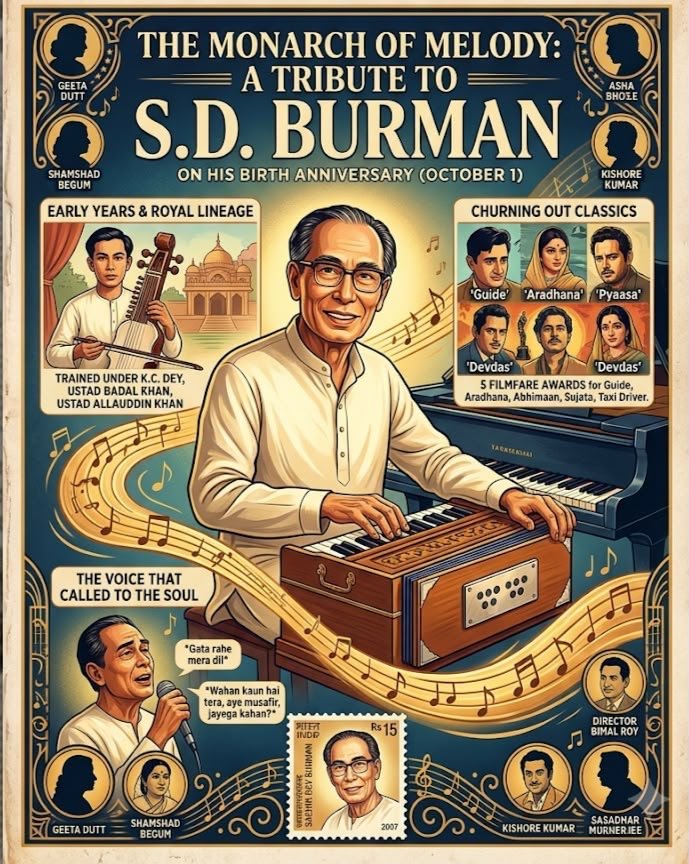
October 1 marks the birth anniversary of Sachin Dev Burman—affectionately remembered across generations as “Burman Da”—a musical maestro who fundamentally redefined the auditory landscape of twentieth-century Indian cinema. Few composers in the history of Hindi film music have wielded as profound and lasting an impact as S.D. Burman. His career spanned nearly four decades, encompassing over a hundred Hindi and Bengali films and an extraordinary trove of timeless melodies. Operating at the graceful intersection where classical discipline, earthy folk traditions, and modern cinematic orchestration meet, Burman Da did not merely compose tunes; he painted delicate emotional canvases that continue to resonate across class, culture, and time.
Today, we pay tribute to a prince who traded royal privilege for the realm of song, forever altering how India listens to music.
“Wahan kaun hai tera, aye musafir, jayega kahan?”
(“Who is there to call your own, O traveller, where will you go?”)
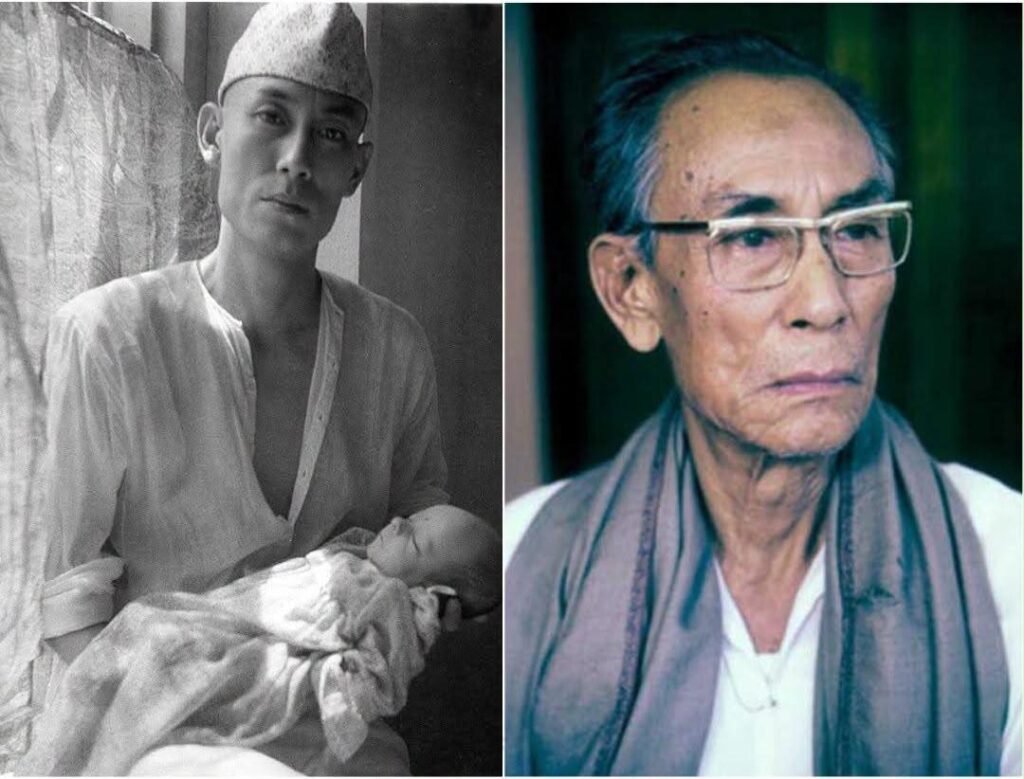
Born on October 1, 1906, in Comilla (in present-day Bangladesh), Sachin Dev Burman carried the regal lineage of Tripura and Manipur royalty. He was the youngest son among nine children born to Nabadwipchandra Dev Burman and Raj Kumari Nirmala Devi, the royal princess of Manipur. Though born into aristocratic grandeur, early tragedy touched his life when his mother passed away when he was just two years old. His early education began at Kumar Boarding in Agartala, continuing through Yusuf School and Comilla Zilla School, where he completed his matriculation in 1920. He subsequently earned his Intermediate in Arts (1922) and Bachelor of Arts (1924) degrees from Victoria College, Comilla, before leaving for Kolkata to pursue a Master’s degree at Calcutta University.
Yet, academic pursuits could not anchor a soul destined for music. Burman Da left university behind to commit himself to rigorous musical training. Between 1925 and 1930, he trained under the legendary blind musician K.C. Dey, followed by advanced instruction under the sarangi maestro Ustad Badal Khan and the revered sarod maestro Ustad Allauddin Khan. By the late 1920s, he had joined Calcutta Radio Station as a singer, blending light Hindustani classical music with the evocative Bhatiali folk traditions of Bengal. His talent gained national recognition in 1934 when he was awarded a Gold Medal for his Bengali Thumri performance at the All India Music Conference in Allahabad. By 1937, he had begun scoring music for Bengali films, establishing a solid reputation as a gifted composer-singer.
“Mera sundar sapna beet gaya…”
(“My beautiful dream has passed away…”)
In 1944, responding to an invitation from Sasadhar Mukherjee of Filmistan Studios, Burman Da relocated to Mumbai. Early assignments like Shikari (1946) and Aath Din set the stage, but it was Filmistan’s Do Bhai (1947) that brought his major breakthrough. The haunting track “Mera Sundar Sapna Beet Gaya,” rendered with exquisite melancholy by Geeta Dutt, struck a powerful chord with audiences nationwide and established both composer and singer as major forces in the industry.
By 1949, his score for Shabnam—highlighted by the multilingual sensation “Yeh Duniya Roop Ki Chor” sung by Shamshad Begum—became a monumental hit. Entering the 1950s, S.D. Burman introduced a fresh, buoyant musical language to Hindi cinema. Works like Afsar (1950), Baazi (1951), Taxi Driver (1954), Munimji (1955), House No. 44 (1955), Funtoosh (1956), Paying Guest (1957), Nau Do Gyarah (1957), and Solva Saal (1958) demonstrated his remarkable stylistic range—effortlessly moving from seductive jazz-inflected rhythms and playful romantic duets to deep, introspective ballads.
“Jaane woh kaise log they jin-ke pyaar ko pyaar mila…”
(“Who were those fortunate people whose love was answered with love?”)
What elevated Burman Da to the status of a master was his ability to heighten a film’s narrative core through melody. His iconic creative partnership with filmmaker Guru Dutt gave birth to landmark cinematic achievements like Pyaasa (1957) and Kaagaz Ke Phool (1959). In Pyaasa, paired with the poetic genius of Sahir Ludhianvi, compositions like “Yeh Duniya Agar Mil Bhi Jaye Toh Kya Hai” and “Jinhen Naaz Hai Hind Par Woh Kahaan Hain” became timeless anthems of existential grief and social critique. Similarly, his work with director Bimal Roy on Devdas (1955), Sujata (1959), and Bandini (1963) gave expression to deep human longing through classic songs like “Jalte Hain Jis Ke Liye” and “O Janewale Ho Sake To.”
Equally historic was his long-standing collaboration with Dev Anand and Navketan Films. Together, they produced a string of effervescent, infectious soundtracks across two decades, including Bombai Ka Baboo (1960), Tere Ghar Ke Samne (1963), Teen Devian (1965), and Jewel Thief (1967). Their creative alliance reached its absolute pinnacle with Guide (1965)—a soundtrack widely considered one of the finest in Indian cinematic history, where every composition, from “Aaj Phir Jeene Ki Tamanna Hai” to “Tere Mere Sapne,” achieved immortal acclaim.
“Gata rahe mera dil, tu hi meri manzil…”
(“My heart keeps singing; you alone are my destination…”)
Beyond his gift for melodic invention, Burman Da was a brilliant sculptor of vocal talent. Following a temporary fallout with Lata Mangeshkar in 1957, he mentored her younger sister Asha Bhosle, making her his primary female voice. Alongside O.P. Nayyar, S.D. Burman was instrumental in refining Asha’s vocal versatility, helping shape her into a powerhouse playback singer—and inadvertently shaping his family’s artistic legacy, as she later married his son and celebrated composer Rahul Dev Burman (R.D. Burman). When Burman Da and Lata Mangeshkar reconciled in 1961 during the recording of R.D. Burman’s debut film Chhote Nawab, their renewed partnership resulted in sublime music for Bandini, Guide, and Abhimaan.
At the same time, Burman Da saw the transformative potential in Kishore Kumar, casting him as the defining voice for Dev Anand and later Rajesh Khanna. His landmark score for Aradhana (1969), featuring Kishore’s memorable renditions of “Mere Sapno Ki Raani” and “Roop Tera Mastana,” catalyzed a cultural shift and redefined playback singing in India. Into the 1970s, Burman Da continued his dominant streak with masterworks like Tere Mere Sapne (1971), Sharmeelee (1971), Abhimaan (1973), Prem Nagar (1974), Sagina (1974), Chupke Chupke (1975), and Mili (1975). Over his distinguished career, he was honoured with five Filmfare Awards for Best Music Director for Taxi Driver, Sujata, Guide, Aradhana, and Abhimaan.
“Sun mere bandhu re, sun mere mitwa…”
(“Listen, my friend, listen, my companion…”)
Yet, beyond his work at the harmonium, Sachin Dev Burman possessed a singing voice that was entirely unique—nasal, high-pitched, and filled with an almost primitive, earthbound ache. Hearing him sing felt like listening to a solitary boatman calling across a wide, misty river. When he lent his voice to “Wahan Kaun Hai Tera” in Guide, “O Mere Majhi” in Bandini, or “Saphal Hogi Teri Aradhana” in Aradhana, he delivered far more than notes; he bared the very soul of human emotion, striking chords of longing that few singers could ever hope to replicate.
When Burman Da passed away on October 31, 1975, in Mumbai after a prolonged illness, he left behind an irreplaceable treasure trove of sound—a legacy carried forward and modernized by his son, Pancham Da. In 2007, India Post commemorated his historic legacy by issuing a postage stamp in his honour. Today, as we mark his birth anniversary, the prince of Tripura remains the undisputed king of Indian musical memory. His melodies continue to echo through the quiet hours of night, proving that while ordinary musicians belong to an era, Sachin Dev Burman belongs to eternity.

~Hasnain Naqvi is a former member of the history faculty at St. Xavier’s College, Mumbai….
The opinions expressed here are solely those of the author.