

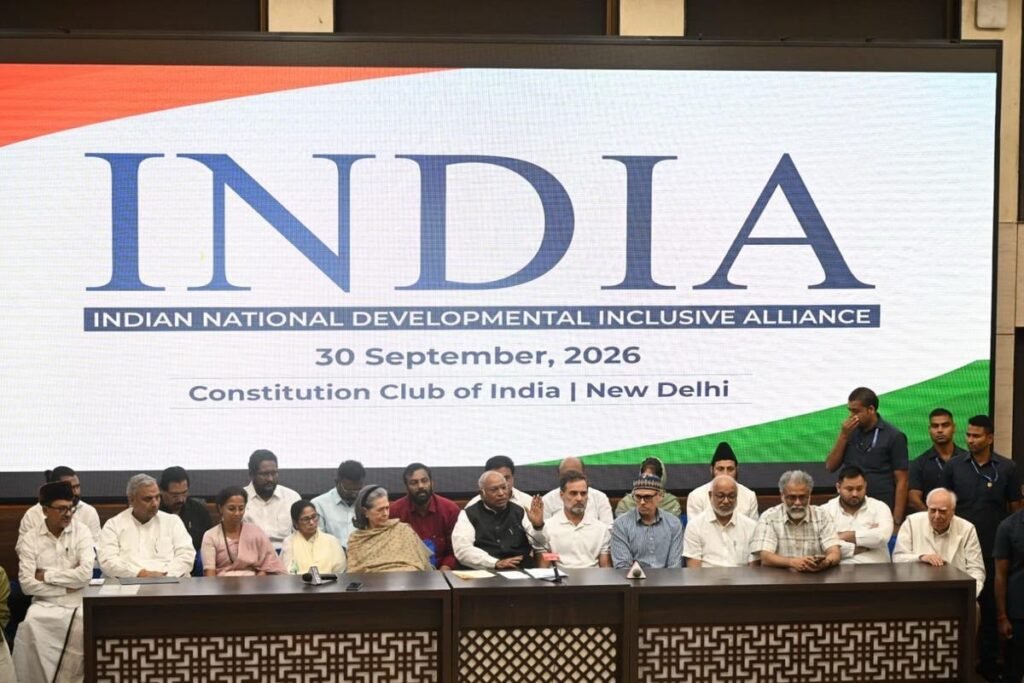
The political atmosphere in New Delhi reached a critical boiling point on September 30, 2026, as top leaders of the INDIA opposition alliance convened for an urgent strategy session. The catalyst was a deepening crisis of institutional trust, centered on Chief Election Commissioner (CEC) Gyanesh Kumar and the contentious implementation of the Special Intensive Revision (SIR) of electoral rolls. Allegations of mass voter deletions, arbitrary procedural modifications under Form-6, and administrative opacity have transformed what is typically a routine logistical exercise into a full-blown constitutional standoff. Rather than restricting their response to parliamentary walkouts or episodic press briefings, the assembled leaders crafted a synchronized six-point blueprint. This roadmap outlines a phased, nationwide movement of “Opposition and Resistance,” seeking to bridge institutional litigation with sustained street-level mobilization.
A Three-Tiered Architecture of Resistance
At its core, the strategic architecture finalized in Delhi reflects a sophisticated understanding of contemporary political resistance. To challenge a determined ruling party and a poll body accused of executive compliance, an opposition alliance cannot rely on a single channel of protest. Instead, the INDIA bloc’s six-point strategy operates across three distinct arenas: local public outreach, formal constitutional pressure, and judicial accountability. By structuring these actions across an escalating timeline spanning October and November 2026, the alliance aims to maintain an uninterrupted political tempo in the lead-up to upcoming state assembly elections.
The initial phase of the roadmap focuses on grassroots decentralization. From October 2 to October 8, the alliance will launch district-level “Save Democracy” (Loktantra Bachao) marches across all districts in the country. Launching this initiative on Gandhi Jayanti carries immense symbolic weight, grounding the movement in the ethos of non-violent civil resistance. Technocratic debates over electoral roll revisions and SIR parameters often fail to resonate beyond policy circles. By taking the fight to district headquarters, the Opposition intends to demystify complex electoral mechanics, translating technical disputes over voter deletion into a relatable struggle for civil rights and local democratic franchise.
Mobilizing Parliamentarians and Scaled Constitutional Pressure
Building upon this regional groundwork, the campaign rapidly pivots toward direct institutional confrontation in the national capital. On October 6, sitting Members of Parliament from all constituent parties of the INDIA bloc will march in unison to the Election Commission of India headquarters at Nirvachan Sadan. This collective march of lawmakers serves as a high-visibility demonstration of legislative challenge against executive arbitrariness. By physically carrying their grievances to the ECI’s doorstep, the alliance seeks to force an institutional reckoning, demanding transparency from CEC Gyanesh Kumar while signaling that administrative evasion will no longer be tolerated without immediate political cost.
Recognizing that bureaucratic pushback requires higher constitutional intervention, the strategy’s third prong escalates the issue to the Head of State. In the second week of October, a delegation of senior opposition leaders will seek a formal appointment with the President of India. This gesture elevates the SIR controversy from a partisan dispute to a systemic constitutional crisis. By appealing directly to Rashtrapati Bhavan, the alliance places a moral and constitutional obligation on the presidency to intervene, framing the alleged voter deletions not merely as administrative lapses, but as an infringement upon the fundamental constitutional guarantee of universal adult suffrage.
Aggregating Mass Support: Regional Rallies to National Convergence
To ensure the momentum generated in early October does not dissipate into political fatigue, the fourth and fifth components of the strategy focus on mass public aggregation. The alliance has planned five mega rallies distributed across critical geopolitical zones, particularly in states where assembly elections are looming and anxieties regarding voter roll manipulation are highest. These regional rallies will serve as critical testing grounds for ground-level coordination among coalition partners—such as the Congress, Samajwadi Party, RJD, and Trinamool Congress—forcing regional cadres to submerge local friction in pursuit of a shared existential mandate.
This regional crescendo is structured to culminate on November 1 in a massive national mega rally in Delhi. Designed as a focal point for nationwide discontent, the Delhi rally aims to project an unmistakable image of opposition unity in the capital. For a coalition frequently criticized by its political adversaries as a fragmented house, a successful mega-mobilization in Delhi would re-establish the INDIA bloc’s narrative authority, signaling to both the electorate and the ruling establishment that the alliance possesses the organizational stamina to mount a sustained joint challenge.
Judicial
Accountability and the Battle for Democratic Legitimacy
Simultaneously, the alliance’s sixth point anchors this political campaign within the judicial forum. The INDIA bloc issued a collective appeal for the Supreme Court of India to prioritize and urgently resolve all pending cases related to the SIR, EVM integrity, and voter verification protocols. Street politics and moral appeals to the executive must be undergirded by enforceable legal mandates. By seeking an expedited hearing from the apex court, the Opposition aims to secure judicial stay orders or binding procedural safeguards against controversial SIR practices, ensuring that administrative revisions do not alter the electoral landscape prior to judicial review.
Underneath this multi-tiered plan lies a broader political imperative: the battle over democratic legitimacy. The demand by INDIA bloc leaders to replace Electronic Voting Machines with physical ballot papers, combined with their fierce resistance against CEC Gyanesh Kumar’s revision drive, underscores a systemic breakdown of trust between the regulatory referee and political participants. When opposition parties feel compelled to launch a month-long national movement over basic electoral mechanics, the underlying conflict transcends simple policy differences—it becomes a contest over the rules of the democratic game itself.
Whether this six-point strategy can successfully force administrative concessions or recalibrate public perception will depend heavily on execution. Synchronizing district marches, parliamentary demonstrations, presidential appeals, regional mega-rallies, and supreme court litigation requires disciplined operational coordination among disparate political entities. Nevertheless, by transitioning from reactive criticism to a proactive, time-bound offensive, the INDIA bloc has drawn a definitive line in the sand. The coming month will determine whether this unified blueprint can effectively safeguard voter rights and restore institutional equilibrium to India’s electoral democracy.

~Hasnain Naqvi is a former member of the history faculty at St. Xavier’s College, Mumbai….
The opinions expressed here are solely those of the author.