

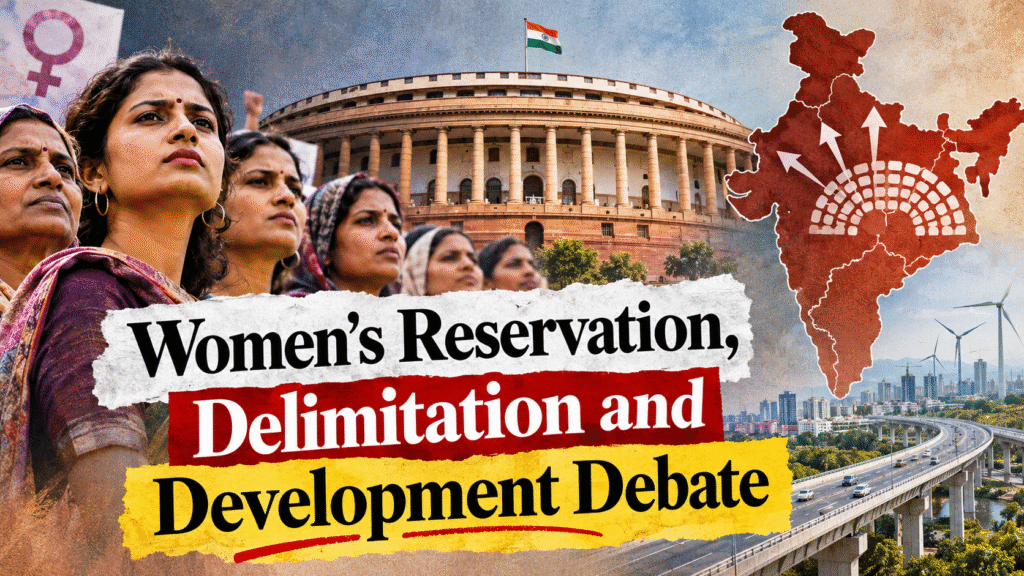
The Modi government is expected to renew its legislative push during the forthcoming parliamentary session beginning November 30. Its earlier constitutional amendment proposal, which sought to link the implementation of women’s reservation with delimitation and an expansion of the Lok Sabha, failed to secure the required majority in April last. The government is now reportedly exploring a revised formula whose contours remain uncertain.
The constitutional provision for 33 per cent reservation for women in the Lok Sabha and state assemblies was enacted in 2023. However, its implementation was linked to a future census and delimitation exercise. The present controversy arises from the government’s attempt to accelerate the process while linking it with a restructuring of parliamentary representation. Women’s empowerment and delimitation are therefore related in the proposed legislative framework, but they are not identical issues. The question is whether the legitimate objective of greater representation for women should be tied to a politically contentious restructuring of seats.
In fact, the delimitation debate must go beyond electoral arithmetic to confront India’s uneven development and demographic transition.
The proposed measure is being opposed by both the southern states and the Opposition parties, though for reasons that are not entirely the same. In the present situation, when the strength of the NDA coalition government has been considerably eroded by agitations—first over the NEET paper leak and subsequently by the demand for Chief Election Commissioner Gyanesh Kumar’s resignation—it is unlikely that the government will be able to secure the two-thirds majority required for the passage of the constitutional amendment.
Allegations of vote manipulation in the name of SIR, as well as controversies surrounding donations and precious metals associated with the much-celebrated Ram Mandir, have further dented the BJP government’s credibility. Allegations and controversies surrounding the Epstein case and undue concessions to business interests in Gujarat have also affected Prime Minister Modi’s standing among sections of the public. He is no longer in a position to push through a controversial measure like delimitation solely on the strength of his personal appeal. Modi and his political associates are well aware of this. Perhaps one of the political objectives of the proposed measure is to divert attention from serious issues such as rising prices, unemployment and allegations of vote theft. Another calculation may be to secure women’s support in the forthcoming Assembly elections, in which the BJP is under considerable pressure in states such as Uttar Pradesh and Uttarakhand, where it is in power, and Punjab, where it is seeking political relevance.
The ruling party’s attempt to reap a democratic dividend and the Opposition’s bid to deny it have pushed into the background the important economic issue underlying opposition to the measure. This issue is the country’s uneven pattern of development and the dichotomy between population growth and economic progress.
The five southern states have long complained that their efforts to control population growth put them at a disadvantage in the allocation of central funds and diminish their political influence in the corridors of power. They feel that the Hindi-speaking northern states receive a disproportionately large share of both political power and financial resources despite their relatively poor record in development and population control.
This perception of an unequal development dividend is not confined to the southern states. Although less articulate in expressing it, resentment against the overpopulated and underdeveloped Hindi-speaking states is also evident in Maharashtra, West Bengal and the northeastern states. The root of the problem lies in the lack of development in heavily populated states such as Uttar Pradesh, Bihar and Madhya Pradesh, which together account for over 32 per cent of India’s population.
While population is often blamed for poverty in the Hindi-speaking states in particular and the country’s underdevelopment in general, a dispassionate public discourse on the relationship between demography and development has never been initiated. We often miss the salient point that development leads to a decline in population growth, rather than the other way around. This approach, which puts the cart before the horse, has severely distorted our perceptions and given rise to unsavoury controversies, with the impending parliamentary debate on women’s reservation being the latest example.
It is surprising that we fail to recognise that some of the most economically developed countries are facing a severe population crunch and are deeply concerned about their future. Equally unfortunate is the fact that we regard our vast population as a liability rather than an asset that can contribute to greater productivity and development. Our attitude towards our population resources is as much a consequence of ignorance as it is of a fundamentally sectarian mindset, in which we tend to find reasons to hate rather than love our fellow human beings.
The parliamentary debate on the bill is likely to follow predictable party lines and will be marked by acrimonious exchanges, allegations and counter-allegations. Historical facts, reasoned arguments and a positive developmental perspective are likely to become casualties, as in the past. However, one hopes that, in the larger national interest, the debate will also address the fundamental issues of demography and development and initiate a genuine public discourse on the country’s developmental challenges.
The country needs a debate that goes beyond the immediate political contest. Women’s reservation should not become a casualty of partisan manoeuvring, nor should it be used to push through a delimitation framework without adequate consultation and consensus.
The challenge is to devise a formula that expands women’s political representation, protects the federal balance, respects the concerns of states that have achieved demographic stabilisation, and ensures that the country’s populous and comparatively underdeveloped regions receive the development investment they urgently need.

(The author is a senior journalist and media guru. Prof. Pradeep Mathur is the head of Media Map News Network and president of the voluntary organization MBKM Foundation.)