
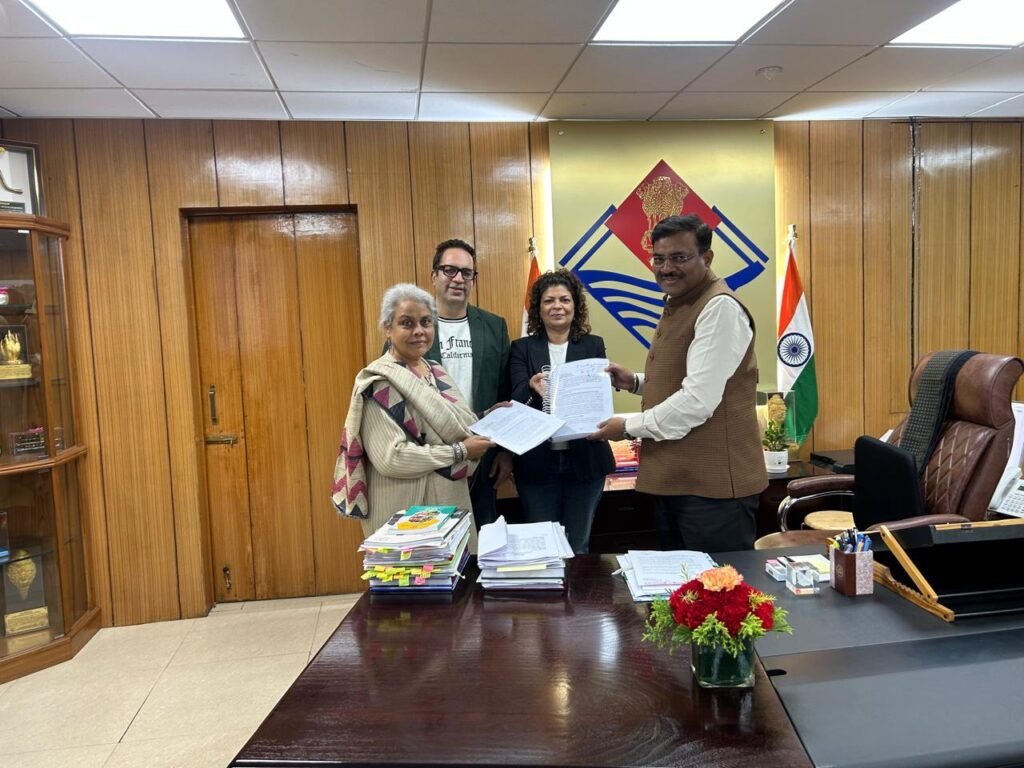
Dehradun: A three-member delegation of environmental organisation Citizens for Green Doon, comprising Ira Chauhan, Jaya Singh and Himanshu Arora, met the Chief Secretary of Uttarakhand to discuss the issue of Mussoorie’s carrying capacity and measures needed to protect the hill town’s fragile environment.
The meeting was held in compliance with the directions of the Hon’ble High Court in connection with a Public Interest Litigation (PIL) concerning Mussoorie’s carrying capacity. The delegation also presented suggestions from the organisation’s members and Anoop Nautiyal on measures to protect Mussoorie from the growing pressure of tourism and unplanned development.
Concern Over Overtourism and Environmental Stress
During the meeting, the delegation expressed serious concern over the increasing pressure on Mussoorie and the Doon Valley caused by uncontrolled tourism and rapid infrastructure development.
Himanshu Arora questioned how much pressure a small hill station like Mussoorie can sustain. He warned that if timely measures are not taken, the town could face a disaster similar to Joshimath. He pointed to reports of land subsidence in areas such as Landour and Jharipani.
Arora also highlighted the reported loss of nearly 47% of the green cover in Dehradun and surrounding areas of the Doon Valley over the past two decades, warning that continued destruction of the remaining green cover could have severe consequences for the region.
Opposition to New Roads and Large-Scale Tree Cutting
Ira Chauhan raised strong objections to the proposed new road project connecting Mussoorie through Jhajra and Missarpatti. According to the delegation, the project could require the cutting of approximately 18,000–20,000 trees, including valuable species such as sal, rohini, buransh and banj.
The delegation also raised concerns over the proposed widening of the LKD Road, which could reportedly involve the removal of around 700 trees.
Chauhan argued that such unplanned infrastructure development could increase the region’s vulnerability to disasters. The delegation also questioned the need for multiple new roads when the government is already developing a ropeway project that is expected to be completed soon.
Sewage, Water Shortages and Parking Constraints
Jaya Singh highlighted the limitations of Mussoorie’s existing infrastructure, particularly its sewage system, water supply and parking capacity.
She pointed out that Mussoorie has parking capacity for only around 1,287 vehicles, questioning the logic of allowing thousands of additional vehicles into a hill town with such limited infrastructure.
The delegation argued that tourism must be planned according to the actual capacity of the town’s water resources, sewage systems, parking facilities and accommodation.
Chief Secretary Raises Constitutional Right to Free Movement
Responding to the delegation’s concerns, the Chief Secretary stated that the government cannot prevent people from entering a city because freedom of movement is a constitutional right, and citizens of India have the right to travel anywhere in the country.
Himanshu Arora responded with an analogy, saying that if a house has space for only four guests, the hosts would invite four people at a time rather than invite everyone simultaneously. Additional guests could be asked to visit at a later date.
He argued that Mussoorie should similarly be treated as a shared home, with tourism regulated according to the town’s ability to accommodate visitors without placing excessive pressure on its infrastructure and environment.
Key Suggestions Submitted by the Delegation
In line with the High Court’s directions, the delegation submitted several recommendations aimed at protecting Mussoorie:
- Cancel proposed new road projects: All proposed new roads to Mussoorie should be cancelled immediately.
- Implement a strict registration system: A mandatory registration system should be introduced and strictly enforced for tourists and vehicles entering Mussoorie.
- Regulate visitors according to carrying capacity: The number of tourists allowed into the town at any given time should be determined by the actual availability of parking spaces and hotel rooms.
- Protect water and sewage infrastructure: Tourist numbers should be regulated to ensure that Mussoorie’s water sources, sewage systems and other essential infrastructure are not placed under unsustainable pressure.
The delegation emphasised that protecting Mussoorie requires a carrying-capacity-based approach to tourism and development, rather than continued expansion of infrastructure without considering the ecological limits of the hill town.

We are a multimedia news network. Website : www.7xnews.com Based in New Delhi (India)
Youtube : umakantlakheraspeaks@gmail.com