

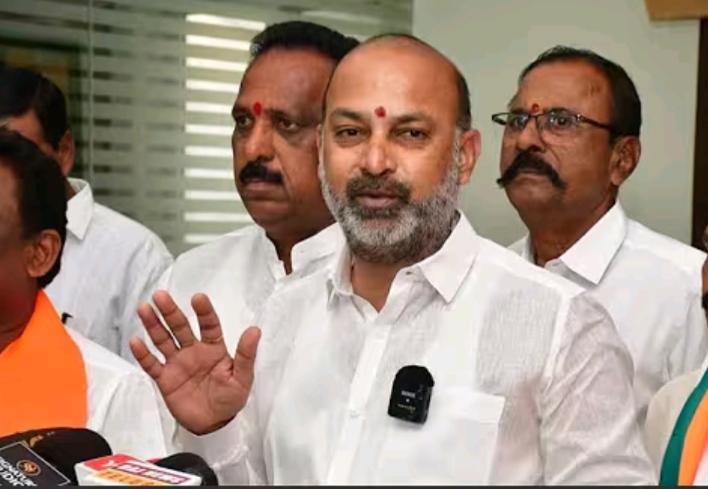
NEW DELHI: Minister of State for Home Bandi Sanjay Kumar on Tuesday told the Lok Sabha in a written reply that the Model Prison Manual just published to reduce overcrowding in jails. He also gave details of three criminal laws made effective from July 1, 2024.
He disclosed that the maximum period for which an undertrial can be detained has been now defined in Section 479 of the Bhartiya Nagrik Suraksha Samhita (BNSS), 2023.
It has been provided that where a person is a first-time offender (who has never been convicted of any offence in the past), he shall be released on bond by the Court, if he has undergone detention for the period extending up to one-third of the maximum period of imprisonment specified for such offence under that law.
Further, it shall be the duty of the Superintendent of Jail to make an application to the Court in this regard.
The BNSS also introduces a time bound plea bargaining, providing that the plea can be made within 30 days from the date of framing of the charges. It says where the accused is the first-time offender and has not been convicted of any offence in the past, the Court may sentence such accused person to one-fourth/one-sixth of punishment prescribed for such offence.
For the first time, Community Service has been introduced as one of the punishments.
The Model Prison Manual 2016 has chapters on “Legal Aid” and “Undertrial Prisoners” which provide the details of facilities provided to undertrial inmates, namely legal defence, interview with lawyers, application to Courts for legal aid at Government cost etc., which help in reducing overcrowding in prisons, the minister said.
A new section 356 has been added in BNSS, 2023 which provides for trial in absentia for persons declared as proclaimed offenders and the Court to proceed with the trial and pronounce the verdict in the absence of the accused. This provision ensures that justice is neither delayed nor denied.
FASTER, FAIR RESOLUTION: The minister said the new laws promise a faster and fair resolution of cases, instilling confidence in the legal system. Crucial stages of investigation and trial like – preliminary enquiry (to be completed in 14 days), further investigation (to be completed in 90 days), supply of document to the victim and accused (within 14 days), commitment of a case for trial (within 90 days), filing of discharge applications (within 60 days), framing of charges (within 60 days), pronouncement of judgment (within 45 days) and filing of mercy petitions (30 days before Governor and 60 days before President) – have been streamlined and to be completed within stipulated time period.
The minister said the new laws also prioritize the investigations for offences against women and children, ensuring timely completion within two months of recording information.
Other positive aspects of the new laws are:
–Provision of a maximum of two adjournments to avoid unnecessary delays in case hearings, ensuring timely justice delivery.
–To significantly improve the speed, efficiency and transparency of the judicial process, applications like e-Sakshya, e-Summon, and Nyaya-Shruti (VC) have been developed.
–While the e-Sakshya enables lawful, scientific and tamper-proof collection, preservation and electronic submission of digital evidence thus ensuring authenticity and reducing delays, e-Summon allow summons to be delivered through electronic means, making the process faster, time-bound and easily trackable.
Nyaya-Shruti (VC) facilitates virtual appearance of accused persons, witnesses, police officials, prosecutors, scientific experts, prisoners etc. through video conferencing.