

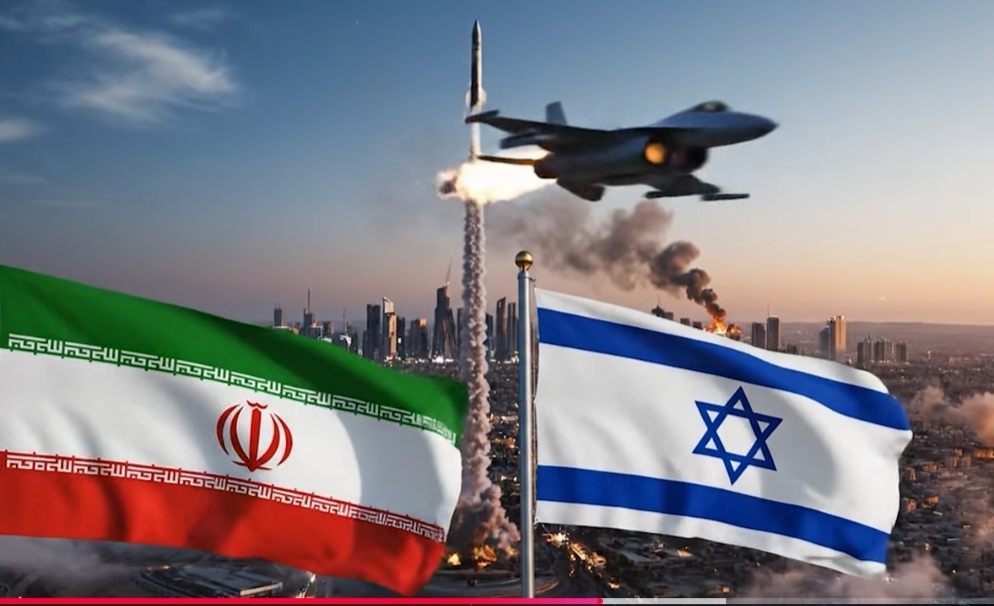
New Delhi 14 March 2026 : On the fourteenth day of the US–Israel war against Iran, the conflict has already begun to reshape strategic assumptions that governed West Asia for decades. What was initially projected as a swift demonstration of American military supremacy has evolved into a confrontation whose strategic consequences are still unfolding.
Among the voices drawing attention to these developments is Israeli journalist and peace activist Alon Mizrahi, who has argued that the scale of Iranian retaliation against American military infrastructure has surprised many observers. His commentary reflects a growing perception that the war is testing the resilience of the vast military architecture built by the United States across the Gulf.
Recent developments in the conflict suggest that the confrontation has expanded far beyond a conventional military exchange, affecting maritime trade, regional security alliances, and global energy markets.
The Network of Bases Under Fire
For more than three decades, the United States constructed an elaborate web of military installations across the Gulf region. Bases in Bahrain, Kuwait, Qatar, Jordan and Saudi Arabia have long formed the backbone of Washington’s strategic dominance in West Asia.
These installations—among the largest and most technologically sophisticated military bases in the world—were intended to ensure air superiority, rapid deployment capability, and extensive surveillance coverage across the region.
However, since the war began on 28 February with coordinated US and Israeli strikes on Iran, several of these installations and surrounding areas have come under retaliatory missile and drone attacks. Iranian strikes have hit sites in Gulf states, including areas near the headquarters of the US Navy’s Fifth Fleet in Bahrain and military facilities in Kuwait and Saudi Arabia. 
Such attacks highlight the vulnerability of concentrated military infrastructure in an era dominated by long-range missiles and drone warfare.
The Silence of the Battlefield
One of the most puzzling aspects of this war has been the scarcity of verified visual evidence emerging from the battlefield.
During the Gulf War of 1991, the global media broadcast continuous footage of precision strikes and military operations. In contrast, the present conflict has produced far fewer confirmed images of sustained air dominance or large-scale battlefield successes.
This relative silence has been attributed to tight wartime censorship, operational secrecy, and the increasingly complex nature of modern warfare—where cyber operations, drone strikes, and missile exchanges often occur far from conventional front lines.
Escalation Across the Gulf
As the conflict enters its third week, it has widened geographically. Iranian missile and drone attacks have struck infrastructure across the Gulf region, including energy facilities and port infrastructure. In Bahrain, a drone strike recently ignited a major fire at fuel storage tanks near the international airport, illustrating the vulnerability of civilian infrastructure amid the escalating war. 
Meanwhile, Iranian strikes and counter-strikes have been reported in multiple Gulf states, with missile barrages and drone attacks targeting military facilities and energy installations in Saudi Arabia and Kuwait. 
The war has also extended into other theatres. Israel has carried out strikes in and around Tehran, while regional tensions have spilled into Lebanon and other neighbouring areas where Iran-aligned groups operate. 
The Strait of Hormuz Factor
Perhaps the most immediate global concern lies in the waters of the Strait of Hormuz, one of the most critical maritime chokepoints in the world.
Following the outbreak of war, Iran warned that shipping through the strait could be restricted and that vessels may need to coordinate with Iranian naval forces to transit the waterway. 
The consequences have been dramatic. Commercial shipping traffic through the strait has slowed sharply, and several civilian vessels have reportedly been attacked since the start of the conflict. Roughly one-fifth of global oil and liquefied natural gas normally passes through this corridor, meaning even partial disruption has significant global repercussions. 
Oil prices have surged above $100 per barrel as energy markets react to the possibility of prolonged disruption. 
Leadership Shock and Strategic Uncertainty
A dramatic turning point in the conflict occurred when the joint US–Israeli strikes reportedly killed Iran’s supreme leader Ali Khamenei, triggering a rapid leadership transition. His son Mojtaba Khamenei was subsequently elevated to the position, pledging that Iran would continue attacks on US military installations and maintain pressure on the Strait of Hormuz. 
The new leadership has also warned Gulf states hosting American bases that they risk further attacks if those installations remain operational.
This development has added a new layer of uncertainty to the conflict, raising fears that the war could widen further if regional states become more directly involved.
Mounting Human and Military Costs
The intensifying war has also brought mounting casualties and operational challenges. Reports indicate that injured American personnel have been evacuated from the region, while a US military refueling aircraft crashed in western Iraq during operations related to the conflict. 
At the same time, Washington claims that thousands of Iranian targets—including military infrastructure and vessels—have been struck since the beginning of the campaign. 
Iran, for its part, reports heavy civilian casualties and widespread damage to infrastructure as a result of the ongoing air strikes. 
Iran’s Long Preparation
Unlike many conflicts fought by the United States over the past three decades, Iran has spent years preparing for a potential confrontation with Washington.
Military facilities, missile depots, and command centers are believed to be dispersed across the country and often located deep underground. Combined with Iran’s vast geography—covering roughly 1.6 million square kilometers—this has complicated attempts to neutralize its military capabilities through air power alone.
These structural advantages have made the conflict far more difficult and prolonged than many strategists initially anticipated.
Echoes of Strategic Shock
Some observers have drawn historical parallels between the strategic surprise confronting the United States today and the shock of the Attack on Pearl Harbour in 1941.
While the contexts differ dramatically, the comparison reflects a similar sense that entrenched assumptions about military dominance may be facing an unexpected test.
Unlike Pearl Harbour, however, this confrontation is not a single strike but a sustained war unfolding across multiple theatres—airspace, cyberspace, maritime routes, and regional proxy networks.
A Turning Point for West Asia?
A fortnight into the war, its final outcome remains uncertain. Yet the geopolitical consequences are already visible.
The conflict has disrupted global energy markets, threatened critical shipping lanes, and shaken the foundations of a regional security system that has long revolved around American military power.
If the war continues to challenge the credibility of that security architecture, it could accelerate broader shifts in the strategic balance of West Asia. Regional powers may reassess alliances, while global actors watch closely for signs that the long-standing military order in the Gulf is undergoing a profound transformation.
Whether this moment becomes a temporary crisis or a historic turning point will depend on how the conflict evolves in the days ahead. But even at this early stage, the war has opened a new and uncertain chapter in the geopolitics of West Asia—one whose consequences may resonate far beyond the battlefield.
Picture credit social media

~Hasnain Naqvi is a former member of the history faculty at St. Xavier’s College, Mumbai….
The opinions expressed here are solely those of the author.