

New Delhi, 14 April 2026,The history of empires is often written in ink, but it is punctuated by blood. For the British Raj, the ink of the 1919 *Rowlatt Act*—a legislative monstrosity that permitted imprisonment without trial—was quickly eclipsed by the crimson stain left on the soil of *Jallianwala Bagh*. Today, as we reflect on the legacy of April 13, 1919, we recognize it not merely as a day of mourning, but as the precise moment the moral scaffolding of British rule in India collapsed beyond repair.
The Anatomy of Repression
The spring of 1919 was heavy with tension. The Great War had ended, but the “reward” for India’s massive contribution of soldiers and resources was not the promised self-governance, but the *Anarchical and Revolutionary Crimes Act* Known colloquially as the “Black Act,” it sought to make the wartime suspension of civil liberties permanent. The dissent was immediate. Figures like *Madan Mohan Malaviya* and *Mohammed Ali Jinnah* resigned from the Imperial Legislative Council in disgust, with Jinnah famously noting that a government that passes such a law in peacetime “forfeits its claim to be called a civilized government.”
In Punjab, this political friction reached a flashpoint. The arrest of two popular leaders, *Dr. Saifuddin Kitchlew*and *Dr. Satyapal*, acted as a catalyst. When a crowd gathered on the day of *Baisakhi* at Jallianwala Bagh, they were not just celebrating a harvest festival; they were asserting their right to exist as a political body.
A Massacre by Design
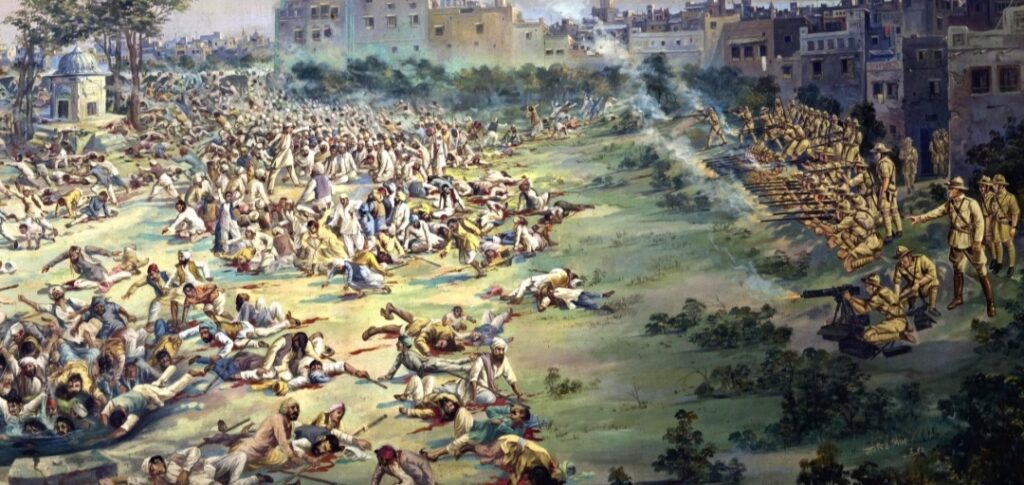
What followed was not a panicked response to a riot, but a “deliberately calculated massacre,” as historians like *V.N. Datta* have meticulously documented. *Brigadier-General Reginald Dyer* did not enter the garden to disperse a crowd; he entered to “punish.” By blocking the narrow exit—the only point of escape for the thousands trapped within the high-walled enclosure—and ordering 1,650 rounds to be fired into the thickest parts of the crowd, Dyer transformed a public garden into a slaughterhouse.
The numbers remain a point of historical contention, yet the tragedy remains absolute. While the official British inquiry, the *Hunter Commission*, cited 379 dead, Indian National Congress investigations placed the figure at over 1,000. The “Martyrs’ Well,” where hundreds leaped to escape the hail of bullets, remains a chilling testament to the desperation of that afternoon.
The Fracture of the Imperial Myth
The aftermath of the massacre achieved the exact opposite of Dyer’s intended “moral effect.” Instead of cowing the population into submission, it galvanized a subcontinent.
*The Renunciation of Honor:* The brutality shocked the intellectual conscience of the world. *Rabindranath Tagore* renounced his knighthood, stating that “honorary ornaments were incongruous in the context of such degradation.”
*The Birth of Mass Resistance:* For *Mahatma Gandhi*, who returned his *Kaiser-i-Hind* medal, the massacre was the final proof that the British Empire was “satanic.” It shifted his strategy from constitutional protest to the *Non-Cooperation Movement*, turning the independence struggle from an elite debate into a mass peasant revolution.
*The Long Memory of Justice:*The echoes of the gunfire traveled across decades and borders. In 1940, the revolutionary *Udham Singh*, who had witnessed the carnage as a young man, assassinated *Michael O’Dwyer*, the Lieutenant Governor who had sanctioned Dyer’s actions, in London—a final, grim postscript to the tragedy of Amritsar.
A Legacy Beyond the Bullet Marks
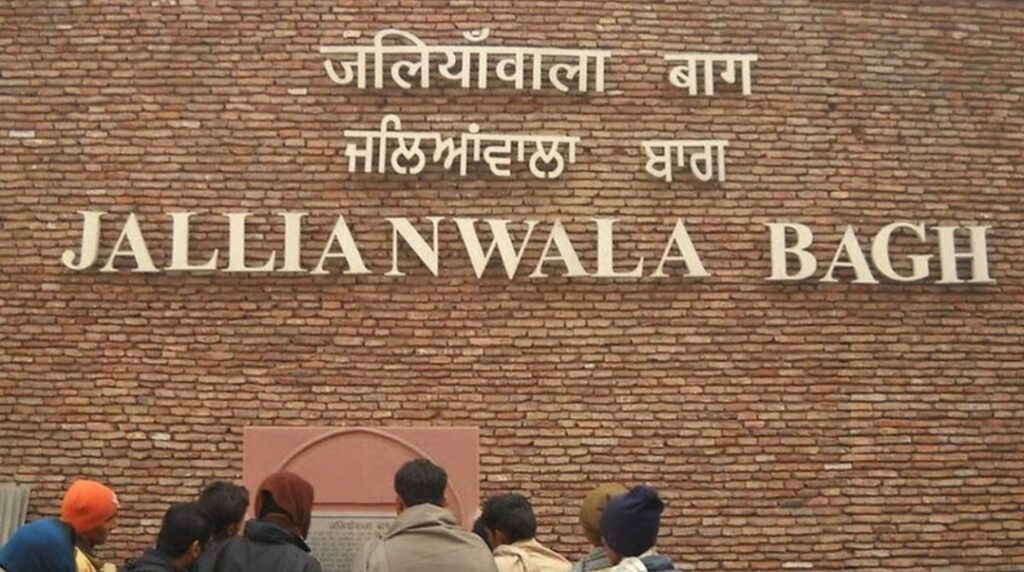
Today, the bullet marks preserved on the walls of Jallianwala Bagh serve as a reminder that the path to *Purna Swaraj* (complete self-rule) was paved with immense sacrifice. The massacre did more than kill civilians; it killed the illusion of the “civilizing mission” of the Raj.
As we look back, Jallianwala Bagh stands as a global symbol of the high cost of liberty. It teaches us that when a state replaces the rule of law with the rule of the gun, it does not achieve order—it only hastens its own inevitable end. The “Eternal Flame” at the site now flickers not just for the fallen of 1919, but for the enduring spirit of a nation that refused to stay silent in the face of tyranny.
Symbolic picture used

~Hasnain Naqvi is a former member of the history faculty at St. Xavier’s College, Mumbai….
The opinions expressed here are solely those of the author.