
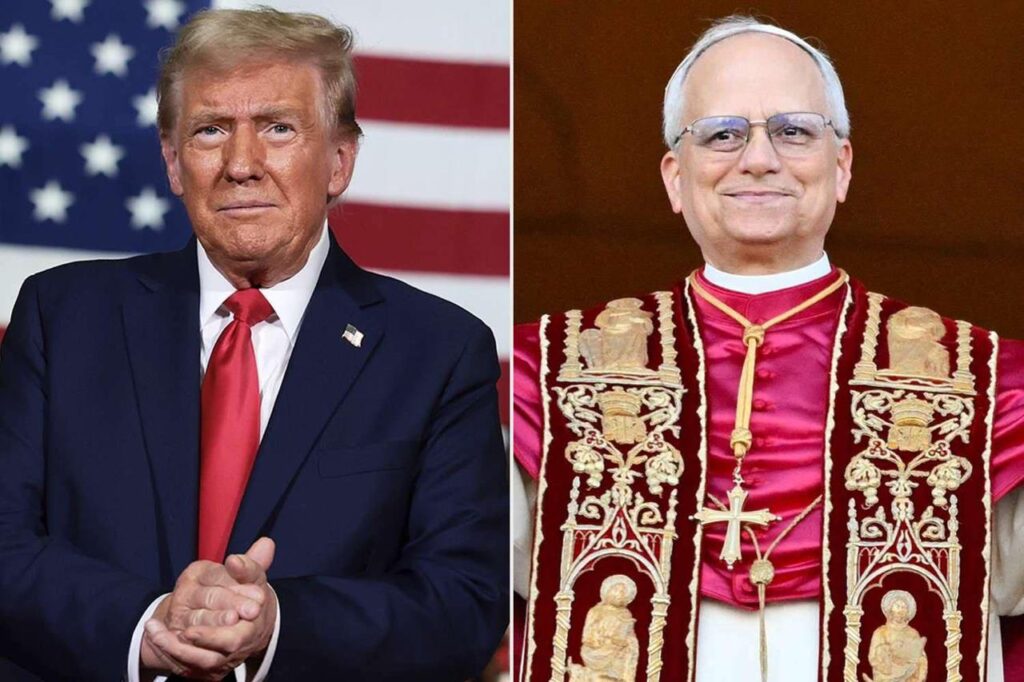
New Delhi,15 April2026 ,The annals of history are scarred by the friction between “the two swords”— the temporal power of the state and the spiritual authority of the Church. From the Holy Roman Emperor Henry IV standing barefoot in the snow at Canossa to beg for Pope Gregory VII’s forgiveness, to Napoleon Bonaparte snatching the crown from the hands of Pius VII to crown himself, the struggle for ultimate legitimacy is a recurring fever in Western civilization. Today, that fever has returned with a modern, digital virulence, as U.S. President Donald Trump engages in a high-stakes collision with Pope Leo XIV over the soul of the West and the fate of the Iranian people.
The Rhetoric of Annihilation
The current crisis was ignited not by a theological dispute, but by a terrifying departure from international norms. As the U.S.-Israeli military campaign in Iran intensified, President Trump issued a harrowing ultimatum on Truth Social, warning that “a whole civilization will die tonight, never to be brought back again.”
This was not the language of surgical strikes or strategic deterrence; it was the rhetoric of total erasure. Pope Leo XIV, the Chicago-born pontiff whose Chicagoan directness has become his hallmark, refused to remain a silent observer. Denouncing the “delusion of omnipotence” driving the conflict, the Pope positioned the Catholic Church as a moral bulwark against what he termed “unacceptable” threats to human existence. In doing so, he invoked a lineage of papal resistance to state-sponsored carnage, echoing Benedict XV’s desperate, ignored pleas for peace during the “useless slaughter” of World War I.
Blasphemy in the Digital Age
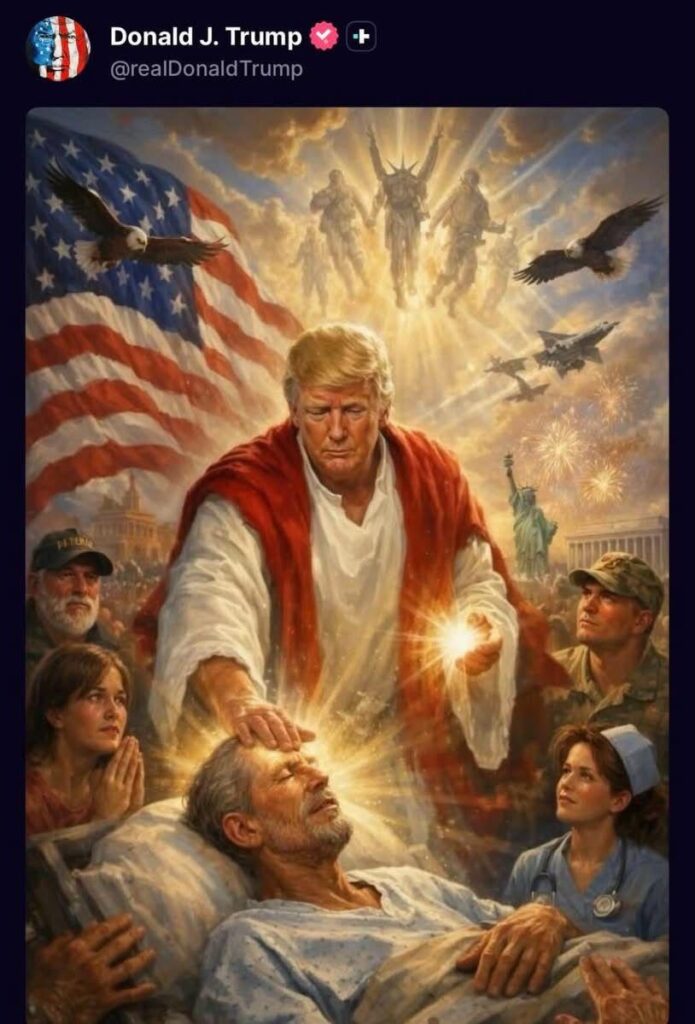
The President’s retaliation marked a surreal escalation. In a move that veered from political critique into the realm of the sacrilegious, Trump shared an AI-generated image of himself as a Christ-like figure, draped in robes and “healing” the sick. Though the post was later deleted—with the President offering the improbable defence that he thought it depicted him as a doctor—the message of self-deification was clear.
Accompanying this was a visceral attack on the Pope himself. Labeling the Supreme Pontiff “WEAK on crime” and “terrible for Foreign Policy,” Trump attempted to strip the papacy of its moral standing, reducing the leader of 1.3 billion Catholics to a partisan hack for the “Radical Left.” By claiming, “If I wasn’t in the White House, Leo wouldn’t be in the Vatican,” Trump echoed the hubris of the medieval monarchs who believed they held the power to appoint and depose the Vicars of Christ at will—a doctrine that led to centuries of European bloodletting.
A Global Fracture: From Washington to Rome
The fallout of this confrontation has reverberated far beyond the Beltway. In Europe’s Catholic heartlands, the reaction has been one of profound unease. Italy’s Prime Minister Giorgia Meloni—a leader who has often aligned with Trump’s nationalistic fervor—found herself in the impossible position of defending her faith against her ally. Her branding of Trump’s remarks as “unacceptable” signals a significant fracture in the global far-right coalition. For Meloni and other European leaders, the Pope remains a symbol of cultural and moral continuity that no political alliance can supersede.
Domestically, the President risks a terminal rift with the religious right. While his base has long forgiven his personal eccentricities, the overt mockery of the Papacy and the appropriation of Christ’s image for a war-time PR campaign cross a line from populism into hubris. Catholic voters, particularly in key swing states, now face an agonizing choice between a Commander-in-Chief promising “total victory” and a Holy Father pleading for the “Gospel of Peace.”
The Necessity of the Moral Check
History teaches us that when the state claims the authority of the divine to justify the annihilation of its enemies, disaster follows. The conflict between Trump and Leo XIV is a modern re-enactment of the Investiture Controversy, played out not in cathedrals, but on social media feeds and over the skies of Isfahan.
Pope Leo XIV’s assertion that he has “no fear” of the administration is a reminder that spiritual authority, when rooted in the defence of life, possesses a resilience that outlasts any four-year term. If the United States is to avoid the “demonic cycle of evil” the Pope warns against, it must rediscover the humility to accept moral limits on its power. The “sword of the state” is a formidable tool, but when it is brandished against the very concept of civilization itself, it is the “sword of the spirit”—wielded by a “weak” Pope in Rome—that may offer the only path back from the brink.
The real question is:
Does the President’s messianic self-projection mark a permanent shift in how his religious base perceives his authority, or will the political demands of the Iran conflict ultimately overshadow this theological rift?
Picture credit social media

~Hasnain Naqvi is a former member of the history faculty at St. Xavier’s College, Mumbai….
The opinions expressed here are solely those of the author.