

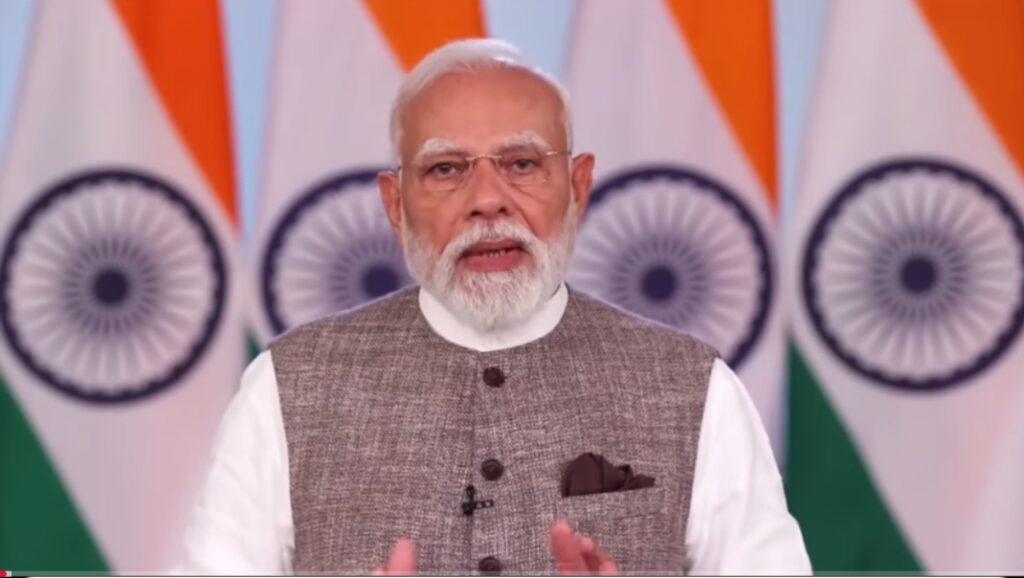
Prime Minister Narendra Modi’s 29-minute address to the nation on April 18, 2026, was billed as an act of contrition. After the Constitution (131st Amendment) Bill, 2026—intended to fast-track 33 per cent women’s reservation through delimitation—failed to secure the required two-thirds majority in the Lok Sabha the previous day, the Prime Minister expressed regret to the women of India. Yet what followed was anything but remorseful. It was a calculated, election-season broadside that transformed an official broadcast into a campaign rally, complete with inflammatory accusations, selective history, and a flagrant disregard for institutional boundaries.
The Legislative Context: Empowerment or Electoral Engineering?
The defeated legislation was no ordinary reform. It sought to operationalise the 2023 Nari Shakti Vandan Adhiniyam by linking women’s reservation to a delimitation exercise predicated on 2011 Census data. This would have expanded the Lok Sabha well beyond 800 seats while redrawing boundaries in ways that disproportionately favoured states with higher population growth—largely in the north—at the expense of southern and eastern states that have successfully curbed demographic expansion through education and health initiatives. Opposition parties, including the Congress, TMC, DMK and CPI(M), rightly argued that the move was less about gender justice than about pre-empting a politically inconvenient north-south federal imbalance. Southern leaders have long warned that punishing states for responsible population policies would erode the delicate balance of Indian federalism.
By presenting the bill’s defeat as a singular act of betrayal against women, the Prime Minister sidestepped these substantive federal concerns. The address framed the opposition’s parliamentary stand as an assault on “Nari Shakti” itself, conveniently ignoring that the 2023 Act—passed with cross-party support—had already deferred implementation pending a proper census and consensus-driven delimitation. The government’s rush to bypass that process invited the very deadlock it later decried.
Breach of the Bully Pulpit: Violating the Model Code of Conduct
Far more damaging was the Prime Minister’s choice of platform. Delivered at 8:30 pm while the Model Code of Conduct (MCC) remained in force for Assembly elections in Assam, Kerala, Tamil Nadu, West Bengal and Puducherry, the speech openly targeted political opponents. The Election Commission’s own guidelines are unambiguous: the party in power must not use official machinery for partisan ends, and criticism must be confined to policies, not personalities.
A televised address funded by the public exchequer is the very definition of official machinery.
Yet Mr Modi accused the Congress and its allies of “bhroon hatya” (female foeticide), declared that “a woman may endure anything else, but she never forgets an insult,” and labelled party workers “Urban Naxals” walking in British footsteps. These were not measured critiques of legislative strategy; they were visceral campaign slogans. Congress president Mallikarjun Kharge captured the breach succinctly: “Desperate and frustrated, PM Narendra Modi turned an official address into a political speech full of mudslinging and ‘lies’, misusing official machinery despite the MCC… This is a travesty of democracy and the Constitution.” CPI(M) Rajya Sabha MP John Brittas was blunter still: “No Prime Minister has ever used a national address to openly criticise and target the opposition in this manner. This breaks a long-standing democratic norm and undermines constitutional traditions.”
The distinction matters. Previous Prime Ministers have used the airwaves for national crises or policy announcements, not to settle parliamentary scores during an election cycle. The opposition has rightly demanded that the cost of the broadcast be charged to the BJP’s election expenditure—an accounting that would at least restore some parity.
The Perils of Hyperbolic Rhetoric
The rhetorical excess compounds the institutional offence. Equating a parliamentary vote with female foeticide trivialises a grave social evil while insulting the very women the Prime Minister claimed to champion. By seeking “forgiveness” from women in one breath and promising they would “severely punish” the opposition in the next, the speech revealed a deeper cynicism: gender justice reduced to electoral ammunition. The repeated invocation of Congress as perpetual obstacle further distorted history. The 2023 reservation law passed with bipartisan support; the current impasse arose from the government’s decision to yoke it to a contentious delimitation framework.
Such language does not strengthen the case for women’s representation. It polarises debate, erodes parliamentary dignity, and risks normalising the use of the Prime Ministerial pulpit for campaign warfare. When the highest executive office blurs the line between governance and electioneering, public trust in democratic institutions inevitably suffers.
A Warning for Indian Democracy
Mr Modi’s address was not an aberration; it was the logical outcome of a political culture that increasingly treats every institution—Parliament, the Election Commission, even the national airwaves—as an extension of the ruling party’s campaign machinery. The MCC exists precisely to prevent such capture during elections. Its selective enforcement, or perceived absence thereof, only deepens cynicism.
The women of India deserve more than performative outrage dressed as contrition. They deserve a serious, consensus-driven path to reservation that respects federal sensitivities and upholds the sanctity of constitutional processes. Prime Ministers, likewise, owe the nation addresses that unite rather than divide, inform rather than inflame. By turning a moment of legislative reflection into a 29-minute election rant, Narendra Modi has not only failed that test but set a dangerous precedent—one that future governments of any stripe may be tempted to emulate.
India’s democracy has weathered many storms. It cannot afford to see its highest offices reduced to soapboxes. The time for restraint—and accountability—is now.

~Hasnain Naqvi is a former member of the history faculty at St. Xavier’s College, Mumbai….
The opinions expressed here are solely those of the author.