

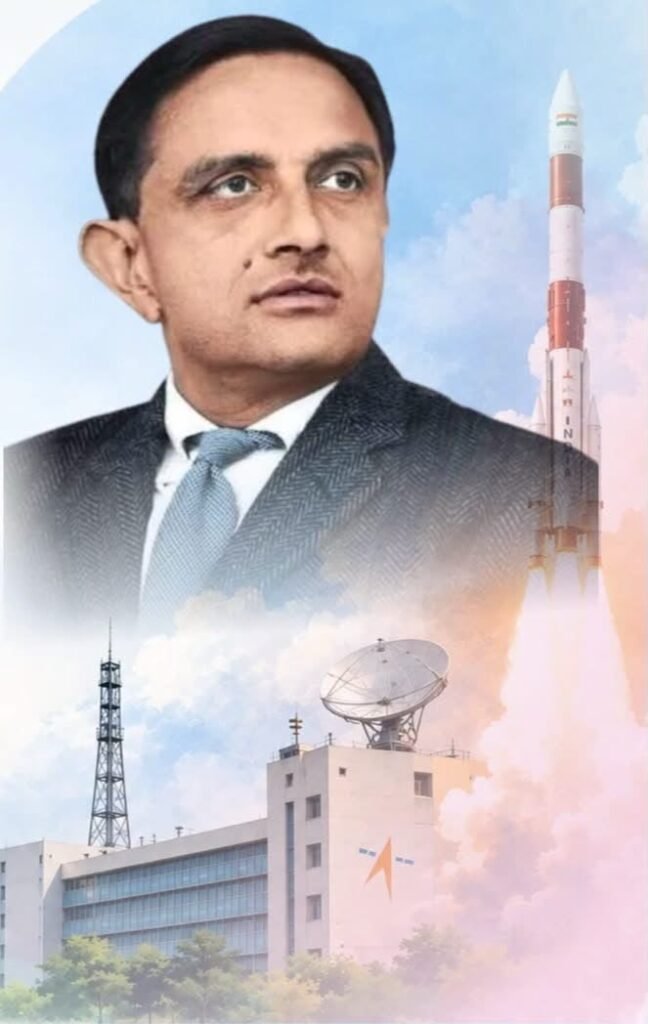
On the twelfth of August each year, India reflects on the extraordinary life and monumental legacy of Dr. Vikram Ambalal Sarabhai, a titan of modern science whose visionary leadership reshaped the contours of national progress. In the nascent years following Independence, when a young republic struggled with widespread poverty, illiteracy, and economic fragility, many argued that advanced scientific research was an unsustainable indulgence. Yet, Dr. Sarabhai possessed the rare, transformative clarity to see beyond immediate hardships. He recognized that high technology was not an exclusive luxury reserved for industrialized superpowers, but an essential catalyst for national development, social equity, and economic self-reliance.
Driven by an unwavering faith in human potential, Sarabhai articulated a guiding philosophy that defined India’s technological renaissance:
“We do not have the riches of oil, but we have the genius of our people.”
This profound insight shifted the national narrative from one of resource scarcity to intellectual abundance, laying the cornerstone for a self-reliant scientific ecosystem that continues to inspire the world today.
Roots of Greatness: From Ahmedabad to Cambridge
Born in 1919 into a prominent industrial and philanthropic family in Ahmedabad, young Vikram grew up in an extraordinarily stimulating intellectual environment. His family residence, The Retreat, served as a vibrant crossroads for political leaders, creative thinkers, and scientific visionaries, including Mahatma Gandhi, Rabindranath Tagore, Jawaharlal Nehru, and Sir C.V. Raman. This early immersion in freedom movements, artistic expression, and rigorous inquiry cultivated in Sarabhai a deep sense of social responsibility and an expansive, humanist worldview.
After completing his initial studies at Gujarat College, Sarabhai moved to the University of Cambridge, earning his Natural Sciences Tripos at St. John’s College. The outbreak of World War II forced his return to India, leading him to the Indian Institute of Science in Bengaluru. There, under the direct mentorship of Nobel laureate Sir C.V. Raman and alongside Dr. Homi J. Bhabha, Sarabhai conducted groundbreaking research in cosmic ray physics. Following the war, he returned to Cambridge to complete his doctorate in 1947 with a seminal thesis titled ‘Cosmic Ray Investigations in Tropical Latitudes’, a research path that laid the foundation for his lifelong passion for space science.
The Catalyst of Modern Indian Institutions
Returning to an independent India in 1947 at the age of just twenty-eight, Sarabhai immediately threw himself into building the scientific infrastructure of a nation in revival. In November 1947, operating initially out of a modest room in his family residence, he established the Physical Research Laboratory (PRL) in Ahmedabad, an institution that would rightfully come to be known as the ‘cradle of space sciences’ in India. However, Sarabhai’s genius was not confined to a single discipline; he was an institution builder par excellence.
With extraordinary foresight, Sarabhai recognized that a modern nation required multifaceted institutional excellence. He founded the Ahmedabad Textile Industry’s Research Association (ATIRA) to integrate science with manufacturing, established the Indian Institute of Management Ahmedabad (IIMA) to pioneer professional management education, created the Operations Research Group (ORG) for market intelligence, and instituted the Nehru Foundation for Development. Furthermore, alongside his wife, the celebrated classical dancer Mrinalini Sarabhai, he co-founded the Darpana Academy of Performing Arts—vividly demonstrating his belief that scientific advancement and cultural heritage must flourish hand in hand.
Launching India into the Space Age
Sarabhai’s most historic breakthrough came with his realization that space technology possessed immense potential to address the practical problems of a developing society. In 1962, alongside Dr. Homi Bhabha, he persuaded the Government of India to establish the Indian National Committee for Space Research (INCOSPAR), which evolved in 1969 into the Indian Space Research Organisation (ISRO).
The saga of India’s entry into the cosmic age stands as a moving chapter in technological history. Selecting Thumba, a modest fishing village near Thiruvananthapuram in Kerala, owing to its ideal proximity to the Earth’s magnetic equator, Sarabhai achieved what seemed impossible. In a remarkable demonstration of interfaith trust and scientific diplomacy, he persuaded the local congregation and Bishop Peter Bernard Pereira to relinquish St. Mary Magdalene Church to serve as the project’s primary laboratory and control room.
On November 21, 1963, India successfully launched its first sounding rocket, the Nike-Apache. In those pioneering days, equipment and rocket components were transported to the launch site on bicycles and bullock carts. That humble church altar, transformed into a scientific control room, set in motion an extraordinary institutional trajectory—advancing from INCOSPAR to the formal establishment of ISRO, driving indigenous satellite development with Aryabhata, enabling lunar exploration via the Chandrayaan missions, and paving the way for human spaceflight through Gaganyaan.
Technology with a Soul: Space for Social Good
While global powers viewed space exploration through the lens of Cold War rivalry and geopolitical dominance, Dr. Sarabhai charted an entirely distinct, humanistic course for India. He rejected vanity projects, maintaining that space research must serve the common man.
“There are some who question the relevance of space activities in a developing nation. To us, there is no ambiguity of purpose… We are convinced that if we are to play a meaningful role nationally, and in the community of nations, we must be second to none in the application of advanced technologies to the real problems of man and society.”
This philosophy culminated in the conceptualization of the Satellite Instructional Television Experiment (SITE) in the mid-1970s. Utilizing satellites to beam direct educational programming on agriculture, health, hygiene, and literacy to more than 2,400 remote Indian villages, SITE was hailed by international observers as the largest sociological experiment in communications history.
Sarabhai also initiated the indigenous satellite manufacturing programme that led to the launch of India’s first satellite, Aryabhata, in 1975, and mentored a generation of scientific stalwarts, including Dr. A.P.J. Abdul Kalam, U.R. Rao, and M.G.K. Menon. When Dr. Homi Bhabha tragically died in 1966, Sarabhai stepped forward to lead the Atomic Energy Commission of India, expanding the nation’s capabilities in nuclear power, electronics, and medical applications.
An Enduring Legacy and Timeless Inspiration
Though his life was abruptly cut short on December 30, 1971, at the young age of fifty-two, Dr. Vikram Sarabhai accomplished in a few brief decades what few could achieve in multiple lifetimes. Honoured with the Padma Bhushan in 1966 and the Padma Vibhushan posthumously in 1972, his name remains immortalized across the scientific community—from the Vikram Sarabhai Space Centre in Thiruvananthapuram to the Sarabhai crater on the Moon and the historic ‘Vikram’ lander that touched down on the lunar south pole.
As India celebrates his birth anniversary, Dr. Sarabhai’s message echoes across generations with renewed power. He taught us that true national greatness stems not from imitating foreign models, but from nurturing indigenous innovation, daring to dream without fear of failure, and deploying science as a force for compassion and human dignity. In an era marked by rapid technological change, Vikram Sarabhai remains our guiding star—a polymath who listened to “the music in the midst of noise” and showed a rising nation how to touch the heavens while keeping its feet firmly planted in the service of humanity.

~Hasnain Naqvi is a former member of the history faculty at St. Xavier’s College, Mumbai….
The opinions expressed here are solely those of the author.