
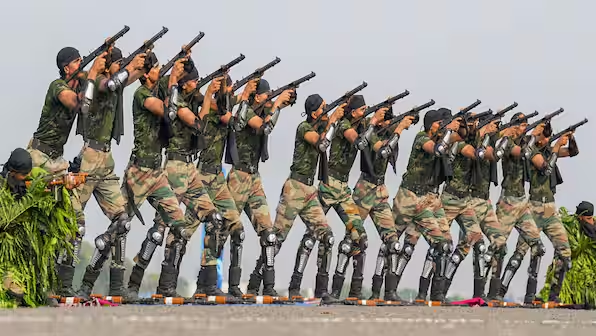
(Photo) Curtesy : Firstpost
NEW DELHI: The Indian Armed Forces are reportedly proposing to retain a higher percentage of Agniveers after their 4-year service, beyond the current retention for 25% for each arm of the tri-services.
The first batch of Agniveers recruited under the Agnipath scheme is yet to conclude their 4-year service. They began training in 2023 and will complete their tenure later this year.
According to the Agnipath scheme, twenty-five percent of the released Agniveers will be retained as regular soldiers as per their merit.
Notably, the armed forces are planning to raise the retention percentage of the Agniveers from the current twenty-five percent. According to the Indian Express, the Navy is likely to seek a higher retention rate of around 75% for sailors who joined under the scheme, while the Army and the Indian Air Force (IAF) may push to increase their retention from the current 25% to about 50%.
Earlier, the former Chief of Army Staff General Upendra Dwivedi, in an interview with IANS, emphasised that any improvements to the Agnipath Scheme in the future should be “guided by operational requirements” and field experience rather than by “predetermined numbers,” hinting at a similar move to raise the retention percentage of Agniveers.
The former Indian Army Chief described the Agnipath scheme as a major human resource reform designed to create a younger, fitter, more energetic, and future-ready Army.
“The character of warfare is changing rapidly, and today’s soldier must be physically robust, mentally agile, and technologically adept,” he said.
He noted that initial feedback from operational units has been encouraging. Agniveers are adapting well to unit life, training standards, and field requirements. Their ability to quickly learn and operate modern battlefield systems, including drones, surveillance equipment, communication networks, and other technology-driven platforms, has been a positive development.
However, General Dwivedi cautioned that the scheme is still evolving. Since the first batch is yet to complete its full service period, any final assessment would be premature.
The Army is continuously monitoring and analysing training outcomes, unit integration, operational performance, and feedback from commanders across the force.
On the potential changes to the Agniveer model, the former Army Chief said any future refinements must be driven by operational requirements and real-world field experience, rather than predetermined targets or percentages.
“If future assessments reveal the need for adjustments, particularly in specialised and technology-intensive domains such as air defence, drones, counter-UAS, signals, surveillance, and electronic warfare, the matter can be examined at an institutional level,” he added.
The push for higher retention stems from the need for a larger pool of trained and experienced soldiers. Many of these Agniveers have participated in multiple operations over the past four years and have gained valuable hands-on experience with new technologies and modern weapon systems.

We are a multimedia news network. Website : www.7xnews.com Based in New Delhi (India)
Youtube : umakantlakheraspeaks@gmail.com