

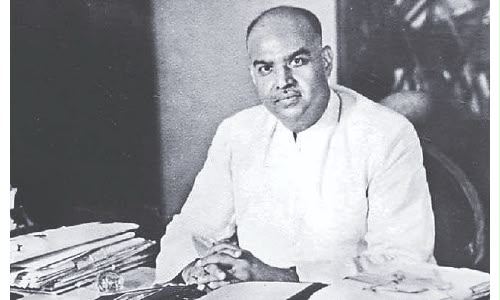
In the contemporary theatre of Indian politics, history is rarely left to rest; it is continuously excavated, weaponized, and remodeled to serve modern ideological projects. The recent state-sponsored hagiography surrounding Dr. Syama Prasad Mookerjee—marked by newly declared public holidays and the fervent elevation of his stature to that of a flawless founding father—is a classic case in point. For the ruling dispensation, Mookerjee is the unsullied ideological progenitor, a martyr for national integration whose vision achieved its ultimate realization in the remodeling of Jammu and Kashmir.
Yet, history possesses a stubborn resistance to the simplistic binaries of political myth-making. Beneath the polished veneer of the icon lies a labyrinth of deep ideological contradictions, tactical compromises, and actions that sit uncomfortably with the hyper-nationalist ethos championed in his name today. To critically examine Mookerjee is not to dismiss his intellect or his undeniable impact on India’s political landscape, but to confront a legacy defined by profound paradoxes: a man who is celebrated as a nationalist icon but who actively collaborated with the colonial state during the peak of the freedom struggle; a champion of Hindu interests who shared power with the Muslim League; and a constitutionalist whose final act was a provocative defiance of state law.
The Wartime Compromise: Suppressing the Call for Freedom
The most glaring fracture in the narrative of Mookerjee as an unyielding patriot occurs in the summer of 1942. As Mahatma Gandhi galvanized millions with the defining ultimatum of the independence struggle—the Quit India Movement—the Indian National Congress leadership was swiftly imprisoned, and the nation erupted in mass civil disobedience. During this pivotal anti-colonial crucible, Mookerjee chose a path that aligned him directly with the British Raj.
Serving as the Finance Minister in the Bengal Provincial Government, Mookerjee made his allegiances clear in a letter written to the Governor of Bengal, John Herbert, on July 26, 1942—just weeks before the Quit India resolution was formally adopted. In this communication, Mookerjee did not merely urge caution; he actively counselled the colonial administration on how to effectively neutralize the nationalist uprising. He argued that preservation of internal order was paramount due to the advancing Japanese forces, concluding that:
“…anybody, who during the war, plans to stir up mass feeling, resulting in internal disturbances or insecurity, must be resisted by any Government that may function for the time being.”
Mookerjee went further, asserting that the provincial administration must ensure that “despite the best efforts of the Congress, this movement will fail to take root in the province.” His rationale was anchored in a conservative constitutionalism: he posited that because Indians possessed limited representation within the colonial provincial system, revolutionary agitation was unnecessary.
In his view, the freedom sought by the Congress “already belongs to the representatives of the people.” For an icon of modern Indian nationalism, this overt endorsement of British repressive machinery to crush an anti-colonial revolt remains a historical reality that no amount of contemporary political canonization can erase.
The Bengal Coalition: Ideology Yielding to Expediency
Mookerjee’s political career in the 1940s was defined by a pragmatic elasticity that challenges the purist ideological image constructed posthumously by his followers. In 1941, as a prominent leader of the Hindu Mahasabha—an organization explicitly dedicated to countering Muslim political mobilization—Mookerjee entered into a ruling coalition in Bengal with the Muslim League under Fazlul Haq’s Progressive Coalition.
To his apologists, this alliance was a masterstroke of defensive statecraft, a strategic necessity aimed at securing Hindu representation and safeguarding community interests in a Muslim-majority province polarized by communal friction. To his detractors, however, this partnership exposed a fundamental ideological inconsistency. By sharing power with the very political force advocating for the partition of India on religious lines, Mookerjee demonstrated a willingness to prioritize immediate regional influence and the marginalization of the Congress party over rigid ideological coherence. Though the coalition eventually fractured under the weight of escalating communal tensions and the catastrophic Bengal Famine of 1943, this chapter underscores a career-long pattern: when purity clashed with political pragmatism, pragmatism frequently won.
Defending Tradition: The Fracture Over Social Reform
Following independence, Mookerjee’s inclusion in Jawaharlal Nehru’s first national cabinet as Minister of Industry and Supply was heralded as an exercise in national reconciliation—an attempt to build a pluralistic consensus by incorporating diverse ideological voices. Yet, this uneasy coexistence between Nehru’s secular-socialist vision and Mookerjee’s conservative worldview was short-lived, culminating in his resignation in 1950.
While geopolitics and the treatment of minorities in East Pakistan triggered the final break, the underlying ideological battleground was the historic Hindu Code Bill. Spearheaded by Nehru and Dr. B.R. Ambedkar, the bill sought to fundamentally modernize and codify Hindu personal law, introducing progressive reforms such as women’s rights to property, inheritance, and divorce.
Mookerjee emerged as a vocal adversary of these reforms, aligning himself with orthodox Hindu sentiments. He argued that the state-driven legislation constituted an unwarranted overreach into sacred religious traditions and threatened to dismantle the foundational fabric of the traditional Hindu family structure. This stance crystallizes the core orientation of his cultural nationalism: it was a vision that frequently prioritized the preservation of traditional social hierarchies over universal rights and gender equality, framing progressive social evolution as a threat to cultural sovereignty.
The Birth of the Bharatiya Jana Sangh (BJS) and the Engineering of Martyrdom
Disillusioned by the post-independence state’s trajectory, Mookerjee pivoted in 1951 to found the Bharatiya Jana Sangh (BJS), the ideological and organizational ancestor of today’s ruling Bharatiya Janata Party (BJP). Collaborating closely with the Rashtriya Swayamsevak Sangh (RSS), Mookerjee constructed a political vehicle centered on cultural nationalism, a uniform civil code, and a fierce opposition to what he termed the “appeasement” of minorities.
It was through the BJS that Mookerjee launched his final, fateful political crusade against the special constitutional status granted to Jammu and Kashmir under Article 370. Coining the enduring political mantra, “Ek desh mein do vidhan, do pradhan, do nishan nahi chalenge” (One nation cannot have two constitutions, two prime ministers, two flags), Mookerjee sought to force the absolute integration of the state into the Indian Union.
In May 1953, he deliberately violated the prevailing permit system to enter Kashmir, resulting in his arrest and subsequent detention in a Srinagar prison. His sudden death in custody on June 23, 1953, officially attributed to a heart attack, was immediately enveloped in suspicion and conspiracy theories. This tragic end effectively transformed a controversial political gambit into an act of supreme martyrdom.
The Persistent Shadow of an Unresolved Legacy
Decades later, Mookerjee’s political afterlife has achieved a utility that far outstrips the realities of his lifetime. The revocation of Article 370 in 2019 was loudly messaged as the fulfillment of his dying wish, solidifying his status as the foundational architect of the modern right-wing project.
However, a rigorous reading of history demands that we look beyond the political iconography. The state may build monuments and declare holidays to enforce a singular narrative, but it cannot scrub the archival record clean. Syama Prasad Mookerjee’s life remains an unresolved mosaic of contradictions: the nationalist who aided the Raj, the Hindu majoritarian who partnered with the Muslim League, and the conservative who resisted fundamental social emancipation.
In acknowledging these fractures, we find a truer mirror to the complexities of India’s ongoing ideological battle—a reminder that the foundations of modern majoritarian politics were built not on a monolith of pure patriotism, but on the shifting sands of political expediency and historical paradox.

~Hasnain Naqvi is a former member of the history faculty at St. Xavier’s College, Mumbai….
The opinions expressed here are solely those of the author.

