

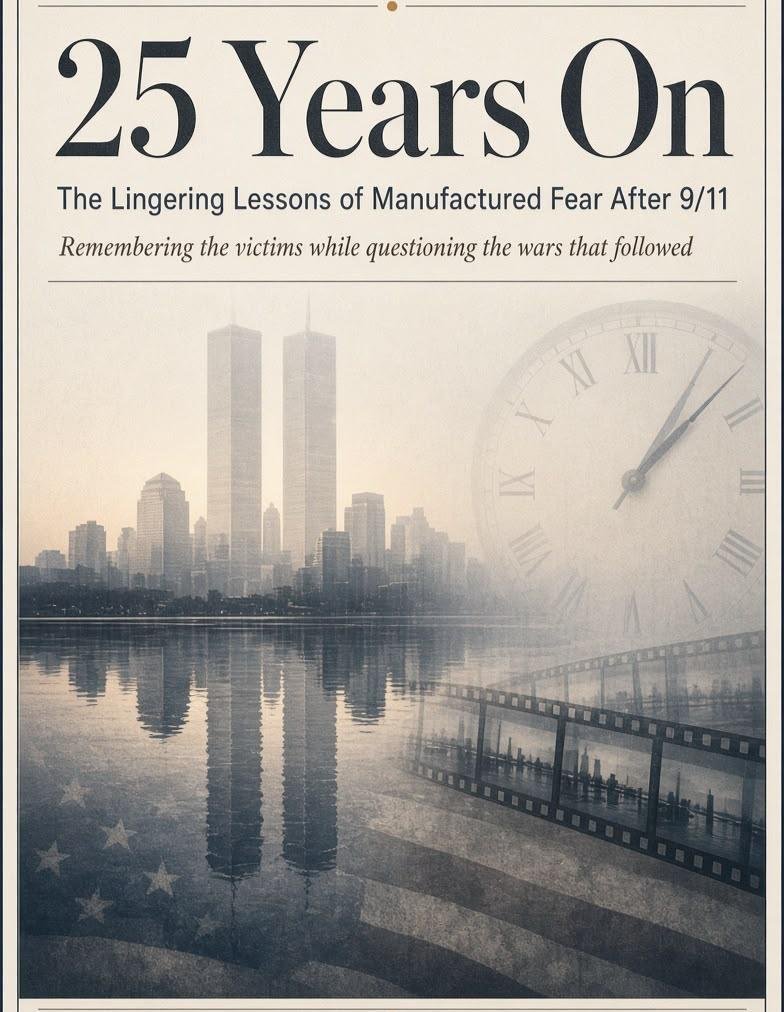
A quarter of a century after September 11, 2001, the images of hijacked aircraft crashing into the World Trade Centre remain etched into the global memory. Nearly 3,000 people were killed that morning. What followed was not merely a hunt for those responsible but the beginning of a sprawling “war on terror” whose consequences continue to shape international politics, civil liberties and the lives of millions.
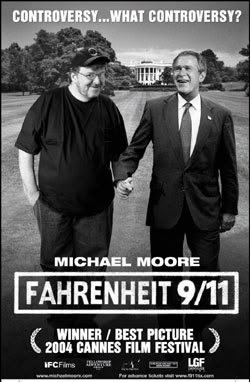
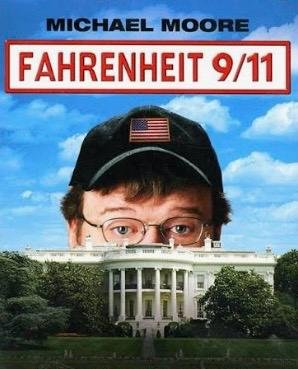
Among the most controversial cultural responses to that transformation was Michael Moore’s 2004 documentary Fahrenheit 9/11. Released as the United States was fighting in Iraq, the film was deliberately provocative. It argued that the Bush administration had exploited the trauma of 9/11 to build public support for a war that had little to do with the attacks, while fear, political messaging and a compliant media helped narrow the space for dissent.
Twenty-five years later, parts of Moore’s argument look strikingly prescient. But hindsight also demands an important distinction: a documentary’s political interpretation is not the same thing as an official finding of fact. Some of Moore’s central claims have since been corroborated by investigations; others were arguments, suspicions or rhetorical extrapolations that should not be presented as established fact.
From 9/11 to Iraq: The Critical Distinction
The most consequential issue is the relationship between 9/11 and the 2003 invasion of Iraq.
Fahrenheit 9/11 forcefully challenged the impression, widespread in the immediate post-9/11 atmosphere, that Saddam Hussein’s Iraq was somehow connected to the attacks. On this central point, subsequent investigations provide substantial support for Moore’s scepticism.
The 9/11 Commission found contacts between Iraqi officials and al-Qaeda but concluded that there was no evidence that these contacts developed into a collaborative operational relationship, nor evidence that Iraq cooperated with al-Qaeda in attacks against the United States. It also found no compelling evidence that Iraq had planned or participated in 9/11.
The question of Iraq’s alleged weapons of mass destruction was similarly consequential. The U.S. Senate Intelligence Committee later concluded that many of the key intelligence judgments underpinning the pre-war assessment were overstated or unsupported by the underlying intelligence, with “groupthink” contributing to the failure.
That does not mean that every element of the administration’s case for war was invented, nor that all intelligence officials were deliberately dishonest. Rather, the subsequent record demonstrated a profound failure of intelligence analysis and political judgment—and a willingness to present uncertain assessments with far greater confidence than the evidence warranted.
That distinction matters. Moore made a political argument about manipulation. Official investigations subsequently documented serious failures in the intelligence and policy process. The two should not simply be collapsed into one another.
Fear as a Political Instrument
Where Moore was at his most effective was in examining the political psychology of the post-9/11 period.
The United States was a traumatised society. The fear of another attack was genuine, and governments had an undeniable responsibility to protect the public. But fear also became a powerful political language. The expansion of surveillance, homeland-security institutions, military operations and executive authority occurred within an atmosphere in which questioning national-security policy could easily be portrayed as weakness or disloyalty.
Moore’s filmmaking was intentionally polemical, but his larger question remains relevant: what happens to democratic scrutiny when a society is frightened enough to accept extraordinary measures as normal?
That question has acquired greater resonance as the post-9/11 wars are assessed not simply in terms of military campaigns but in terms of their human and institutional consequences.
The Human Cost
The scale of those consequences is now considerably clearer than it was when Fahrenheit 9/11 appeared.
According to Brown University’s Costs of War Project, more than 940,000 people were killed directly by post-9/11 war violence in Iraq, Afghanistan, Syria, Yemen and Pakistan between 2001 and 2023. More than 432,000 of those deaths were civilians. Brown estimates another 3.6–3.8 million indirect deaths, resulting from the destruction of healthcare systems, infrastructure, economies and living conditions. Taken together, the project estimates at least 4.5–4.7 million deaths, while stressing that the precise toll remains unknowable. More than 38 million people have also been displaced by the post-9/11 wars.
These figures require care. They do not represent a single official death register, and the indirect-death estimates are necessarily modelled estimates rather than individually recorded fatalities. But they convey something that conventional battlefield statistics often obscure: modern war kills not only through bombs and bullets but through the collapse of hospitals, food systems, public services and economies.
The human ledger is therefore far larger than the casualty counts usually associated with individual military operations.
Saudi Arabia: Another Necessary Nuance
Moore also drew attention to the uncomfortable Saudi dimension of 9/11. Fifteen of the 19 hijackers were Saudi nationals, a fact confirmed by the FBI.
But this does not establish the broader implication sometimes drawn from that fact.
The 9/11 Commission found that Saudi Arabia had been a significant environment for al-Qaeda fundraising and that individuals and charities in the kingdom had provided important sources of money. Yet it also found no evidence that the Saudi government as an institution, or senior Saudi officials individually, funded al-Qaeda. (9/11 Commission)
Similarly, the existence of business and personal connections between prominent American and Saudi circles does not by itself establish that U.S. policy was dictated by those relationships. Moore used those connections to construct a larger political argument about privilege, oil and power. They are legitimate subjects for scrutiny, but they should not be presented as proof of a conspiracy that official investigations did not establish.
From Afghanistan to Iraq—and Beyond
The consequences of the post-9/11 strategy eventually extended far beyond the original objective of dismantling al-Qaeda.
The U.S.-led intervention in Afghanistan removed the Taliban from power, but the movement eventually returned. The chaotic American withdrawal in 2021 symbolised the limits of a military project that had continued for two decades.
Iraq, meanwhile, became the site of a prolonged insurgency and sectarian conflict following the overthrow of Saddam Hussein. The wider destabilisation contributed to conditions from which new extremist movements, including the Islamic State, emerged.
None of this proves Moore’s entire thesis. History is rarely that tidy. But it does underline the danger of treating military power as a substitute for political strategy.
What the Film Ultimately Still Asks
Fahrenheit 9/11 has aged unevenly. Its humour, editing and political rhetoric were unmistakably partisan, and some of its insinuations went beyond what evidence could conclusively establish. It would therefore be a mistake to treat the film as a historical verdict.
Its enduring value lies elsewhere.
Moore asked whether a frightened democracy could be persuaded to accept policies it might have questioned under calmer circumstances. Subsequent investigations established that the case for Iraq rested on deeply flawed intelligence, that there was no demonstrated operational partnership between Saddam Hussein and al-Qaeda in 9/11, and that the wars launched in the post-9/11 era would exact an extraordinary human cost.
Twenty-five years after 9/11, the lesson is therefore not that Fahrenheit 9/11 was wholly right. It is that democracies need scepticism most when fear makes scepticism difficult.
Remembering the victims of September 11 means remembering the nearly 3,000 people murdered that day. It also means examining, without false equivalence, the immense human consequences of the policies pursued in its aftermath.
The enduring warning of 9/11 is not simply about terrorism. It is about what happens when genuine trauma becomes the foundation for political certainty—and when the urgency of security overwhelms the obligation to question power.

~Hasnain Naqvi is a former member of the history faculty at St. Xavier’s College, Mumbai….
The opinions expressed here are solely those of the author.

