
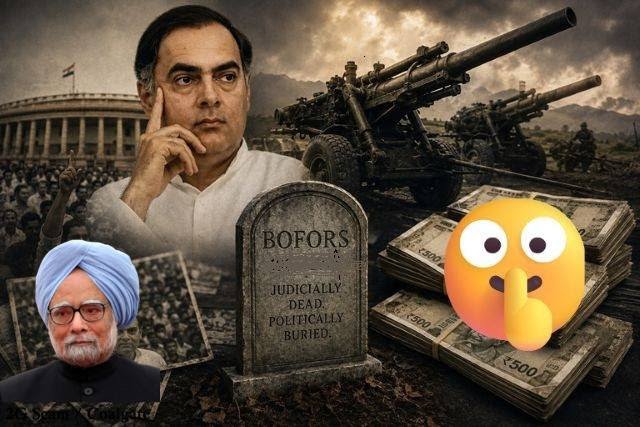
There was a time when the word “Bofors” needed no explanation. It was not merely the name of a Swedish gun. It was a political weapon, an election slogan and, for a generation, almost a synonym for corruption.
The Bofors deal was signed in 1986. When it became controversial and was debated in and outside Indian Parliament, at home and abroad, Rajiv Gandhi’s government acquired a political label from which it never recovered.
The ₹650 million kickback allegation became bigger than the gun itself. That amount would be peanuts today.
In the 1989 election, Bofors helped defeat a government with a formidable majority.
Forty years later, on July 29, the Supreme Court finally ended the long legal saga. The mainstream media almost ignored the news on a matter it had earlier pursued with great vigour. No explanation, no editorial comment. Not ‘news’ anymore, it was treated almost as an administrative obituary.
One might have expected fireworks. There is, instead, deafening silence.
That is curious. For decades, Bofors was treated as a national scandal of almost Biblical proportions, with international ramifications. All guns ablaze. Yet when its judicial afterlife finally reaches a dead end, the story seems to have lost its political ammunition.
Not even a recall that the much-maligned gun, which was accused of firing at those who fired, not at the target, had vindicated its purchase during the 1999 Kargil conflict. Another government was in office then. There is not even a lament about how the scam delayed India’s military preparedness, for which it still suffers.
The reason is simple. Those who once shouted “Bofors!” from the opposition benches, or their political successors, are in power today.
And the Congress, then in power and the principal accused, now in opposition, is too squeamish to claim a we-said-so high moral ground. Worried, perhaps, that it would attract counter-fire from political trolls who may be upset at the court verdict.
Politics, like history, has a remarkable capacity to change sides. And the politician, its principal player, is merely a product of the time.
Bofors, however, is not alone.
There was 2G.
The allocation of telecom licences under the UPA government (2004-2014) became one of the great scandals of the period.
The Comptroller and Auditor General’s much-publicised estimate of “a possible presumptive loss” of Rs 1.76 lakh crore became a figure too large for the collective imagination.
The Supreme Court subsequently quashed the licences, finding the allocation process arbitrary and unconstitutional. That was a serious judicial indictment of the policy.
But then came the other half of the story. In 2017, the special CBI court acquitted all the accused in the criminal case, holding that the prosecution had failed to establish the charges. But “2G scam” entered the political vocabulary and has stayed there.
So, what exactly was 2G?
An illegal allocation policy? Yes, according to the Supreme Court. A criminal conspiracy established against those prosecuted? The trial court said no. A political scandal? Undoubtedly. A shorthand for corruption? Absolutely.
But law has an inconvenient habit of asking questions that slogans do not.
Then came coal.
The allocation of coal blocks became “Coalgate”, another jewel in the expanding vocabulary of Indian political corruption. Dr Manmohan Singh, whose reputation for personal integrity was rarely questioned even by many of his political opponents, found himself drawn into the controversy because he had been in charge of the coal ministry for part of the period.
In March 2015, a trial court summoned him in the Talabira-II allocation despite the CBI having filed a closure report. The Supreme Court stayed the trial court’s summoning order on April 1, 2015, before he was required to appear.
Last month, the Supreme Court accepted the CBI’s closure report and set aside the summoning order. Again, the legal conclusion is more precise than the political slogan.
Of course, the Court did not declare that everything about coal allocation under the UPA was exemplary. Nor did it conduct a grand posthumous trial of Manmohan Singh. It only dealt with the specific case before it.
Months before this verdict, Singh had passed away. He had left office in 2014 with the hope: “I honestly believe that history will be kinder to me than the contemporary media or, for that matter, the parties in Parliament.”
But that is precisely the point: The political verdict on Singh had been delivered long before the judicial process had finished.
And here lies the larger Indian paradox.
An allegation requires a headline.
A political scandal requires a slogan.
A criminal case requires evidence.
But a court requires proof.
The first three can be completed remarkably quickly. The fourth may take decades, especially in India.
By then, governments change, parties change their line, political careers rise and fall, many accusers and the accused die —and yesterday’s critics may be today’s rulers.
This creates an awkward problem for those who once made corruption allegations the centrepiece of their politics. The graft allegations on the Rafael aircraft deal, which did not cut ice electorally earlier, may be headed for this in the future.
The dictum: When in opposition, every allegation is ‘urgent’. When in power, some allegations suddenly become “old cases” and are ignored. Or, “not in national interest” to discuss.
Yesterday, the question was: Why has justice taken so long?
Today, the answer sometimes seems to be: Why are you still talking about it? The more interesting phenomenon is to stay quiet. The volume changes, if and when needed.
Bofors made headlines for years. Its eventual judicial closure is now largely an archival event.
2G once seemed capable of swallowing the entire political system. The later acquittals are remembered much less loudly than the original allegation. That is the name of the political game.
Coal once threatened to bury the credibility of an entire government. Perhaps this is how political scandals acquire immortality.
The allegation survives.
The headline survives.
The election slogan survives.
The political consequences survive.
Only the accused and the evidence are eventually required to face the courts. Remember the Commonwealth Games scam?
There is an even deeper irony. The Congress cannot claim the moral high ground merely because some of these cases ended differently than the political narrative would suggest. Governments are certainly liable to be criticised for bad policy, poor judgment, and administrative failure, even when criminal charges do not succeed. Same for any other party or government.
But neither should a political allegation acquire the status of a judicial fact merely because it proved electorally useful and brings “people’s verdict.”
There is something deliciously contradictory in the transformation:
Yesterday, the opposition demanded that every allegation be treated as a matter of national importance. Today, the government discovers that some judicial conclusions are matters of archival interest. And media. Let it pass.
Perhaps that is the real lesson to be learnt from Bofors, 2G, coal and much more that is flying around in the political firmament and in public discourse.
India has often mixed three different things: a bad decision, an unlawful decision and a criminal conspiracy. Sometimes they overlap. Sometimes they do not.
Politics prefers the simple version.
Courts, inconveniently, do not.
There are no victors, and no vanquished in these ‘scams’.
The products – Bofors, the gun and the 2G, now advanced to 5G — which caused the scandals, meanwhile, remained curiously above politics. They have already survived several governments.
Perhaps India needs a new convention. Here is a modest proposal for the future.
Whenever a government changes, let the new government deal with the files of its predecessor, but not its slogans. Let “Bofors”, “2G” and “Coalgate” be placed in the same cupboard as the old election posters.
And firmly close that cupboard. Open it if and when history requires it. Otherwise, let the courts have the last word.
But that doesn’t happen.
With an Indian’s argumentative nature, and unending thirst for litigation, and the fate that once-explosive issues like anti-defection and anti-graft Lokpal laws have met, this plea would seem Utopian.

Mahendra Ved is a veteran Journalist and an Expert on international affairs.