

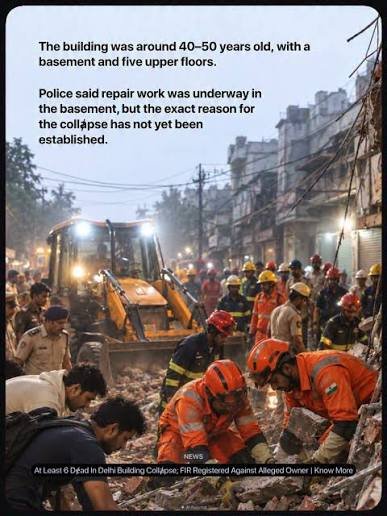
New Delhi, September 7, 2026— They came to Delhi to study, packed into tiny, windowless rooms stacked one atop another in a building that was never supposed to hold them. On Sunday, that building folded in on itself, and the students inside paid with their lives for a room that was never safe.
An eyewitness near the site told ANI the collapse sounded “like the rumble of an earthquake.” “We rushed out immediately; there was a lot of smoke and dust. The entire building had collapsed,” he said, recalling that he could hear students crying out from beneath the debris: “Save us, save us.” Of the roughly 16–17 people believed inside — mostly students, alongside a few labourers 12 were pulled out alive; seven ultimately died, five remain under treatment at AIIMS.
Among the dead was Akshat, an 18-year-old from Katni in Madhya Pradesh who dreamed of becoming an IAS officer. He had returned to Delhi just two days earlier after visiting home for Raksha Bandhan. “His body was identified by a scar on his leg,” said his neighbour, Vijay Kumar Rajak, who rushed to Delhi the moment he heard. “We are awaiting the post-mortem to be concluded.”
Akshat’s death exposes exactly the conditions students like him were forced to accept. Delhi University’s hostel capacity has never matched its enrolment, pushing thousands of outstation students into a private PG economy of matchbox-sized rooms renting for ₹15,000–18,000 a month cramped, often shared, and built on plots barely large enough for a single small house, let alone five floors of tenants.
That is precisely what happened here. A nearby shop owner said the property, held under a 100-year lease, had recently seen basement excavation carried out purely to expand the hostel and squeeze out more rental income. Delhi Police confirmed the structure was 40 to 50 years old. MCD’s own preliminary assessment found no sanctioned building plan, illegal basement construction, and no fire clearance violations that, on paper, should have triggered action long before anyone moved in. Two additional floors, residents say, were added illegally about two years ago. A civic official admitted authorities still cannot say for certain whether seepage from incessant rain or the unauthorised repair work caused the collapse only that both are likely.
None of this is unusual for Delhi. A Delhi High Court-appointed panel once found that at least 90 percent of the capital’s roughly 4.5 million structures carry some building-law violation. More than 64,000 unauthorised constructions have been flagged over recent years, with only a fraction ever demolished. Illegal construction here is not the exception it is close to the rule, and students, unable to negotiate or inspect what they rent, are among its most defenceless victims.
The enforcement gap is stark even in the MCD’s own numbers. As per Hindustan Times, the civic body identified 4,762 high-risk, old structures and issued notices to 4,571 but structural audit reports came back for only 1,155. Demolition followed in just 56 cases, retrofitting in 47. The MCD blames non-response from owners and the sheer scale of unauthorised colonies. But the deaths keep coming: 11 in Mustafabad in April 2025, six more a month later, seven in Jaitpur’s Hari Nagar in August 46 deaths from building collapses across Delhi between January 2024 and December 2025 alone, per HT. The starkest warning came in 2010, when the Lalita Park collapse killed 70 people; nearly eight years later, the junior engineer held responsible was fined just ₹21,000.
Owner Hariram Bansal remains untraceable despite a Look Out Circular and ten police teams hunting him. Five MCD officials have been suspended, a magisterial inquiry is underway, and MCD has again ordered action against illegal structures above four floors.
Delhi has the notices, the audits, the numbers, and now, again, the bodies. The only question left is how many more collapses it will take before its authorities finally wake up

Aspiring multimedia journalist. Dedicated to uncovering underreported community issues and transforming complex data into compelling human stories.

