

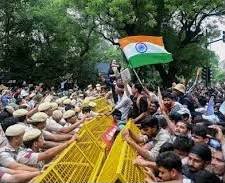
Heavy security, transit shutdowns and preventive arrests mark Saturday’s attempt to reach Jantar Mantar demanding CEC’s resignation
The national capital remained under an extensive security blanket on Saturday as police and central forces prevented a planned march to Jantar Mantar by the youth-led Cockroach Janta Party (CJP), supported by sections of the INDIA bloc and student groups. Demonstrators sought the resignation of Chief Election Commissioner Gyanesh Kumar, citing large-scale deletions during the Special Intensive Revision (SIR) of electoral rolls.
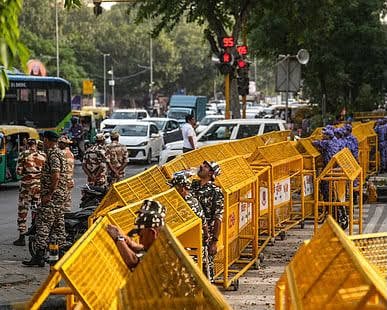
Authorities deployed tens of thousands of personnel, sealed key entry points, cancelled trains, shut metro gates and suspended mobile data in central Delhi. Despite the restrictions, small groups of protesters reached the area, leading to scuffles and preventive detentions. Hundreds were taken into custody across the city.
Fortress measures: Barricades, train cancellations and internet suspension
From early morning, New Delhi operated under heightened restrictions. More than 43,000 security personnel, including Central Armed Police Forces companies, were positioned across the capital. Multi-layer barricades, spiked strips and facial-recognition equipment were installed at major approaches such as Dhaula Kuan.
The Ministry of Railways cancelled over 250 local and long-distance trains bound for New Delhi and Hazrat Nizamuddin stations. Delhi Metro closed entry and exit gates at around 45 stations, including Rajiv Chowk, Central Secretariat, Patel Chowk, Mandi House and Kashmere Gate. Mobile internet and data services were suspended for 24 hours within a four-kilometre radius of the Janpath–Kartavya Path axis to disrupt coordination.
Police denied permission for the gathering, citing procedural issues and invoking Section 163 of the Bharatiya Nagarik Suraksha Sanhita, which restricts assemblies of five or more persons. Armoured vehicles, water cannons and Rapid Action Force units were stationed near Jantar Mantar and Connaught Place. Loudspeakers issued continuous warnings to disperse.
Leadership detained before the march could begin
Pre-emptive action focused on organisers and political supporters. CJP founder Abhijeet Dipke was detained at Delhi airport upon arrival from Mumbai, along with other party functionaries. National spokesperson Deepak Baliyan was taken into custody in Rajasthan as part of a wider multi-state operation.
Opposition figures who attempted to join the protest were also detained. Former Delhi Chief Minister Arvind Kejriwal was stopped outside his Lodhi Estate residence. West Bengal Chief Minister Mamata Banerjee, former Kerala Chief Minister Pinarayi Vijayan and former Tripura Chief Minister Manik Sarkar were among those taken into custody in separate incidents and transported in police vehicles.
A group of lawyers staging a demonstration near the Supreme Court was rounded up and taken to the Yamuna Sports Complex; they were later released after intervention by bar associations. Several independent journalists covering the events were briefly detained or pushed back from sensitive zones.
Small contingents of student activists, including members of the All India Students’ Association, managed to reach the protest vicinity, chanting slogans such as “Vote Chor, Gaddi Chhod.” Police physically moved them into waiting vans amid brief scuffles. Nearby at Janpath, a counter-gathering under the satirical “Lal Hit Janata Party” banner expressed support for the government and police, condemning the language used by the CJP and calling for action against those disrupting order.
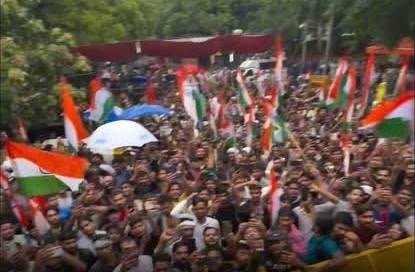
Root of the confrontation: Voter roll deletions and competing claims
The protests stem from the Election Commission’s Special Intensive Revision exercise. Opposition parties and civil society groups allege that the removal of roughly 130 million names from draft rolls across states and Union Territories has disproportionately affected certain communities and created an uneven electoral field.
A day earlier, INDIA bloc leaders submitted a memorandum to President Droupadi Murmu seeking the repeal of assembly election results from the past two years, citing alleged manipulation.
The Election Commission maintains that the revision is a routine administrative process to remove duplicates, deceased voters and those who have shifted residence, and that eligible voters wrongly deleted can re-enrol. Official data indicate the deletions include large numbers of relocated, untraceable and deceased electors. The scale of Saturday’s security arrangements reflected official concerns over the mobilisation’s potential reach.
Legal observers have questioned the proportionality of the restrictions, noting judicial emphasis on the distinction between reasonable regulation of public order and blanket curbs on the right to peaceful assembly.
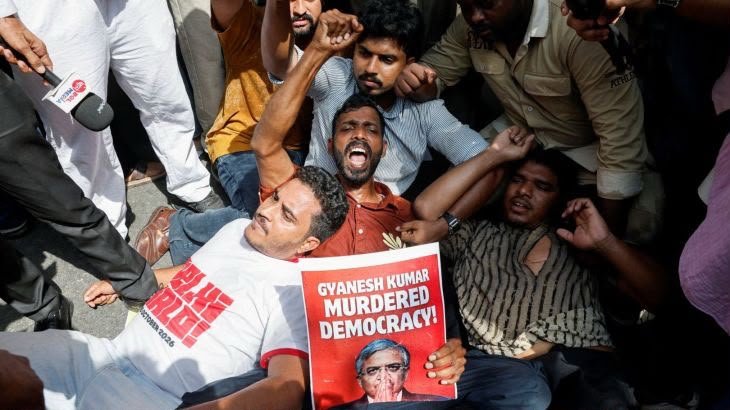
Aftermath and continuing agitation
By evening, central Delhi returned to a tense calm under heavy police presence. CJP organisers and allies indicated that the campaign would continue through decentralised actions in other cities, independent of detained leaders. Hundreds of protesters remained in temporary holding facilities across the National Capital Region as authorities and the judiciary face the task of managing the confrontation between state measures and civil society mobilisation.

~Hasnain Naqvi is a former member of the history faculty at St. Xavier’s College, Mumbai….
The opinions expressed here are solely those of the author.