
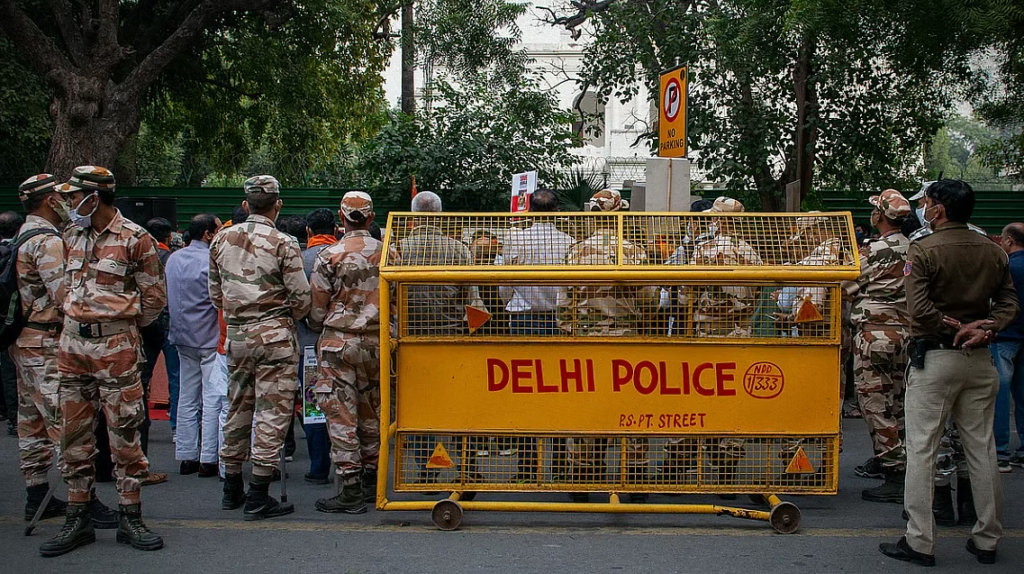
New Delhi, 10 October— With threats so imminent to its political survival by protests and agitations, a beleaguered Modi government took recourse to all possible tools of suppression to thwart the Cockroach Janta Party’s protest call demanding resignation of Chief Election Commissioner Gyanesh Kumar turning the Union capital into a Military cantonment.
Draconian measure unfolded on the streets of Delhi and even thousands of kilometres beyond India’s capital on Saturday as governments at the Centre and some states exercised all their might to keep students, youths, elderly politicians and India’s citizens from congregating to demand the resignation of Gyanesh Kumar.
India did not resemble the world’s “Biggest Democracy” today but a detention camp. October 10, 2026 will go down in the country’s history as the “Black Day” when country’s democracy was assaulted brutally and blundered.
Sealed borders, detentions from aircraft on landing at the airport, arrests from home, detentions en route to Jantar Mantar, internet shutdown and swarms of paramilitary and police personnel, was the picture for most of Saturday in the national capital, that was described variously as “New Pyongyang,” the “global capital of barricades” and sundry other such phrases.
“Total police mayhem on the streets of Delhi,” wrote The New York Times journalist Lydia Polgreen, with a video of cops detaining everyone they could.
The Narendra Modi government had made its intent clear on Friday, around 24 hours before the October 10 demonstrations, as New Delhi-bound trains were cancelled and passengers were picked from incoming trains and detained in states like Madhya Pradesh.
The administration deployed more than 26,000 personnel from the central paramilitary forces including the ITBP, SSB and BSF, which guard India’s international borders, along with Delhi police to stop the students and youths from reaching Jantar Mantar, the capital’s designated protest spot.
The Cockroach Janta Party spearhead Abhijeet Dipke and his associates Ashutosh Ranka and Saurav Das were met by a team from Delhi police inside an Air India flight soon after it landed at the Indira Gandhi International Airport.
“I have come to be arrested, arrest me… I am not afraid of you guys,” Dipke told the police officers who seemed to be accompanied by a team from a news channel seen as close to the ruling party.
Elsewhere in and around Delhi, YouTuber Dhruv Rathee and the CJP legal cell head Ratna Singh were detained from their residence, so were some social media influencers known for their opposition to the current dispensation.
Supreme Court lawyers were detained on the way to Jantar Mantar. Journalists were picked up from places far from the epicentre of the protest.
Detentions happened in Mumbai and Andhra Pradesh too. Mahatma Gandhi’s great-grandson Tushar Gandhi was picked up by Mumbai police from a spot near the Santa Cruz police station and brought to the DN Nagar police station in Andheri (West).
He was on his way to the historically significant August Kranti Maidan to demand the resignation of chief election commissioner Gyanesh Kumar, a demand raised by India’s main opposition parties and now supported by youths and students.
“Saans leta hoon to koi detain ho jata hai (If I take one breathe someone gets detained),” content creator Pulkit Kochar’s one-liner summed up the situation.
Neha Bora, the Left-organisation AISA’s leader and one of the faces of the movement against the former Union education minister Dharmendra Pradhan and now against the chief election commissioner Gyanesh Kumar, was detained while leading a march from Dilli Haat to Jantar Mantar, around 7 km away.
“I am in detention. The movement is not. People are assembling at Safdarjung flyover right now. If you can, reach, if you are stopped, sit down where you are and hold the line,” Neha wrote on her X handle.
The administration’s plan was to not allow the citizens, branded protesters, not to reach Jantar Mantar. Effectively, the protest area widened.
Four former chief ministers – Mamata Banerjee, Pinarayi Vijayan, Manik Sarkar and Arvind Kejriwal – were detained in Delhi.
Vijayan along with CPM general secretary M.A. Baby, Rajya Sabha MP John Brittas and other leaders were detained in the morning.
Mamata Banerjee was detained and allegedly taken aboard a prison van along with four MPs and another leader.
The former Bengal chief minister, who would often advise the opposition parties in Bengal to strap “leucoplast” on their mouths, put a piece of Band-Aid on her own mouth as a symbol of protest.
“We have decided to sit on a dharna here till 5pm to express our solidarity with them, because if we try to go there, they will not allow us to enter and may take us around Delhi in a vehicle, just as they are doing with Vijayan ji, we have received information that he has been taken around on the roads for nearly two hours, so it is better to sit here on the road and make our position clear. Our message is simple – save India and save democracy,” Mamata told the media in Delhi.
She said Delhi former chief minister Arvind Kejriwal was also not allowed to leave his residence. The AAP chief was met by a huge police contingent around 3pm and detained.
I do not think they should be doing all this, because by taking such actions, they are only making the protesters more popular. This has gone beyond an Emergency; it has become a super-emergency,” Mamata said. “Maintaining peace and remaining calm is the most important thing, but what they are doing is not right, neither for the country nor for its people.”
By afternoon, around 3,300 protesters had been detained all across Delhi, with 500-plus from Jantar Mantar area.Yet the display of raw courage was evident among India’s common peopl
Veteran Journalist and Political Commentator

