

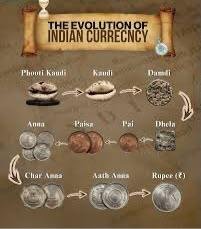
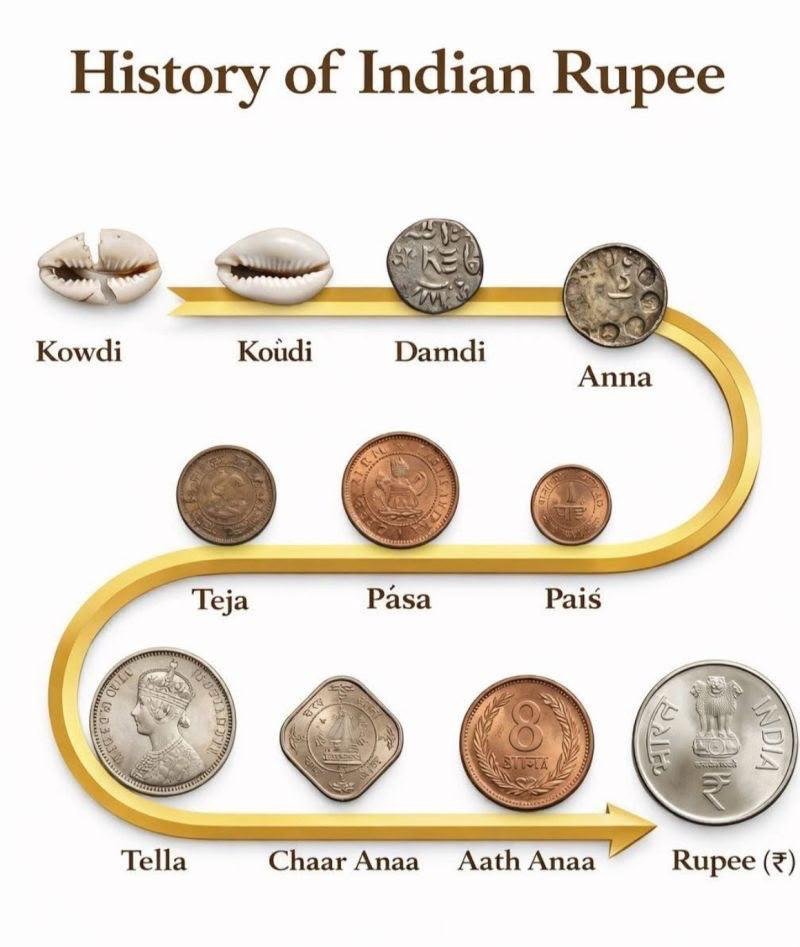
Ten years after the scrapping of Rs 1,000 and Rs 500 notes triggered unprecedented economic turbulence across India, the disruption serves as a timely reminder of how currency itself has constantly evolved. Long before modern banknotes and digital transfers, humanity spent millennia experimenting with what constitutes value.
Life Before Coinage
Before metallic money was invented around the 7th century BC, early civilisations in Mesopotamia, Egypt, China, and the Indus Valley relied on the barter system. Communities exchanged commodities directly—ranging from cattle, food grains, and precious stones to seals, tea bricks, and tobacco.
Certain items eventually emerged as widely accepted mediums of exchange:
- Shells: Ancient Sumerians used cone-shaped shells, while cowrie shells became an international currency across the Indian Ocean, Asia, and Africa.
- Salt: Used as currency in ancient China and Abyssinia, salt also paid the wages of Roman soldiers. Their allowance, known as salarium, gave the English language both the word “salary” and the idiom “true to the salt.”
- Tool Money: Around 1000 BC, the Chinese began casting tiny bronze knives and spades to serve as trade tokens.
The Birth of Standardised Coins
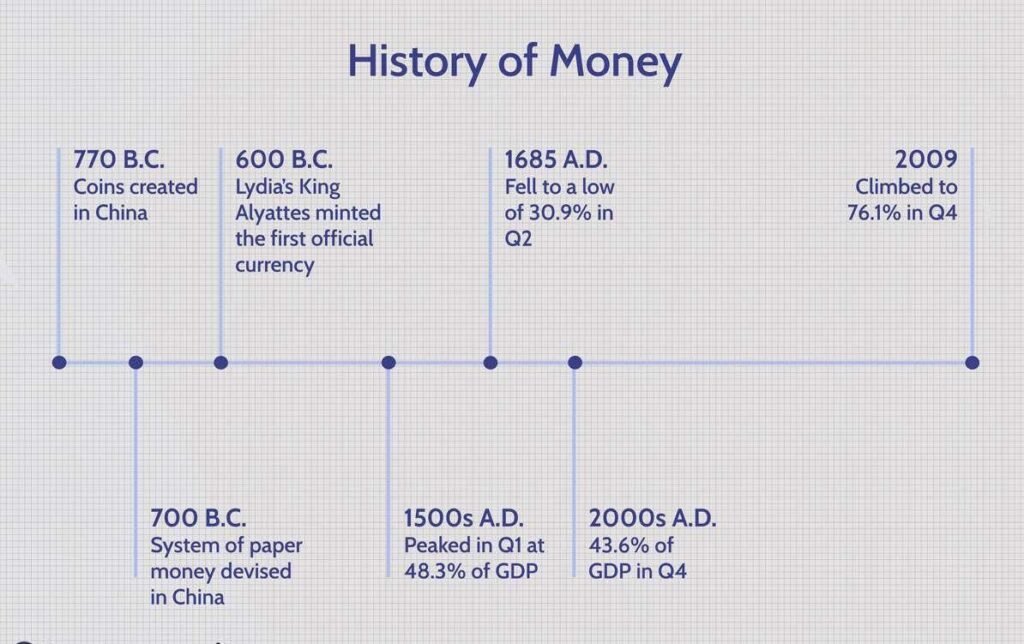
True coinage originated around the 7th century BC in Lydia (modern-day Turkey), where merchants stamped lumps of electrum—a naturally occurring alloy of gold and silver—with a single punch to certify weight and purity.
The innovation spread rapidly. Ancient Greece introduced silver staters across city-states like Aegina, Corinth, and Rhodes, followed by the gold coinage of Philip II and Alexander of Macedon. By 269 BC, the Roman Republic had established a structured system of bronze, silver, and gold coins that eventually spread throughout Europe. In the Middle Ages, issuing authorities began enforcing uniform weights to fix coin values across borders.
The Rise of Paper Currency
Paper money first appeared in China around 1000 AD as Jiaozi—promissory notes circulated by merchants—before the Chinese state officially began issuing banknotes in 1189 AD. Later, the Mongol ruler Kublai Khan introduced the world’s first fiat token currency, backing paper notes with imperial authority rather than precious metal.
India’s Monetary Journey: Punch-Marks to the Rupaiyya
In the Indian subcontinent, trade during the Harappan Age and the early Vedic period ran on barter, using cattle, grains, and seals. By the later Vedic period, measured pieces of metal known as Nishka and Satamana began bridging the gap toward true currency.
- The First Coins (6th Century BC): Coinciding with the rise of the Mahajanapadas and India’s second urbanisation, punch-marked silver and copper coins appeared in the Gangetic plains. Stamped with motifs like hills, trees, bulls, and elephants, these coins—especially those bearing the peacock, hill, and crescent—later served as the imperial currency of the Mauryan Empire.
- Royal Portraits and Gold (2nd Century BC – 4th Century AD): The Indo-Greek rulers were the first in India to issue gold coins and standardised currency bearing royal portraits. The Kushans under Kanishka expanded gold coinage on a massive scale, while the Satavahanas of the Deccan minted coins in lead, potin, copper, and bronze. The Gupta Empire later reached a golden peak, issuing vast numbers of gold Dinaras, alongside notable coinages from King Harshavardhana and the Chola dynasty in the south.
- The Sultanate and Mughal Eras: In the 13th century, the Delhi Sultans introduced Tankas, Dinars, and gold Mohars inscribed with Islamic calligraphy and dates. In the 14th century, Sultan Muhammad bin Tughlaq attempted to replicate Kublai Khan’s token currency using brass and copper coins, though widespread counterfeiting doomed the experiment. In the 1540s, Afghan ruler Sher Shah Suri introduced a standardised silver coin called the Rupaiyya—the direct ancestor of the modern Rupee—which the Mughals, Marathas, and southern kingdoms like Vijayanagar and Bahmani built upon.
Colonial Shifts and Modern India
Although Mughal coins remained in circulation until 1857, the British Crown’s takeover in 1858 brought coins bearing the portraits of British monarchs and introduced India’s first official paper currency in the late 19th century.
Following Independence, India replaced colonial money with its own sovereign currency, which has continued to adapt to modern economic demands:
- Decimalisation: In the late 1950s, India phased out the traditional system where 16 annas equalled one rupee, introducing the decimal naya paisa (in 1, 2, 3, 5, 10, 25, and 50 denominations), most of which were gradually withdrawn between the 1980s and 2000s.
- Demonetisation: High-denomination notes were periodically withdrawn to curb illicit wealth—first in 1954, again in 1978, and most dramatically a decade ago.
From cowrie shells and stamped silver to modern banknotes, the physical form of money has continuously transformed—even as its core purpose as a vessel of human trust remains unchanged.

~Hasnain Naqvi is a former member of the history faculty at St. Xavier’s College, Mumbai….
The opinions expressed here are solely those of the author.