

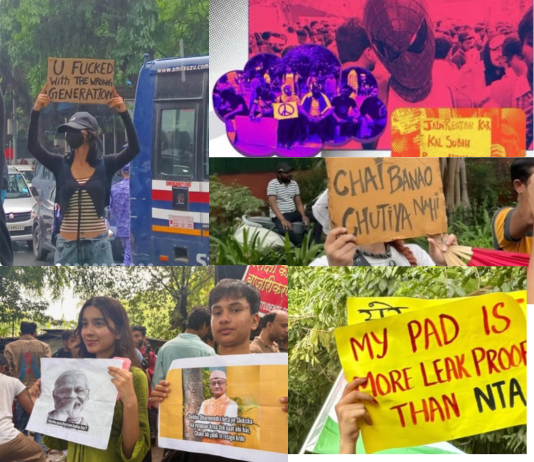
At Jantar Mantar and beyond, India’s Gen Z has turned dissent into a sharp, funny, and highly shareable language of protest. Their placards, reels, memes and slogans suggest that politics is now being argued as much through internet culture as through conventional street speeches.
A protest that speaks meme
The new protest vocabulary is not built around sober platitudes or inherited revolutionary rhetoric; it is built around punchlines, pop references and the idioms of scrolling. At the Jantar Mantar demonstrations linked to exam leaks and education anger, posters such as “Everyone is gangsta, until the cockroaches start flying” and “Kuchupuchu tum resign dedo na” captured attention precisely because they sounded like the internet talking back to power. The same reports describe cockroach costumes, Spider-Man and Batman cameos, and reels designed to travel as fast as the protest itself.
The result is a kind of street theatre that is both political and algorithmic. A placard is no longer just a placard; it is a screenshot waiting to happen, a caption waiting to be clipped, and a joke waiting to become a verdict.
The politics of tone
This new lingo matters because tone has become part of the argument. Ravish Kumar, in his recent episode on Gen Z language, argued that the protest vocabulary now being seen at Jantar Mantar reflects a break from the older, more formal political Hindi that once dominated public life. He points out that the language of these protests is rooted in the immediacy of today, not in the nostalgia of a glorified yesterday. In that sense, the humour is not a distraction from politics; it is the politics.
That shift is visible in the way young protesters mix English, Hindi, slang and irony without apology. One poster on the Chandigarh student protest carried the line “You can’t gaslight an entire Gen,” while another said, “Our futures weren’t lost. The government leaked them for profit”. The point is not grammatical purity; it is emotional precision. Gen Z is not trying to speak like a press release. It is trying to sound like itself.
Why humour hits
Humour gives the movement speed, reach and bite. A dry slogan may persuade a crowd, but a meme can leap across feeds, cities and social classes in hours. The Hindustan Times report on the Jantar Mantar protests notes that the posters and reels are “funny, irreverent, innovative and usually offensive,” with the site itself resembling a phone screen brought into public space. That is not accidental; it is a communication strategy born in the age of short videos, stickers, GIFs and viral audacity.
The joke, however, is not empty. It works because it carries grievance inside it. “Resign” becomes a meme, exam anxiety becomes satire, and political frustration is packed into a one-line visual insult. In the process, the protester gains something that older protest forms often lacked: shareability without surrendering anger.
Posters as public speech
The handmade poster has become Gen Z’s most democratic media asset. It is cheap, instantly legible, and capable of being hilarious, rude, tender or furious in the same frame. In the Jantar Mantar and Chandigarh protests, posters have mocked ministers, education policy and official promises with a kind of literary speed that would make the speechwriters nervous. They are public speech in its most compressed form.
What makes these posters effective is their hybridity. A single board may contain a film reference, a campus joke, a political demand and a punchline that only makes full sense to those who live online. That hybridity is not confusion; it is the new vernacular. If older protest language borrowed from pamphlets and party lines, Gen Z borrows from memes, OTT culture and the grammar of comments sections.
What the state hears
The state is being addressed in a language it cannot easily discipline. Traditional power understands slogans, marches and memoranda; it is less comfortable when confronted with sarcasm, absurdity and remix culture. Ravish Kumar’s episode suggests that this is exactly where the rupture lies: a generation that has rejected the solemn, inherited language of authority and replaced it with a looser, sharper, more volatile register. The irony is that this register often sounds irreverent precisely because it has lost faith in reverence itself.
That does not mean the protest is frivolous. On the contrary, the jokes sharpen the critique. When a poster says the government “leaked” futures for profit, it compresses institutional failure into a line that travels faster than any manifesto. When a meme turns resignation into toddler-talk sarcasm, it reduces authority to something that can be laughed out of its pedestal. In political communication, that is a serious injury.
A new public language
What is unfolding at Jantar Mantar and across other protest sites in India is more than a stylistic shift. It is a change in who gets to sound political, how dissent is packaged, and which emotions count as legitimate public speech. Gen Z is refusing the old fear that politics must always sound grave to be authentic. It is showing that a joke can be a weapon, a poster can be an argument, and a meme can be an indictment.
The larger lesson is linguistic and democratic at once. Languages change when people change, and public language changes fastest when a generation decides that the old vocabulary no longer fits its reality. Gen Z is not vandalising expression; it is redesigning it in real time. If the authorities want to understand this movement, they may need to stop listening for slogans and start reading the captions.
The Education Minister Dharmendra Pradhan’s resignation is just the beginning of the impact of the Gen-Z’s new method of protest!

~Hasnain Naqvi is a former member of the history faculty at St. Xavier’s College, Mumbai….
The opinions expressed here are solely those of the author.

