

From the ramparts of history, a call that blurs security and dissent
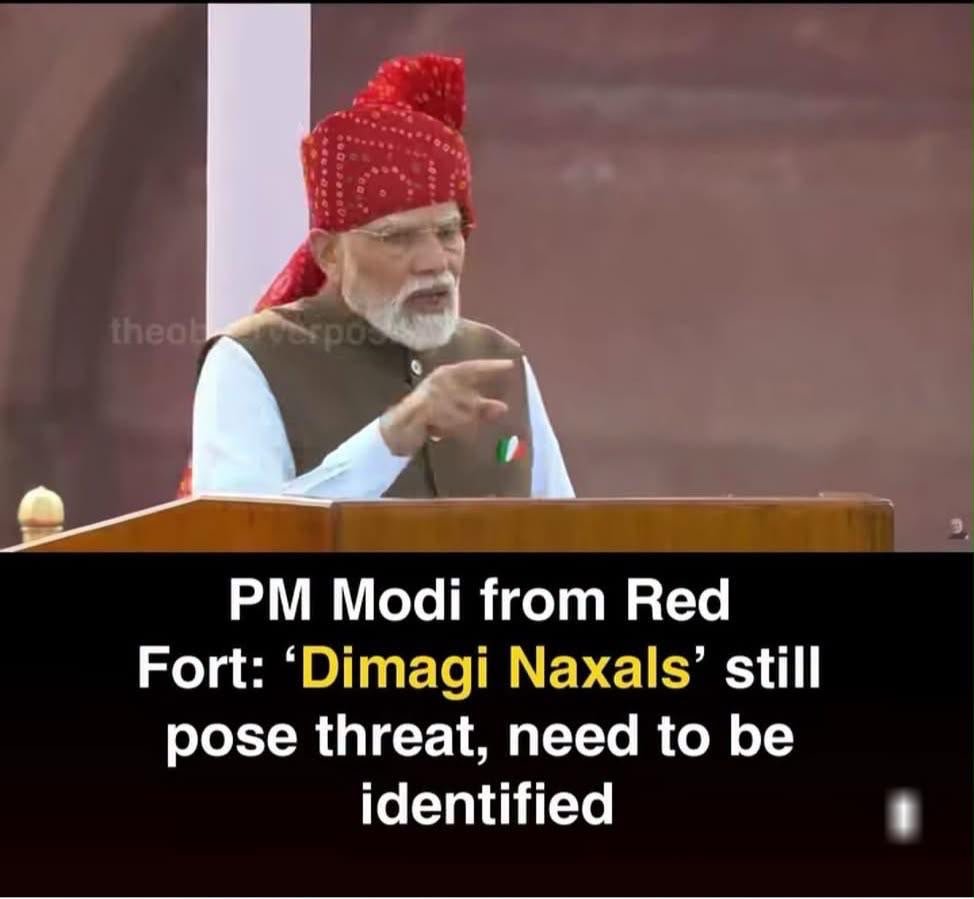
On the morning of India’s 80th Independence Day, Prime Minister Narendra Modi stood once more on the ramparts of the Red Fort and delivered a speech that mixed the familiar cadence of developmental ambition with a sharper, more disquieting note. Amid announcements of AI training for a crore of youth, free coaching, and a seven-stream “Saptadhara” framework for national progress, he turned to the long war against Left-wing extremism. Armed Naxalism and Maoism, he declared, were “breathing their last.” The forests that once rang with gunfire now flew the tricolour of development. Yet a residual threat remained: the “dimagi Naxals”—those with a Naxal mentality—who, he said, still lurked, “looking for ways of violence and anarchy,” seeking opportunities to drag society onto the wrong path. They must be identified and isolated so that the nation’s youth could be steered into the mainstream of building a developed India.
The phrase was new. The impulse was not. For years the ruling dispensation has spoken of “urban Naxals,” “tukde-tukde gang,” and “Andolanjeevis.” Each label has served as a portable category into which critics, activists, academics, and opposition voices could be dropped. “Dimagi Naxal” simply updates the vocabulary, shifting the emphasis from the street and the campus to the realm of thought itself.
The Prime Minister recalled that people with Maoist thinking had once occupied places in government committees and influenced policy. The armed cadres in the jungles had been dealt with; the intellectual residual must now be confronted.
Security achievement or political reframing?
There is little dispute that Left-wing extremism has been substantially degraded. Successive governments, and especially the post-2014 security architecture, have reduced the physical footprint of Maoist violence. Thousands of security personnel have died; large tracts once under effective Naxal control have returned to civilian administration. To claim that the gun is being silenced is not propaganda; it is measurable. The difficulty arises when the residual ideological problem is framed as an ongoing conspiracy that requires not only vigilance but active isolation by the citizenry.
Isolation is a strong word. In a constitutional democracy it carries connotations that go beyond ordinary political contestation. It suggests social quarantine, the drawing of boundaries around ideas and the people who hold them. When uttered from the Red Fort on Independence Day—the most solemn national platform—the call acquires a different weight. It is no longer a partisan speech in Parliament or a campaign rally. It becomes an official diagnosis of the nation’s internal health, delivered by the head of government to the people.
Opposition parties responded with predictable fury. Congress leaders described the remark as a “sure sign of desperation,” a continuation of the earlier “urban Naxal” tag now applied to anyone who questions the government. P. Chidambaram declared himself proud to be a “dimagi Naxal.” Jairam Ramesh noted that the Prime Minister has a habit of first denouncing proposals as the product of such minds and later adopting them. CPI(M) and other Left voices argued that the label was aimed at youth who had recently protested examination irregularities and forced the resignation of a Union minister—protests that the Independence Day speech conspicuously did not address. The charge was that dissent itself was being pathologised.
The government, through Parliamentary Affairs Minister Kiren Rijiju, later clarified that the term was not directed at opposition leaders who accept the Constitution, but at those who support Maoists, reject the constitutional order, stand with separatists, or seek to sever the North-East. The clarification attempts to narrow the category. Yet the original speech offered no such precise taxonomy. It spoke of people “looking for ways of violence and anarchy” and of the need to identify and isolate them so that youth could be brought into the developmental mainstream. Ambiguity, in political speech, is rarely accidental.
The deeper pattern: labels as instruments of governance
What is at stake is not merely a rhetorical flourish. The repeated invention of pejorative categories performs a political function. It collapses the spectrum of legitimate disagreement into a binary of national and anti-national, constructive and destructive, mainstream and deviant. Once an individual or group is successfully placed inside the deviant box, ordinary democratic tools—argument, evidence, protest—lose their force. The conversation shifts from the merits of a policy to the character of the critic.
This is not unique to the present government. Every political system that feels under pressure reaches for moral and security language to discipline its opponents. The difference lies in the consistency and the institutional reach with which the present dispensation has pursued the project. From universities to civil society organisations, from student movements to independent media, the charge of ideological contamination has been used to justify scrutiny, funding cuts, and legal processes. “Dimagi Naxal” extends the logic one step further: it targets the mind before the act.
There is an irony here that should not be lost. The same speech that warned against intellectual Naxals also placed youth at the centre of the developmental story—AI skills, free coaching, a vision of Viksit Bharat by 2047. Youth are simultaneously the hope of the nation and the potential carriers of dangerous ideas. The solution offered is not deeper engagement with their grievances, but isolation of those who might “mislead” them. The recent wave of student and aspirant protests over examination integrity and employment anxiety is thereby reframed: not as a governance failure requiring institutional reform, but as possible evidence of ideological infiltration.
Constitutional costs and democratic health
A mature democracy must be able to distinguish between violent extremism and robust, even radical, critique. Maoist ideology that rejects the constitutional framework and glorifies armed struggle is one thing. Sharp criticism of economic policy, educational failure, or the concentration of power is another. When the state begins to treat the second as a variant of the first, it risks hollowing out the very constitutional order it claims to defend.
The Opposition’s darker warning—that successive labels pave the way for one-party dominance and eventual authoritarianism—may be overstated for partisan effect. India retains competitive elections, a free press that still bites, and an independent judiciary that occasionally checks executive excess. Yet the cumulative effect of securitising dissent is real. It chills speech, encourages self-censorship, and teaches citizens that the safest posture is silence or enthusiastic conformity. Over time, the space for genuine political imagination shrinks.
Independence Day is supposed to celebrate the hard-won right to speak, to disagree, and to hold power to account. When the nation’s highest platform is used to invite the public to identify and isolate those whose thoughts are deemed dangerous, the celebration acquires an uncomfortable edge. The Red Fort has heard many calls to unity. Few have sounded quite so much like a summons to internal surveillance.
The armed Naxal may indeed be in retreat. The larger question is whether the republic will treat the residual challenge as a problem of security and ideology that requires isolation, or as a problem of democratic vitality that requires argument, evidence, and the confidence to let uncomfortable ideas compete in the open. The speech from the ramparts has chosen its answer. The country must now decide whether that answer strengthens the republic or quietly diminishes it.

~Hasnain Naqvi is a former member of the history faculty at St. Xavier’s College, Mumbai….
The opinions expressed here are solely those of the author.