

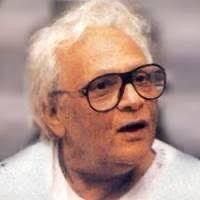
On September 1, 2026, India marks the beginning of birth centenary celebrations of Dr Rahi Masoom Raza (1927–1992), a writer whose pen gave voice to the common man, shaped the language of myth on television, and turned Bollywood dialogue into poetry with a moral compass. In an age of polarisation, his life and work remain a quiet but insistent reminder that pluralism is not an abstraction but a lived ethic.
A childhood forged in illness and stories
Rahi Masoom Raza was born on September 1, 1927, in Gangauli (also spelled Ganguali), a village on the banks of the Ganga in Ghazipur district, Uttar Pradesh. His early years were shadowed by polio and, later, tuberculosis; at 11, a prolonged convalescence from TB kept him away from school and immersed in books from his family’s library. He would later credit Kallu, a family servant who narrated folk tales, with igniting his imagination, once saying that without him he might never have become a storyteller.
Aligarh: the “Byron” with a progressive conscience
After recovering his health, Raza pursued higher education at Aligarh Muslim University (AMU), where he earned a doctorate in Hindustani literature and joined the faculty as a lecturer in Urdu. On campus he acquired the nickname “the Lord Byron of Aligarh,” remembered for his immaculate white sherwani, a certain nonchalance, and a charisma that drew students and peers alike. Yet what set him apart was not style alone but a deepening commitment to progressive, secular ideals; he wrote prolifically for campus publications and forged friendships that cut across religious and class lines, laying the groundwork for a worldview hostile to communal barriers.
The novelist of the “half village” and the ordinary Indian
Raza’s literary reputation rests on novels marked by psychological depth, social critique, and an abiding compassion for the marginalised. His 1966 novel Aadha Gaon (Half a Village) is widely regarded as a twentieth-century masterpiece, often discussed alongside Premchand’s Godan and Yashpal’s Gunahon Ka Devta for its unflinching realism. Set in a Shia-dominated village that mirrors his own Gangauli, the book explores intra-Muslim rivalries, caste and gender hierarchies, and the disorienting impact of Partition on those who chose to stay. Rather than a polemic on nationhood, it is a portrait of everyday life where shared customs and local loyalties make the logic of religious nationalism appear illogical to the villagers themselves.
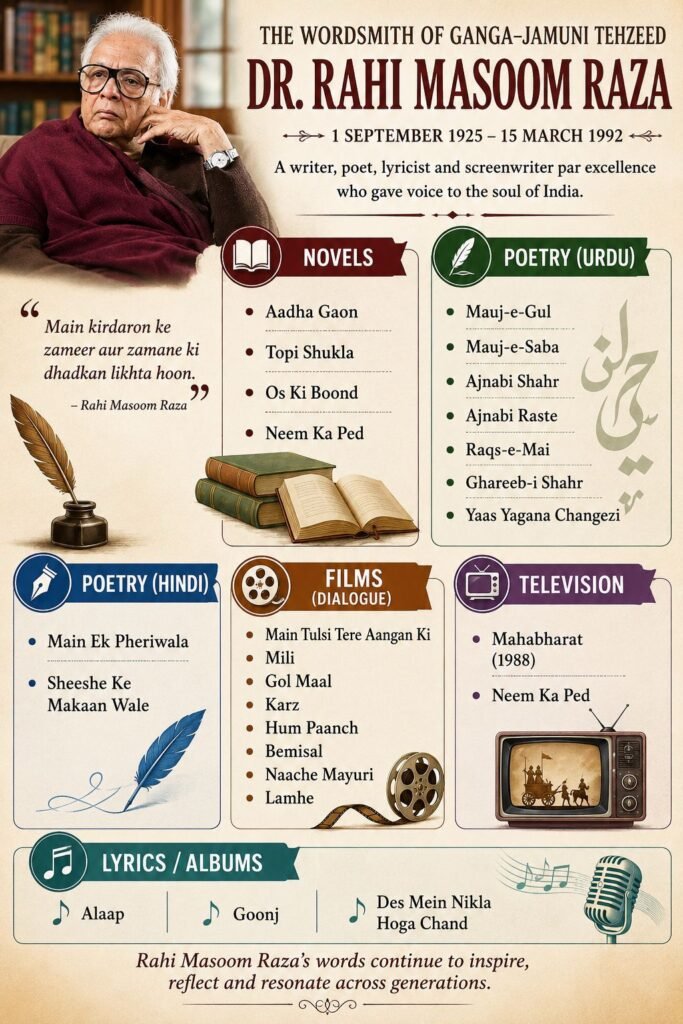
Other major novels—Topi Shukla, Os Ki Boond, and Neem Ka Ped—extend this concern with feudal decay, rural aspiration, and the resilience of ordinary Indians. In Topi Shukla, for instance, a child’s perspective exposes the absurdity of religious prejudice, while Neem Ka Ped casts light on peasant struggles and heartbreak.
A poet in two languages
Though best known as a novelist and screenwriter, Raza was first and foremost a poet, publishing in both Urdu and Hindi. His Urdu collections include Mauj-e-Gul Mauj-e-Saba (1953), Ajnabi Shahr, Ajnabi Raste (1965), Raqs-e-Mai, Ghareeb-i Shahr (1992), and Yaas Yagana Changezi (1967). In Hindi he brought out Main Ek Pheriwala and Sheeshe Ke Makaan Wale, among others, extending his lyric sensibility into the idiom of the street and the workplace. Across languages, his verse is marked by a humane tone, a sharp eye for social detail, and a refusal to let identity narrow the scope of empathy.
Bombay: when dialogue became literature
Raza’s move to Bombay in 1967 transformed him into a household name, though he had already written under the pen name “Shahid Akhtar” for the magazine Rumani Duniya. In Hindi cinema he fused poetic lyricism with cinematic realism, making dialogue a vehicle for social commentary, family drama, and wit. He won the Filmfare Best Dialogue Award for Main Tulsi Tere Aangan Ki (1979), and later received posthumous Filmfare honours for Mili and Lamhe.
His filmography reads like a map of popular Hindi cinema’s moral imagination: Mehmaan (1971), Mili (1975), Gol Maal (1979), Karz (1980), Hum Paanch (1980), Bemisal (1982), Naache Mayuri (1986), and Lamhe (1991), among many others. Whether crafting the gentle comedy of Gol Maal or the ethical tensions of Lamhe, he kept the language grounded in how people actually speak while lifting it just enough to carry a larger idea.
Mahabharat: a Muslim writer and a Hindu epic
No account of Raza’s legacy can omit his epochal work as the dialogue and screenplay writer for B.R. Chopra’s 1988 television Mahabharat. When approached, he initially demurred, citing the scale of the task and his age; anecdotal accounts suggest it was the line “Main Samay Hoon…” that ultimately drew him in. Once news spread that a Muslim writer would script a cornerstone of Hindu mythology, extremist groups protested on sectarian grounds, and Raza received communal letters questioning his right to interpret the epic.
He responded by reaffirming his identity as a “son of the Ganga,” insisting that no one was better equipped to portray India’s civilizational ethos. His dialogues became legendary: the formal modes of address—“Matashree, Pitashree, Bhratashree, Tatshree”—and the seamless blending of Sanskrit terms with Hindi set a new standard for mythological storytelling. The serial’s staggering popularity was matched by an outpouring of letters, with praise vastly outnumbering abuse, restoring his faith in India’s communal harmony.
Television beyond the epic: Neem Ka Ped and the song that travelled
Raza’s influence on television was cemented anew with Neem Ka Ped, adapted from his novel and starring Pankaj Kapur and Nimay Bali. Here too his pen gave voice to rural India’s struggles, casting light on peasants’ aspirations and heartbreak. The theme song, written by Nida Fazli and sung by Jagjit Singh, became an anthem for viewers across the country. He also wrote lyrics for dozens of films and collaborated with Jagjit Singh on the album Des Mein Nikla Hoga Chand, extending his lyrical reach beyond the screen.
A secular ethic tested by polarisation
Throughout his career, Raza remained committed to a vision of India free from hate and division. His writings, public pronouncements, and personal choices—including his marriage to Nayyar Jahan, with whom he shared a love of literature and social causes—embodied this secular, inclusive ethos. His autobiographical work, Chotey Aadmi Ki Badee Kahaani, reveals both his humility and his steadfast identification with the common man, untainted by religious or class hierarchies.
Yet he was often denied belonging by zealots from both minority and majority communities. “People of my religion tell me he is not Muslim and people of other religions say he is Muslim, but no one asked me what I am,” he observed wryly. If ever there was a writer whose life and work embodied the spirit of Indian pluralism, secularism, and creative independence, it was Raza.
Family, legacy, and the centenary moment
Raza passed away in Bombay on March 15, 1992, leaving behind a literary and cinematic legacy that continues to resonate. His son, Nadeem Khan, became a noted film director and cinematographer, further extending the family’s artistic legacy; pop singer Parvati Khan, who married into the family, is another testament to their cosmopolitan bonds.
In today’s literary-political climate—marked by identity politics, polarisation, and debates over national culture—Raza’s example is both an inspiration and a challenge. His robust humanism, refusal to be pigeonholed by religion, and ability to narrate the Indian story from the standpoint of empathy and justice are more vital now than ever. As India remembers the Ganga’s son on his birth centenary, his insistence that the number of those with goodwill far outstrips the purveyors of hate is a lesson worth recalling, preserving, and celebrating.
PS: While some sources list August 1 as his birth date, Dr. Rahi Masoom Raza Sahitya Academy, Lucknow, and most authoritative references observe September 1, the date now widely accepted for centenary
commemorations.

~Hasnain Naqvi is a former member of the history faculty at St. Xavier’s College, Mumbai….
The opinions expressed here are solely those of the author.