
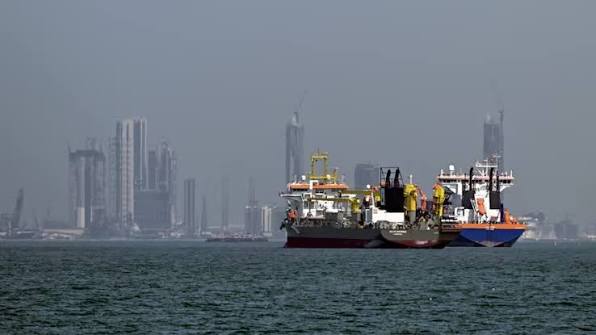
Known facts are being overlooked, if not conveniently forgotten. They need to be recalled when the third round of the War on Iran is raging, making the Strait of Hormuz the “water zero”, like the “ground zero” of military and diplomatic conflict, a term coined during another Gulf War.
Perhaps, they will give a better perspective to millions suffering, with no end to misery and destruction.
Take India’s past links with Hormuz first. They span over a millennium, originating in the medieval era when Gujarati merchants flocked to the Kingdom of Hormuz and dominated the lucrative trades. By the 16th century, these cultural and economic ties had deepened despite Portuguese colonisation and later British-Safavid alliances.
From the 13th to the 15th centuries, the Kingdom of Hormuz was the most vital commercial maritime stopover connecting India, Persia, Arabia, and East Africa. The Indians also formed a massive expatriate population on the island. These traders, mainly Gujaratis, exchanged textiles, spices, and crucially, horses, which were shipped from the Gulf to India to supply the cavalry of various Indian kingdoms.
Historical records of 1264 CE confirm this deep integration. One details the construction of a mosque in Gujarat financed by merchants operating out of Hormuz.
Then came the Europeans, first as traders, but eventually as conquerors and colonisers. In 1515, the Portuguese Empire seized control of Hormuz Island, transforming it into a fortified toll point. Indian traders adapted to the new administration and continued to handle the majority of the trade as well as the local commerce.
The Europeans transformed Hormuz and its trade as they competed for dominance. By 1622, the English East India Company, allied with the Dutch and Safavid Persia, ousted the Portuguese and significantly altered the Strait’s geopolitical landscape.
Throughout these European shifts, Indian financiers and merchants remained the economic backbone of Gulf ports. They financed the warring groups for protection. Once the Europeans colonised India, they were content to use their economic clout to build temples and negotiate religious privileges, like bans on cow slaughter in public.
Hormuz was British India’s “Imperial Lake”. By the 19th and 20th centuries, the British Royal Navy became the primary force in the Persian Gulf, administered primarily from India, policing against piracy and maintaining telegraph lines. The treaty relations with Gulf states were handled out of then-Bombay and New Delhi. Indian currency (the Gulf Rupee) and postal stamps were used throughout the Gulf well into the mid-20th century. As the British vacated, the Americans gradually took over.
Today, India imports a fifth of its energy through the Hormuz Strait and, as is happening now, suffers each time the region undergoes military and economic convulsions. China, the other big consumer, by comparison, accesses 40 per cent of its energy needs. So do South and Southeast Asia.
The world is struggling to find ways to escape this. Massive plans are being considered. India is reportedly considering a 2,000 km-long underwater pipeline from Oman to Gujarat, estimated to cost Rs 40,000 crores. But the government has denied such reports.
In this grim hour, we also need to recall that the US-Iran relationship, which is rocking the global economy today, had blossomed for many years. Indeed, until World War 2, Iran was able to counter the predatory influence of the European powers, particularly Britain and Russia, with America as the “third force.”
We also need to recall that long before the 2 World Wars and the Cold War that followed in the last century, there was the “Great Game” of Imperial powers, when the Britain-led West sought to prevent the Czarist Russia from entering the Indian Ocean. Iran and Afghanistan were most coveted due to their strategic location. Does anyone remember that Iran was able to ‘balance’ its position in the region with American help?
The American role escalated largely after the 2nd World War. The communists’ emergence in China added to fears about the world going communist and fed the Cold War. It brought America and Britain together against Russia, which has a common border with Iran.
When Mohammed Mossadeq was elected the prime minister, Iran nationalised the British-Iranian oil company. The British planned to retaliate by attacking Iran, but US President Harry S. Truman pressed Britain to moderate its position in the negotiations and not invade Iran.
American policies fostered a sense in Iran that the US supported Mossadeq, along with optimism that the oil dispute would soon be resolved through “a series of innovative proposals” that would provide Iran with “significant amounts of economic aid.”
Records say Mossadeq visited Washington, and the American government made “frequent statements expressing support for him.” Yet, “unknown to Truman, the American CIA and the British MI6 collaborated to remove him.”
Shah Mohammed Reza Pahlavi became America’s greatest supporter. Tehran became a highly westernised city. Over 800,000 Iranian students studied in America.
The US-Iran relations hit rock bottom 47 years ago when the Shah was ousted, and Iran witnessed the advent of an Islamic Revolution. The US failed to rescue its citizens held hostage, and with that came economic sanctions and enmity that persists today.
Today, when Iran’s oil and its nuclear programme are being targeted with missiles and drones, we need to be reminded that the US once helped Iran’s nuclear programme and indeed, the building of the first nuclear reactor. And that Iran was the founding member of OPEC, the West-backed cartel of oil-exporting countries. Iran dominated the oil scene, and most of the energy movement was through Hormuz.
This is an extremely brief, even sketchy, recall of a long history of how national interests and geopolitics change relationships. Today, as the world suffers, it is futile to sit in judgment over who is right and who is not.

Mahendra Ved is a veteran Journalist and an Expert on international affairs.