
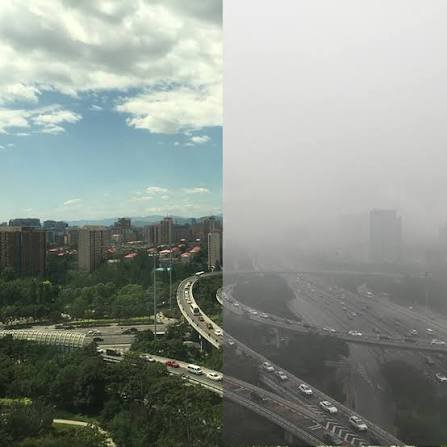
NEW DELHI: The average Air Quality Index (AQI) in New Delhi climbed to a dangerous level of 563—suffocating residents and covering the city in deep haze. About 3780 kilometers away in Beijing on November 13, the AQI was below 170, which was still unhealthy, but a drastic improvement for a city that regularly experiences AQI above 700 in winters of 2013-14.
Beijing was able to achieve this turnaround not through short-term emergency closure but through massive changes in energy consumption, industry and transport in a multi-billion Yuan campaign over several years.
Previously considered as the “King of Bicycles” in the world, the rapid development of the Chinese economy has replaced pedal power with engines, factories and heating systems.
By January 2013, smog in Beijing became so severe that high-rises disappeared behind thick grey clouds of smoke and multiple observers created the term ‘Chinese haze’. As stated by the World Bank, PM2.5 levels in Beijing reached 569 μg/m3 in 24 hours, which was similar to the levels in Delhi in November 2017 at 576 μg/m3.
The residents experienced burning eyes, asthma attacks, and problems in breathing. The Country’s Council started the Action Plan for controlling the pollution in the air in September 2013, aimed at decreasing the PM2.5 levels by 25% in Beijing by 2017 and alleviating pollution.
Four main things were responsible for the success of improvement in air quality.
Firstly, the use of coal and other polluting businesses was banned. It was coal boilers, used for heating, generating electricity, and making products that were causing the most problems in terms of pollution. As reported by UNEP, coal heaters had to be banned, and they had to switch to clean fuels and electricity. Moreover, many plants were shut down or moved to other industries.
Secondly, regional enforcement was also applied, as Beijing worked with the towns of Tianjin and the province of Hebei to fight smog, which does not care about borders of municipalities.
Thirdly, the transport system was reformed. The vehicles were checked and the emissions from old cars were banned, while the new metro system was built and new systems of bike-sharing for short trips were launched.
Finally, proper dust control was introduced, and construction sites turned to dust suppression methods.
Revolutionising urban transport: China has imposed stricter regulations on vehicle emissions, stopped the usage of older vehicles polluting the environment, upgraded the Metro system in Beijing, and encouraged local residents to cycle by providing the infrastructure for bike-sharing options.
Dust control and restoration of ecology: The government imposed strict rules on the dust emergence in construction areas and extended the green zones of the city while restoring the environment in the surroundings.

We are a multimedia news network. Website : www.7xnews.com Based in New Delhi (India)
Youtube : umakantlakheraspeaks@gmail.com