
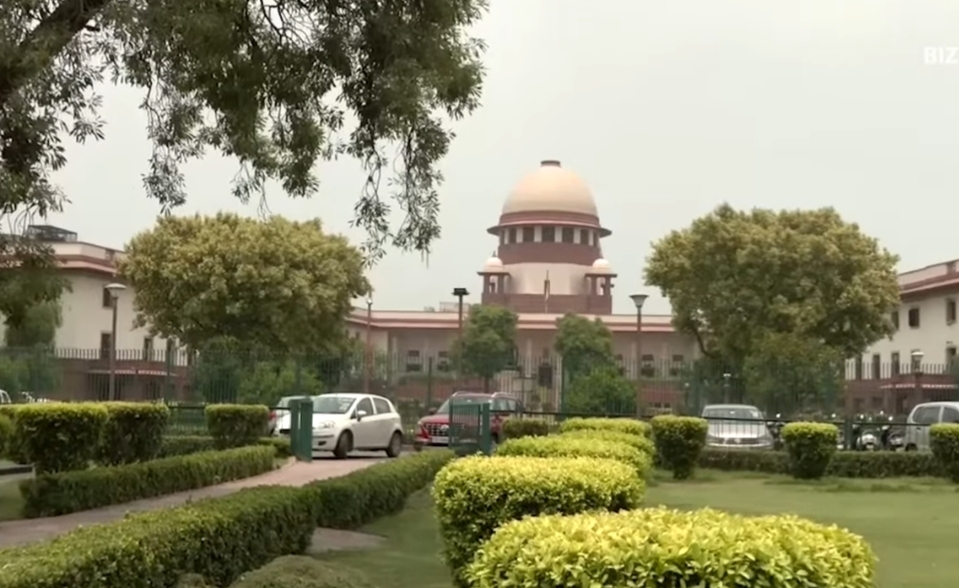
New Delhi, 7May 2026: The Supreme Court on Thursday termed it “very unfortunate” that political parties demand an independent Election Commission when in opposition, but turn silent on the issue or take a completely contrary stand once in power, even as the court was told that free and fair elections — a part of the basic structure of the Constitution — necessarily presuppose an independent and impartial Election Commission.
Justice Dipankar Datta, heading a bench also comprising Justice Satish Chandra Sharma, lamented that whosoever comes to power does the same thing, describing it as “very unfortunate” for the country.
“Whoever comes to power is doing the same thing. It is unfortunate for the country,” said Justice Datta. Referring to a parliamentarian speaking about the “tyranny of the unelected”, Justice Datta said that this should be equated with the “tyranny of the elected”, with Justice Sharma describing it as the “tyranny of the majority”.
The observations from the bench came during the submissions by advocate Prashant Bhushan, appearing for the NGO Association for Democratic Reforms (ADR), who told the court that every government, irrespective of the colour of the political party in power, took advantage of the absence of a law governing the appointment of the Chief Election Commissioner and Election Commissioners and misused it.
“When people were in opposition, they were clamouring that there should be an independent body, but when they came to power, they stopped bothering about it,” Bhushan told the bench. He referred to five earlier Constitution Bench judgments — SCORA I, SCORA II, NJAC, Central Organisation for Railway Electrification and Rojer Mathews — where the court had emphasised the independence and impartiality of institutions from the executive. He said that there could be no executive dominance over the Election Commission, more so when the latter also plays a quasi-judicial role.
Bhushan said that the Supreme Court, by its March 2, 2023 judgment, had directed that until Parliament enacted a law, appointments of the CEC and ECs should be made on the advice of a committee comprising the Prime Minister, the Leader of Opposition, and the Chief Justice of India to ensure independence of the poll panel. He said this did not mean that Parliament could enact a law disregarding the constitutional principles laid down in the 2023 judgment for the independence of the Election Commission.
Responding to the court’s observation on whether there was anything in the 2023 judgment that was required to be followed while enacting the Chief Election Commissioner and Other Election Commissioners (Appointment, Conditions of Service and Term of Office) Act, 2023, senior advocate Vijay Hansaria, continuing his arguments from the previous day, said that he was not suggesting that the court should frame the law, but surely it could test whether the law follows the constitutional norms spelt out in the 2023 judgment.
Emphasising the need for an independent, free and fair Election Commission, another advocate appearing for a petitioner said that if free and fair elections are essential to democracy, then the Election Commission conducting and supervising the elections must also remain free from executive influence.
The Supreme Court is hearing a batch of petitions challenging the constitutional validity of the Chief Election Commissioner and Other Election Commissioners (Appointment, Conditions of Service and Term of Office) Act, 2023, which excluded the Chief Justice of India from the panel for the selection of the CEC and Election Commissioners.
Challenging the exclusion of the CJI from the selection panel, the petitions by ADR, Jaya Thakur (General Secretary of Madhya Pradesh Mahila Congress), and others, including Sanjay Narayanrao Meshram and advocate Gopal Singh, have questioned the constitutional validity of Sections 7 and 8 of the Chief Election Commissioner and Other Election Commissioners (Appointment, Conditions of Service and Term of Office) Act, 2023.
Section 7 of the law, under challenge, states that the Chief Election Commissioner and other Election Commissioners shall be appointed by the President on the recommendation of a Selection Committee consisting of the Prime Minister as Chairperson, the Leader of Opposition in the Lok Sabha, and a Union Cabinet Minister nominated by the Prime Minister.
Section 8 of the Act states that the Selection Committee shall regulate its own procedure in a transparent manner for selecting the Chief Election Commissioner or other Election Commissioners.
The petitioners have contended that the removal of the Chief Justice of India from the selection panel and his replacement with a Union Cabinet Minister nominated by the Prime Minister tilts the balance in favour of the government and renders the appointment process vulnerable to partisan influence.
Picture credit social media

Pramod kumar is a Senior Journalist, Covering Supreem Court of India