
New Delhi: The Supreme Court on Thursday ruled that the Bar Council of India (BCI) has no jurisdiction to take disciplinary action against students pursuing legal education, holding that such power rests with the university or educational institution in which they are enrolled and that the statutory body’s regulatory authority over an individual comes into play only after a law graduate enrols as an advocate.
A bench comprising Chief Justice Surya Kant, Justice Joymalya Bagchi and Justice V. Mohana said the Advocates Act, 1961, under which the BCI has been constituted, conferred no express or implied power on it to initiate disciplinary proceedings against law students.
Considering that the BCI had already withdrawn its circular against students of NALSAR’s 2026 batch, the court closed the matter, declaring its August 13 communication and subsequent modified communications to have been issued “without jurisdiction”. It also made absolute its earlier direction restraining the BCI from taking punitive action against NALSAR, its students or faculty, or any other national law university.
The bench said that while the BCI could prescribe and enforce standards of legal education under the statutory framework and applicable regulations, disciplinary control over students remained with their respective university or educational institution.
CJI Surya Kant observed that, as far as the conduct of law students was concerned, the BCI had neither jurisdiction nor statutory competence. Its role in regulating an individual as an advocate arose only after the student graduated and enrolled with the statutory body, he said, pointing out that none of the NALSAR students concerned had enrolled as advocates.
Justice Bagchi drew a distinction between disciplinary control during legal education and scrutiny at the stage of enrolment as an advocate. He observed that even where a student’s conduct involved moral turpitude, it was for the university to decide whether the student should be permitted to continue pursuing legal education.
The BCI, Justice Bagchi said, could examine at the enrolment stage whether a law graduate fulfilled the prescribed conditions for becoming an advocate, but could not impose an advance condition that a student would be denied enrolment upon graduation.
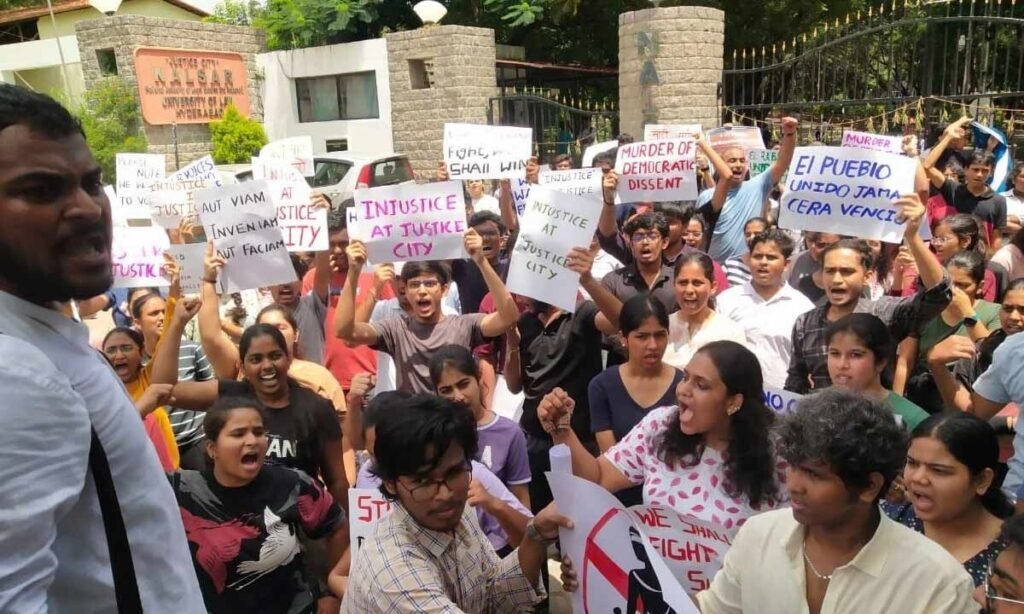
The controversy arose after NALSAR students protested against the invitation extended to CJI Surya Kant to attend their convocation as chief guest. The BCI subsequently issued a circular barring NALSAR’s 2026 batch of law graduates from enrolment as advocates and sought an inquiry into those behind the protest.
The decision barring enrolment was withdrawn within hours, though the inquiry initially ordered by the BCI continued. The BCI later closed those proceedings and informed NALSAR that no further action was required.
On August 14, a day after the BCI issued the controversial circular, which was subsequently withdrawn, the Supreme Court had strongly disapproved of its action, terming it “absolutely uncalled for”, and directed that no punitive action be taken against the students or faculty.
CJI Surya Kant had observed that the issue was essentially a dialogue between the students and him and questioned the BCI’s intervention in the matter. Recalling his own involvement in student activities, the Chief Justice said that even assuming the students were wrong, they had a right to protest and the BCI had “no business” interfering in the matter.

Pramod kumar is a Senior Journalist, Covering Supreem Court of India

