

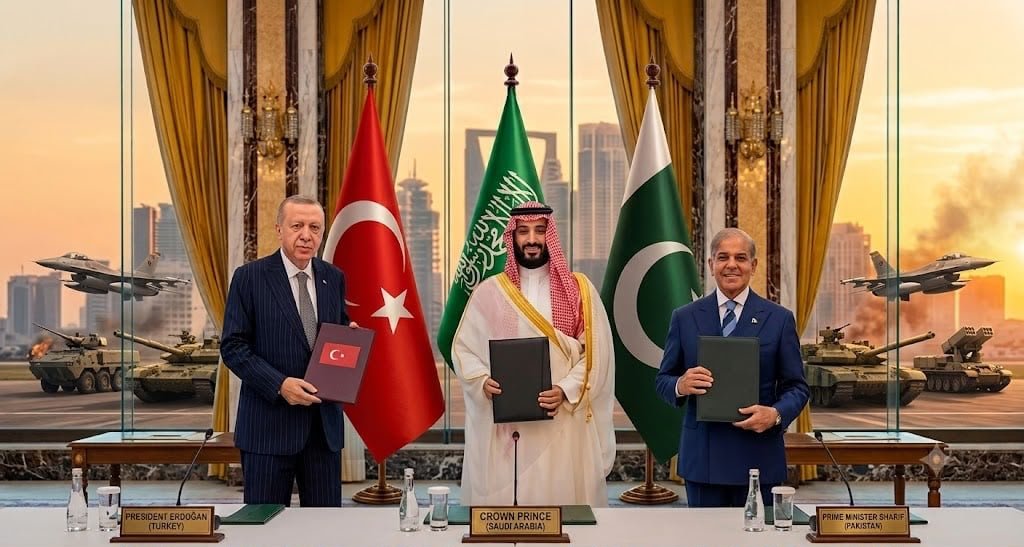
The Mecca Joint Defence Agreement, signed on 7 August 2026 by Saudi Arabia, Türkiye and Pakistan, is being described as the embryo of an “Islamic NATO”. That description is politically dramatic but strategically premature. The agreement is undoubtedly significant: it declares that an armed attack on one signatory will be regarded as an attack on all three. Yet its real importance will depend not on the symbolism of the signing ceremony, but on the military obligations, command structures and escalation procedures that remain undisclosed.
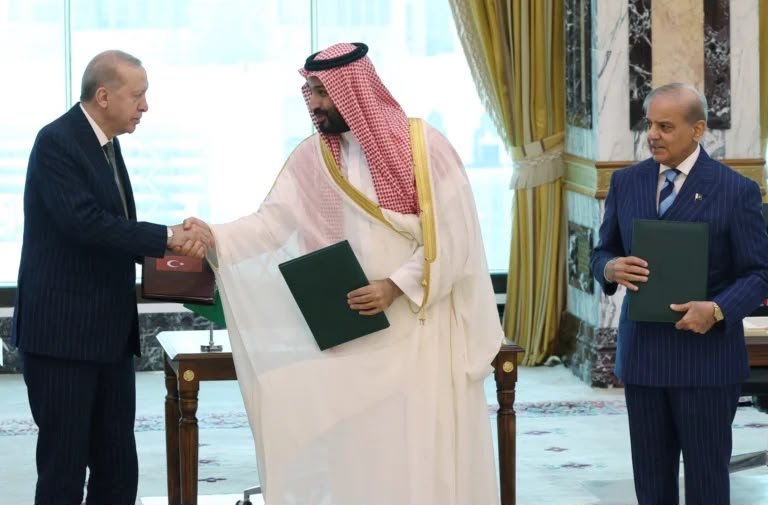
Signed in the holy city by Saudi Crown Prince Mohammed bin Salman, Turkish President Recep Tayyip Erdoğan and Pakistan’s Prime Minister Shehbaz Sharif, the pact binds together three countries with remarkably different strategic assets. Saudi Arabia brings financial power, energy influence and religious legitimacy; Türkiye contributes a large military and an increasingly sophisticated defence industry; Pakistan offers military manpower, operational experience and nuclear capability. The arrangement is therefore less a conventional alliance than a carefully assembled strategic triangle.
Who will be affected?
The first and most immediate impact will be felt by Iran. Tehran is not named as the adversary, and Turkish and Saudi officials insist that the agreement is defensive and directed at no particular country. Nevertheless, the pact emerges amid heightened regional tensions, attacks involving Iran and its partners, and growing anxiety in Gulf capitals over the reliability of external security guarantees.
The agreement complicates Iran’s calculations in two ways. Any attack on Saudi territory—whether by missiles, drones, aircraft or possibly proxies—could now carry the risk of Turkish and Pakistani involvement. At the same time, the pact may encourage Tehran to test the alliance indirectly through deniable attacks, cyber operations or non-state actors, precisely because the treaty does not publicly define whether such actions would activate collective defence.
Israel, too, will be watching closely. A Saudi-Turkish-Pakistani security framework creates a new military equation around Israel, even if the agreement is not formally anti-Israeli. Türkiye’s political opposition to Israeli military actions, Pakistan’s traditional position on Palestine and Saudi Arabia’s regional weight could combine to produce diplomatic and military pressure on Israel. But it would be an error to assume that Riyadh has signed up to an automatic confrontation with Tel Aviv. Saudi Arabia’s interests remain centred on regime security, economic transformation, energy infrastructure and regional stability.
The United States is another affected power. Washington remains deeply embedded in the security architecture of the Gulf, but the pact signals that Riyadh is diversifying its options. The agreement is not necessarily an anti-American act; it is an insurance policy against excessive dependence on Washington. The public text also reportedly does not replace existing bilateral or multilateral commitments.
For India, the implications are more direct. Pakistan’s entry into a security arrangement with Türkiye and Saudi Arabia gives Islamabad greater diplomatic reach and potentially greater access to military cooperation, finance and advanced defence technology. New Delhi will be particularly attentive to Türkiye’s established support for Pakistan on Kashmir and to the possibility that West Asian security forums could become platforms for amplifying Islamabad’s positions.
Yet the pact does not automatically transform the India-Pakistan relationship. Pakistan’s economic vulnerabilities, its dependence on external financing and the severe risks of opening another front with India remain powerful restraints. The agreement may give Pakistan greater confidence, but confidence is not the same as a licence for aggression.
Will Pakistan become more aggressive towards India?
The danger lies less in an immediate military offensive than in increased political risk-taking. Islamabad could interpret the pact as evidence that it will not stand alone in a crisis. Saudi financial support and Turkish diplomatic backing may embolden Pakistan in international forums, particularly on Kashmir and Palestine.
However, a formal defence commitment to Saudi Arabia and Türkiye would also impose responsibilities on Pakistan. Its armed forces would have to consider the possibility of simultaneous crises in South Asia and West Asia. Any conflict with India could jeopardise Pakistan’s relations with Riyadh and Ankara, both of which have strong economic reasons to avoid being dragged into a South Asian war.
The agreement may therefore produce a paradox: greater Pakistani assertiveness in rhetoric, but greater caution in the use of force. India should neither dismiss the pact as theatre nor exaggerate it into an operational encirclement. The appropriate response is intensified diplomatic engagement with Saudi Arabia and Türkiye, stronger maritime and air-defence preparedness, and a clear effort to prevent West Asian partnerships from becoming instruments of South Asian confrontation.
Is China behind the alliance?
There is no public evidence that China designed or directed the Mecca agreement. The pact appears to have emerged from the three signatories’ immediate security concerns and from negotiations that reportedly preceded the August signing by several months.
China will nevertheless be an important beneficiary. Beijing has close relations with Pakistan and substantial economic ties with Saudi Arabia. It is also expanding its diplomatic and commercial presence across the Gulf. A regional security arrangement that reduces dependence on the United States creates greater room for Chinese influence, even if China is not formally a participant.
Chinese technology may also enter the relationship through Pakistan’s defence-industrial ecosystem. But Chinese involvement should not be confused with Chinese control. Türkiye remains a NATO member with its own strategic ambitions; Saudi Arabia is pursuing autonomous diplomacy; and Pakistan is balancing among China, the Gulf monarchies and the West. The more accurate description is that China may gain from the alliance’s consequences without being its architect.
Will the alliance act as a shield?
Potentially—but only as a shield of deterrence, not yet as an integrated military umbrella. The agreement’s central clause creates uncertainty for any would-be attacker. A strike on Saudi Arabia could invite military, intelligence or logistical assistance from Türkiye and Pakistan. A threat to Pakistan or Türkiye could, in theory, draw Saudi political and financial support.
But collective defence clauses are only as credible as the machinery behind them. The text made public so far does not specify the size of the forces to be deployed, the decision-making process, the meaning of “armed attack”, or whether missile and drone strikes by proxies would trigger a joint response. The full agreement has not been published, leaving the parties’ precise obligations unclear.
For the pact to become a genuine shield, the three governments would need to establish permanent consultation mechanisms, intelligence-sharing arrangements, joint exercises, interoperable air and missile defence, and agreed rules for responding to hybrid warfare. Without these, the treaty risks becoming a political warning rather than a functioning defence structure.
Will Pakistan and Türkiye defend Saudi Arabia?
They have now made a political commitment to do so in the event of an armed attack, but political commitment does not necessarily mean automatic deployment of combat forces. Pakistan already has longstanding defence ties with Saudi Arabia, including military cooperation and the deployment of personnel during periods of heightened concern. Türkiye, meanwhile, offers advanced drones, air-defence technology, naval capabilities and defence-industrial cooperation.
Their likely role would initially involve intelligence, air defence, training, logistics, cyber capabilities and protection of critical infrastructure. A large-scale ground intervention would be far more difficult. Pakistan would face logistical challenges in projecting force into the Gulf, while Türkiye would have to reconcile any action with its NATO responsibilities and wider relations with the United States and Europe.
The agreement therefore creates deterrent ambiguity: enough uncertainty to make an adversary hesitate, but not enough clarity to guarantee a predetermined military response.
Is there a Pakistani nuclear umbrella?
This is the most consequential—and most misunderstood—question. Pakistan is the only nuclear-armed Muslim-majority state, and its nuclear capability inevitably lends the pact strategic weight. Reuters has reported that Pakistan’s defence minister previously implied that an earlier Saudi-Pakistani arrangement could place Saudi Arabia under a Pakistani nuclear shield.
But implication is not treaty language. The publicly available Mecca statement does not establish nuclear sharing, nuclear deployment or an explicit Pakistani promise to use nuclear weapons in defence of Saudi Arabia or Türkiye. Nor does it suggest that Pakistan has extended a formal nuclear umbrella to either partner.
Such an arrangement would carry enormous legal, political and strategic consequences. It could provoke Israel, alarm Iran, unsettle the Gulf monarchies and invite pressure from the United States and other nuclear powers. Pakistan itself has strong reasons to preserve ambiguity rather than formalise nuclear guarantees outside South Asia.
The wiser conclusion is that Pakistan’s nuclear arsenal strengthens the pact’s psychological deterrence but does not yet constitute a nuclear umbrella. The Mecca agreement is a serious strategic signal, not a finished military alliance. Its future will be determined by whether the three states can turn shared anxiety into shared capability—or whether their divergent interests reduce the “Islamic NATO” label to a memorable headline.

~Hasnain Naqvi is a former member of the history faculty at St. Xavier’s College, Mumbai….
The opinions expressed here are solely those of the author.

