

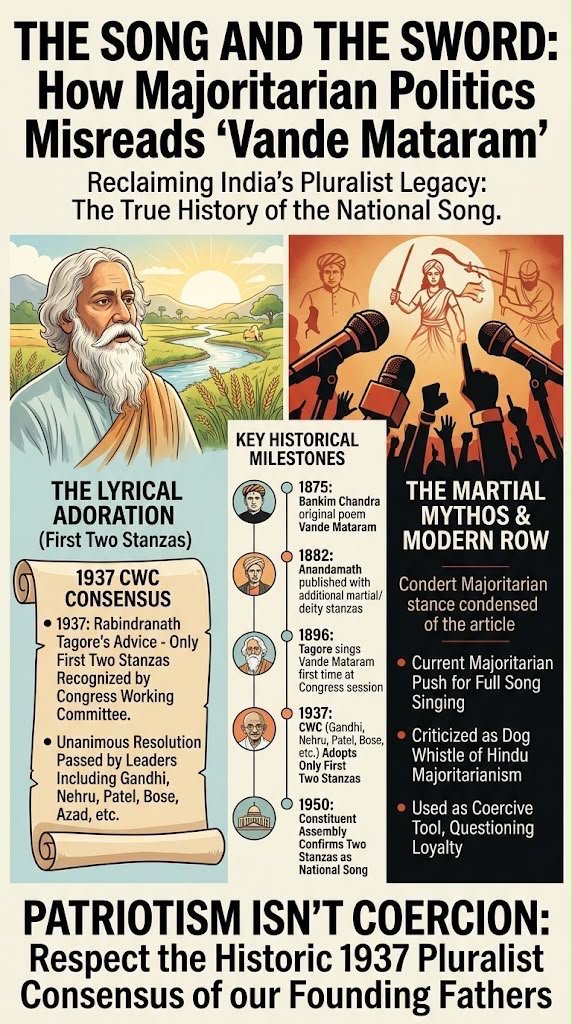
From Bankim’s pen to Tagore’s moral caution, the national song was woven into India’s pluralist struggle. Modern attempts to convert it into a tool of ideological coercion dishonour both history and the republic.
In the political theatre of contemporary India, few symbols are subjected to as much synthetic fury as Bankim Chandra Chattopadhyay’s Vande Mataram. Whenever the majoritarian machinery seeks an ideological distraction or an instrument of coercion, this iconic nineteenth-century hymn is summoned—not as an elevation of patriotic consciousness, but as a political cudgel. Accusations of “insulting” the national song are flung across the political aisle, accompanied by strident demands for uncritical, mandatory compliance. Yet this performative outrage relies on a profound, deliberate historical amnesia. It conveniently erases how the architects of Indian independence—from Mahatma Gandhi and Sardar Vallabhbhai Patel to Subhas Chandra Bose and Jawaharlal Nehru—navigated the song’s complex literary evolution with remarkable nuance, statesmanship, and commitment to pluralism.
The Manufacture of Political Sacrilege
The contemporary campaign to lionize every stanza of Vande Mataram as an immutable litmus test of national loyalty is less about honouring anti-colonial heritage and more about enforcing majoritarian hegemony. Political leaders who brand those adhering to the historical two-stanza consensus as “traitors” engage in a double deception. First, they slander the very founders of the republic who crafted that consensus; second, they conceal their own ideological lineage’s historical detachment from the freedom struggle.
While the Indian National Congress routinely opened its sessions with Vande Mataram from 1896 onward, the RSS and its political predecessors never incorporated the song—nor the national anthem Jana Gana Mana—into their daily shakhas or core literature, choosing instead their organizational chant, Namaste Sada Vatsale. The current obsession with legislating forced devotion is thus an exercise in retroactive posturing.
From Pastoral Hymn to Martial Mythos
To understand why Vande Mataram became a subject of debate in a multi-religious society, one must examine its textual evolution. Composed by Bankim Chandra in 1875 as an independent poem, its opening lines present a breathtakingly tranquil, non-denominational adoration of the motherland—a land well-watered, rich with fruit, cooled by southern breezes, and green with bountiful crops (sujalam, suphalam, malayaja-shytalam). However, when Bankim embedded the hymn into his 1882 political novel Anandamath, he appended four additional stanzas that fundamentally altered its character.
In the novel, set against the backdrop of the eighteenth-century Sannyasi Rebellion, the motherland ceases to be merely a fertile landscape and is explicitly conflated with militant Hindu deities—Durga wielding ten weapons and Kali draped in skulls. As the distinguished historian Tanika Sarkar demonstrates in her seminal scholarship (Hindu Wife, Hindu Nation), Anandamath recasts anti-colonial resistance through an overtly sectarian lens, constructing a martial Hindu ethos where the struggle against oppression is directed as much against Muslim rulers as against British colonizers.
In his entry on Bankim Chandra in the “Encyclopædia Britannica”, the eminent historian and civil servant Sir Ramesh Chandra Dutt observed:
“Though the Anandamath is in form an apology for the loyal acceptance of British rule, it is none the less inspired by the ideal of the restoration, sooner or later, of a Hindu Kingdom in India. This is especially evident in the occasional verses in the book, of which the Bande Mataram is the most famous.”
Historian Sabyasachi Bhattacharya, in “Vande Mataram: The Biography of a Song”, further details how this dual identity created a permanent tension between the hymn’s universal anti-colonial appeal and its sectarian imagery.
Tagore’s Moral Compass and the 1937 Consensus
No figure understood the transformative power—and potential danger—of nationalistic fervour better than Rabindranath Tagore. It was Tagore who first set Vande Mataram to music and sang it at the Kolkata session of the Indian National Congress in 1896 under the presidency of Rahimtullah Sayani. During the Swadeshi movement (1905–1910), when British authorities banned the song and jailed activists for chanting it, Vande Mataram served as a rallying cry against imperial tyranny.
Yet Tagore harboured a profound moral dread of fetishizing the nation above humanity. In his masterpiece “Ghare Baire”(The Home and the World), Tagore depicted how Hindu zealots transformed the chanting of Vande Mataram into a coercive instrument during the Swadeshi drive, trampling upon the livelihoods of poor Muslim traders and igniting tragic communal violence. Tagore’s warning was clear: when patriotism becomes an aggressive, idolatrous religion, it loses its moral center.
As communal tensions flared in the 1930s under British encouragement, Muslim leaders expressed deep misgivings regarding the deity-centric later stanzas of the song. Recognizing the need to preserve national unity without compromising conscience, Congress leaders sought guidance:
- September 1937: Babu Rajendra Prasad wrote to Sardar Patel emphasizing the need for a clear stance on the song.
- October 1937: Netaji Subhas Chandra Bose wrote to Rabindranath Tagore seeking his explicit counsel.
- October 1937: Tagore advised Bose and Nehru with unequivocal clarity that the Congress should officially adopt only the first two stanzas, which expressed a universal, non-denominational love for the soil, while eschewing the later stanzas containing explicit deity imagery.
On October 28, 1937, the Congress Working Committee—comprising Mahatma Gandhi, Sardar Patel, Subhas Chandra Bose, Jawaharlal Nehru, Maulana Azad, Govind Ballabh Pant, and Acharya Kripalani—unanimously adopted Tagore’s recommendation. This was not “appeasement,” as contemporary majoritarians claim, but statesmanship of the highest order. It recognized that a national song in a diverse republic must unite rather than divide.
Constitutional Legacy Versus Majoritarian Coercion
This statesmanlike compromise was formally enshrined at the dawn of the republic. At midnight on August 14–15, 1947, as India stepped into freedom, Sucheta Kripalani sang Vande Mataram in the Constituent Assembly immediately before Nehru delivered his historic “Tryst with Destiny” address. On January 24, 1950, Constituent Assembly President Rajendra Prasad formally declared that the first two stanzas of Vande Mataram would hold equal status with Jana Gana Mana as the National Song of India.
For over seven decades, this constitutional settlement stood as a testament to India’s pluralist architecture. To overturn this consensus today and demand the mandatory recitation of all stanzas is an act of historical revisionism aimed at transforming a national symbol into an instrument of ideological conformity. The supreme irony, of course, lies in the political theater: key leaders of the ruling establishment weaponize the issue in public rhetoric while remaining conspicuously absent from parliamentary proceedings where such legislative debates unfold.
Reclaiming the Motherland
To reduce Vande Mataram to a majoritarian dog whistle is to betray both Bankim’s poetic genius and the vision of India’s freedom fighters. True patriotism does not demand coercive conformity, nor does it equate love for the nation with the subjugation of minority identities. As Tagore wrote in his essays on nationalism, a country is never greater than the ideals of humanity. Liberating Vande Mataram from the clutches of majoritarian zealotry is not merely an academic exercise; it is an imperative for preserving the democratic, pluralistic core of the Indian Republic.
References
- Bhattacharya, Sabyasachi. Vande Mataram: The Biography of a Song. Penguin Books / Primus, 2003.
- Sarkar, Tanika. Hindu Wife, Hindu Nation: Community, Religion, and Cultural Nationalism. Permanent Black, 2001.
- Dutt, Sir Ramesh Chandra. Entry on “Bankim Chandra Chattopadhyay”, Encyclopædia Britannica.
- Tagore, Rabindranath. Ghare Baire (The Home and the World), 1916; and CWC Correspondence on Vande Mataram, October 1937.

~Hasnain Naqvi is a former member of the history faculty at St. Xavier’s College, Mumbai….
The opinions expressed here are solely those of the author.