

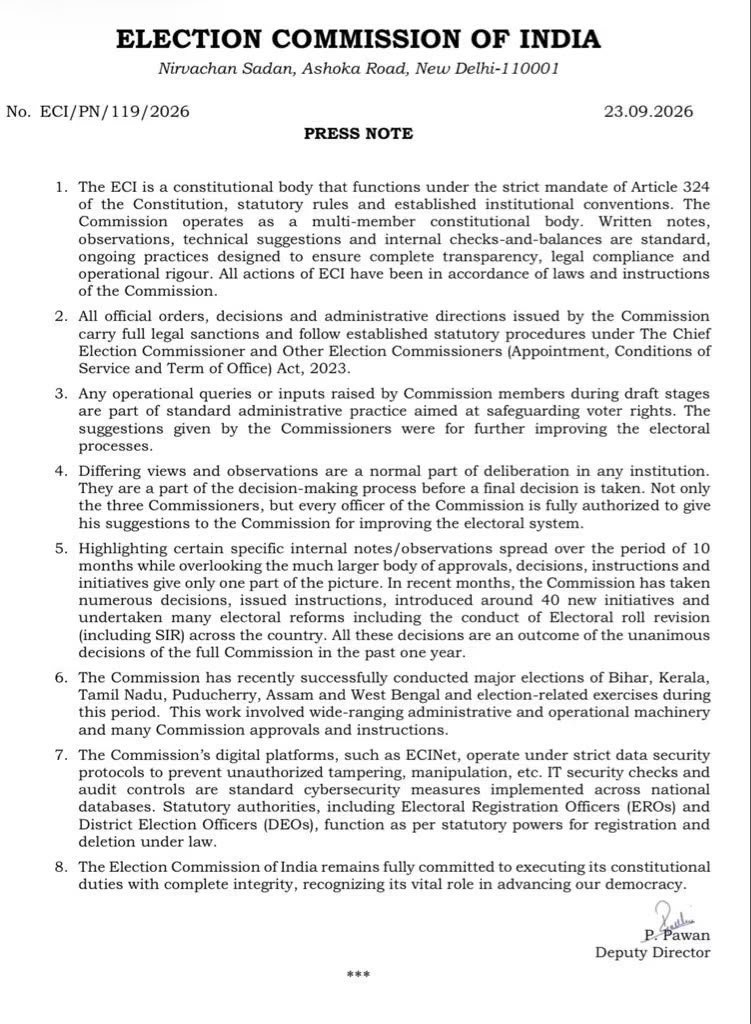
On 23 September 2026, the Election Commission of India released Press Note No. ECI/PN/119/2026. Issued the same day The Indian Express published its investigation into an unprecedented internal rupture—two of three Election Commissioners formally objecting, on record, at least fourteen times over ten months to decisions taken without their knowledge—the note is less clarification than institutional self-exoneration. It converts documented dissent into “standard administrative practice,” unilateral action into “unanimous decisions,” and legitimate alarm into healthy deliberation. The result is not transparency. It is theatre.
Let us examine the press note against the facts the Commission would prefer remain obscured.
Point 1 asserts that the ECI is a constitutional multi-member body under Article 324, with written notes and internal checks as “standard practices” ensuring transparency and legal compliance. All actions, it claims, followed law and Commission instructions.
This is true in the abstract and false in the particular. The investigation revealed that Commissioners Sukhbir Singh Sandhu and Vivek Joshi repeatedly recorded that decisions on electoral-roll management—new voter registration, deletions and restorations, changes to Form 6, appeals, and control of the voter database—were taken without their knowledge. In one instance, Sandhu called a step “unauthorised and illegal.” When two constitutional authorities must place on record that the third is acting without them, the claim of multi-member functioning collapses. Article 324 does not licence a one-person Commission with two decorative footnotes.
Point 2 states that all official orders and directions carry full legal sanction under the 2023 Act governing the appointment and service of the Chief Election Commissioner and other Election Commissioners.
The Act was meant to reinforce the multi-member character of the institution. The Commissioners’ own notes repeatedly invoked the requirement that decisions be taken by the full Commission—unanimously or by majority. If orders were issued and software changes implemented without the knowledge of two members, the statutory procedure now cited was not followed. Legal sanction cannot be conferred retroactively by press note.
Point 3 recharacterises the objections as “operational queries or inputs… part of standard administrative practice aimed at safeguarding voter rights.” Their suggestions, it says, were merely for improving electoral processes.
This is linguistic alchemy. A formal written objection labelling an action “unauthorised and illegal,” or warning that a software change bypasses statutory officers, is not a polite operational query. The Commissioners flagged what they regarded as breaches of process that risked the integrity of the electoral roll itself—the very safeguard the Commission now claims to champion.
Point 4 declares that differing views are a normal part of deliberation and that every officer is authorised to offer suggestions.
Of course they are. The problem is the pattern. Fourteen formal objections over ten months, four on a single day, directed at decisions the Commissioners say were taken without them, and culminating in separate letters to the Cabinet Secretary, do not resemble ordinary collegial give-and-take. They resemble two constitutional functionaries attempting to reassert the multi-member character of the institution against a practice that had reduced them to after-the-fact observers. Equating that with routine commentary treats the public as naïve.
Point 5 complains that highlighting “certain specific internal notes” over ten months while overlooking the larger body of approvals and “around 40 new initiatives” gives only one part of the picture. All decisions, including the Special Intensive Revision, are said to be the outcome of “unanimous decisions of the full Commission.”
Selective highlighting is what investigative journalism does when institutions prefer the flattering narrative. The claim of unanimity is difficult to reconcile with the documented record of sustained objection. If final decisions were truly unanimous, why the repeated written protests that the process itself was being circumvented? Unanimity declared after objections have been set aside is not collegial decision-making. It is institutional self-preservation.
Point 6 lists the successful conduct of major elections in Bihar, Kerala, Tamil Nadu, Puducherry, Assam and West Bengal as proof of institutional health.
Administrative competence in conducting polls does not immunise the Commission from scrutiny of how the electoral rolls underpinning those polls were prepared. The SIR exercise, which has seen the deletion of crores of names, sits at the heart of the Commissioners’ objections. Pointing to subsequent elections as validation is a non-sequitur. One can run an election efficiently while still compromising the foundational integrity of the list of electors.
Point 7 assures the public that ECINet operates under strict data-security protocols and that EROs and DEOs exercise their statutory powers as per law.
This is the most carefully worded paragraph, and the most revealing. The investigation reported concerns precisely about the centralisation of access to the voter database in Delhi and changes that appeared to bypass statutory officers on the ground. When Commissioners raise alarms about software integrity and the locus of control—and approach the Cabinet Secretary—a bland assertion of “strict protocols” does not answer the charge. It restates the official position while leaving the specific objections unaddressed.
Point 8 closes with the familiar declaration that the Commission remains fully committed to executing its constitutional duties with complete integrity.
Commitment is not demonstrated by assertion. It is demonstrated by process. When two of three constitutional authorities feel compelled to place on record that decisions affecting the right to vote were taken without them, and when the institution’s response is to redefine those records as “standard practice,” the claim of complete integrity rings hollow.
The press note is an exercise in institutional gaslighting. It takes documented evidence of internal rupture—formal objections, accusations of illegality, appeals to the Cabinet Secretary—and dissolves it into the soothing vocabulary of routine deliberation and eventual unanimity. In doing so, the Election Commission treats the public, and the two Commissioners who risked institutional discomfort by putting their concerns on paper, with a casualness that borders on contempt.
An independent Election Commission is not a slogan. It is a practice. When that practice is reduced to a single dominant will, dressed up after the fact as collegial consensus, the constitutional promise of free and fair elections is placed under strain.
The press note of 23 September does not relieve that strain. It deepens it. The public is entitled to more than carefully worded denial. It is entitled to an institution that does not confuse the suppression of dissent with the appearance of unanimity.

~Hasnain Naqvi is a former member of the history faculty at St. Xavier’s College, Mumbai….
The opinions expressed here are solely those of the author.