

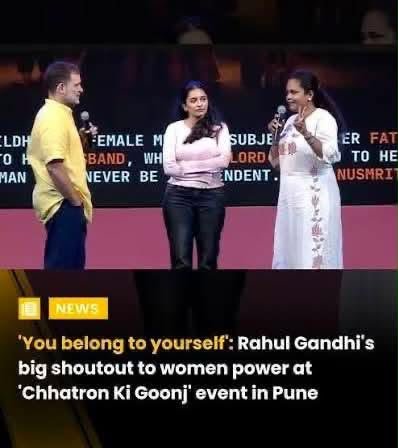
In the humid evening air of Pune on August 22, 2026, thousands of young women filled the grounds of the AISSMS College for the fourth edition of Rahul Gandhi’s Chhatron Ki Goonj campaign. Unlike the earlier gatherings in Kota, Dehradun and Prayagraj, this one was deliberately exclusive to female students. What unfolded was not a conventional political rally but a sustained conversation about identity, control, safety and the quiet cages that still shape the lives of India’s women. At its heart stood a simple, resonant assertion from the Leader of Opposition: “You belong to nobody, except yourself.”
A Deliberate Shift in Focus
Chhatron Ki Goonj began in June 2026 as an outreach to students grappling with paper leaks, expensive education, unemployment and the uncertainties of a job market increasingly shaped by artificial intelligence. In Pune, the focus narrowed deliberately to the experiences of young women. Organisers restricted the event to female participants, creating a space where conversations about education, career aspirations, online abuse, family expectations and physical safety could unfold without the usual dominance of male voices. Police permission came with thirty conditions, including bans on objectionable banners and drones, and requirements for women security personnel at entry points. An estimated 8,000 to 10,000 people were expected; the venue filled with young women who had travelled from colleges across Maharashtra and beyond.
Rahul Gandhi arrived in a yellow shirt, a departure from his more familiar white T-shirts and the pink he had worn in Prayagraj. The visual shift mirrored the thematic one. He told the gathering that India’s greatest strength was not its economy, military or medical system, but “70 crore unique journeys, unique imaginations, unique dreams that the women of India are living.” He described women as more sensitive, gentle and empathetic, and insisted that these qualities made them the country’s most valuable asset.
Challenging the Manusmriti Mindset
The most striking moment came when Gandhi directly confronted a passage he attributed to the Manusmriti. “In childhood, a female belongs to her father. In youth, she belongs to her husband. When her lord is dead, she belongs to her sons. A woman must never be independent,” he quoted. He called the words a shame that should never have been spoken. The critique was not an academic digression. It was the philosophical core of his argument: that reducing women to the roles of daughter, wife or mother — each defined by a relationship with a man — diminishes their individuality and limits the nation’s potential.
He was careful to note that there is nothing wrong with those relationships. A woman can be a daughter, a sister, a wife and a mother. What he rejected was the idea that these roles exhaust her identity or imply ownership. “You have a relationship with your father, brother, husband, your son, but you do not belong to them. You belong to yourself,” he said. The line, repeated across reports of the evening, quickly became the event’s defining statement. On social media and in subsequent coverage, it was framed as both a personal affirmation and a political challenge to patriarchal assumptions that continue to shape social norms and policy attitudes.
The Everyday Architecture of Control
Gandhi did not stop at ideology. He mapped the practical mechanisms through which control is exercised. He spoke of three forms of violence: direct physical violence, the violence of lost opportunity, and financial violence. He cited figures on female foeticide, harassment and physical abuse, noting that a significant percentage of women forgo jobs or higher education because of safety concerns, and that many incur additional costs simply to move safely through public space. The statistics, whatever their precise sourcing in the moment, served to translate abstract principles into lived reality for the students listening.
Students themselves spoke. They described online abuse, social pressure, the double burden of employment and domestic expectation, and the subtle ways families and institutions ration freedom. Gandhi listened and responded, turning the stage into something closer to a dialogue than a monologue. In a political culture often dominated by set-piece speeches, the interactive format mattered. It signalled that the concerns of young women were not peripheral issues to be addressed after the “real” political questions had been settled, but central to any serious conversation about India’s future.
Context and Contestation
The event did not occur in a vacuum. It followed clashes between ABVP and NSUI activists on a Pune campus the previous day. Maharashtra Chief Minister Devendra Fadnavis had earlier described the format as a potential monologue rather than a genuine dialogue. BJP leaders questioned the selection of attendees and alleged paid participation. Congress leaders countered that the restrictions and online targeting of young women revealed discomfort with the very idea of an open platform for female students. These exchanges are familiar in Indian politics; what stood out was the decision to centre the discussion on women’s autonomy rather than the usual catalogue of competitive grievances.
Gandhi’s post-event message on X reinforced the evening’s themes: “Women are the strength of India — its foundation, its present, and its future. You belong to no one but yourself. Be loud. Be proud. Fight for your space. Smash the patriarchy!” The language was direct, even confrontational. It marked a willingness to use the vocabulary of contemporary feminism in mainstream political discourse, something relatively rare at the national level.
A Beginning, Not a Culmination
Whether this constitutes the arrival of feminism in Indian electoral politics remains an open question. Politics is measured in votes, organisational strength and policy outcomes, not in resonant phrases alone. Yet the Pune gathering represented something distinctive: a national opposition leader choosing to place women’s self-ownership, rather than their utility as a demographic or a moral symbol, at the centre of a major public event. The critique of the Manusmriti was not new in progressive circles, but hearing it delivered from a platform of this scale, to an audience of young women who themselves articulated their experiences of constraint, carried a different weight.
The resonance will depend on what follows. Rhetoric that challenges patriarchal frameworks must eventually confront the harder tasks of policy design, institutional reform and cultural change. Safety on campuses and streets, equitable access to education and employment, freedom from online harassment, and the dismantling of everyday controls that disguise themselves as protection — these are the tests that will determine whether the evening in Pune was a memorable moment or the start of a sustained political project.
For the young women who filled the grounds that evening, the message was simpler and more immediate. They were told, in public and without qualification, that their primary allegiance is to themselves. In a society that still routinely defines women through the men in their lives, that assertion retains the power to unsettle. Rahul Gandhi did not invent the idea. He chose, on a prominent stage in Pune, to make it the heart of his address. In doing so, he offered a language of autonomy that many in the audience had been waiting to hear spoken aloud.

~Hasnain Naqvi is a former member of the history faculty at St. Xavier’s College, Mumbai….
The opinions expressed here are solely those of the author.