

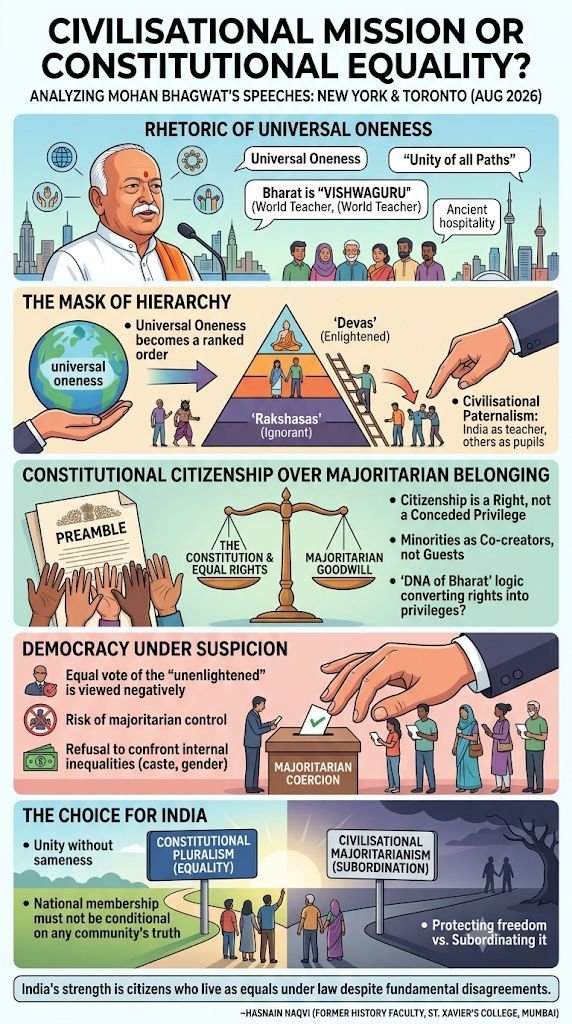
Mohan Bhagwat’s Speeches Reveal a Hierarchy Masquerading as Oneness
When the chief of the Rashtriya Swayamsevak Sangh speaks of universal oneness and the unity of all spiritual paths, the language sounds generous. In New York on 29 August 2026, Mohan Bhagwat invoked these themes with practised fluency. One speech celebrated the idea that human beings must live with mutual concern, protect nature and resist hatred. The other insisted that every path ultimately leads to the same divine truth. Both formulations are calculated to appeal to modern audiences who value tolerance and interdependence.
Addressing the Indian diaspora in Toronto shortly thereafter at the “Hindu Vishwa Bandhu” gathering, Bhagwat extended this rhetoric of benevolence to global history and citizenship. Asserting that India became a Vishwaguru (world teacher) rather than a Mahashakti (superpower) through selfless service, he claimed that ancient Bharat conquered no nation and converted no one, but shared wisdom across continents. Turning to domestic pluralism, he argued that even those who entered India as “aggressors”—alongside persecuted minorities like Parsis and Jews—were granted asylum and continue to “thrive” because of the host tradition and “DNA of Bharat”.
Yet this framing of host-like accommodation exposes the central flaw in the RSS worldview. By casting non-Hindu communities and religious minorities as guests or beneficiaries of ancient Hindu hospitality rather than as equal co-creators of the sovereign republic, the Toronto address converts equal rights into a conceded privilege. Universal oneness is once again presented not as constitutional equality, but as majoritarian benevolence.
From Oneness to Hierarchy
Yet the surface harmony dissolves once the metaphysical scaffolding is examined. Universal oneness is rapidly converted into a ranked order of perception. Differences among people are explained by analogy to the limited vision of dogs compared with humans. Some human beings, it is said, have grasped the reality of the eternal soul; others have not. Those who possess the knowledge—styled as “devas”—carry the responsibility of educating those still trapped in ignorance, the “wicked” or “rakshasas.” The same hierarchical logic is projected outward: Bharat is assigned a civilisational mission to instruct the world in the truth of the atman as revealed through ancient legend.
This is not pluralism. It is a theology of progressive enlightenment in which one tradition supplies the definitive map and everyone else occupies an earlier, incomplete stage.
The Limits of Metaphysical Absorption
Other religious systems make parallel exclusive claims. They cannot be quietly absorbed into a single Hindu metaphysical frame without dissolving their integrity. Still less can the large body of Indian citizens who are atheists, materialists, agnostics, non-theistic Buddhists or secular humanists be fitted into such a scheme. Their ethical horizon is this-worldly. They seek institutions that protect liberty, equality, fraternity, democracy, scientific temper and equal citizenship. That orientation is not a deficient perception of a higher truth; it is a different and fully coherent commitment.
Genuine pluralism begins from the recognition that people may hold irreconcilable answers to the ultimate questions—God, salvation, the soul, history, morality, the purpose of life—and that none of these answers requires correction by the state, by civilisation or by majoritarian power.
Constitutional Belonging, Not Spiritual Convergence
Equal citizenship does not rest on the goodwill of those who define harmony in Hindu terms. Muslims, Christians, Dalits, atheists, communists and every other citizen belong to the republic by constitutional right, not by spiritual convergence with any particular account of the divine.
Bhagwat’s statement that a Hindu who wishes to see no Muslims in India ceases to be Hindu is welcome and should be noted. It does not, however, resolve the deeper problem. The standard of belonging cannot be tolerance within a majority’s spiritual framework. It must be the Constitution’s guarantee of equal citizenship irrespective of belief.
Civilisational Paternalism and Historical Evasion
The claim that Bharat exists to carry a universal spiritual message produces civilisational paternalism. Those who believe they have seen the truth appoint themselves teachers of those still allegedly lost in error, ego or materialism. Hierarchy is reintroduced under the language of care.
The same pattern appears in the historical narrative. Decline is attributed almost exclusively to external invasions. The internal architecture of hierarchy—varna, caste exclusion, untouchability, gender inequality—is left largely unexamined. A doctrine of oneness that refuses to confront institutional inequality becomes a moral vocabulary that conceals unequal power rather than dismantling it.
Politics, Rights and the Equal Vote
Politics is frequently criticised as divisive or cynical. Yet politics remains the arena in which rights have been secured. Universal adult franchise, the abolition of untouchability, affirmative action, labour protections, women’s rights, minority safeguards, independent courts and constitutional remedies are political achievements. Social service and inter-community dialogue have value; they cannot substitute for equal laws, accountable institutions and enforceable rights.
When the equal vote of the “unenlightened” is treated as a regrettable feature of politics rather than its moral foundation, democratic equality itself is placed under suspicion. In that atmosphere, the temptation grows to regard money power, electoral manipulation or majoritarian coercion as legitimate instruments for realising a higher civilisational purpose.
The Choice Before India
Unity need not require sameness. Fraternity need not demand metaphysical agreement. National membership must never be made conditional on acceptance of any community’s account of ultimate truth.
India’s strength lies not in a divinely mandated mission to educate the world, but in the more modest and more demanding promise that citizens who disagree fundamentally about the nature of reality can still live as equals under law. That is the difference between constitutional pluralism and civilisational majoritarianism. The former protects freedom; the latter, however eloquently dressed in the language of oneness, ultimately subordinates it.

~Hasnain Naqvi is a former member of the history faculty at St. Xavier’s College, Mumbai….
The opinions expressed here are solely those of the author.