

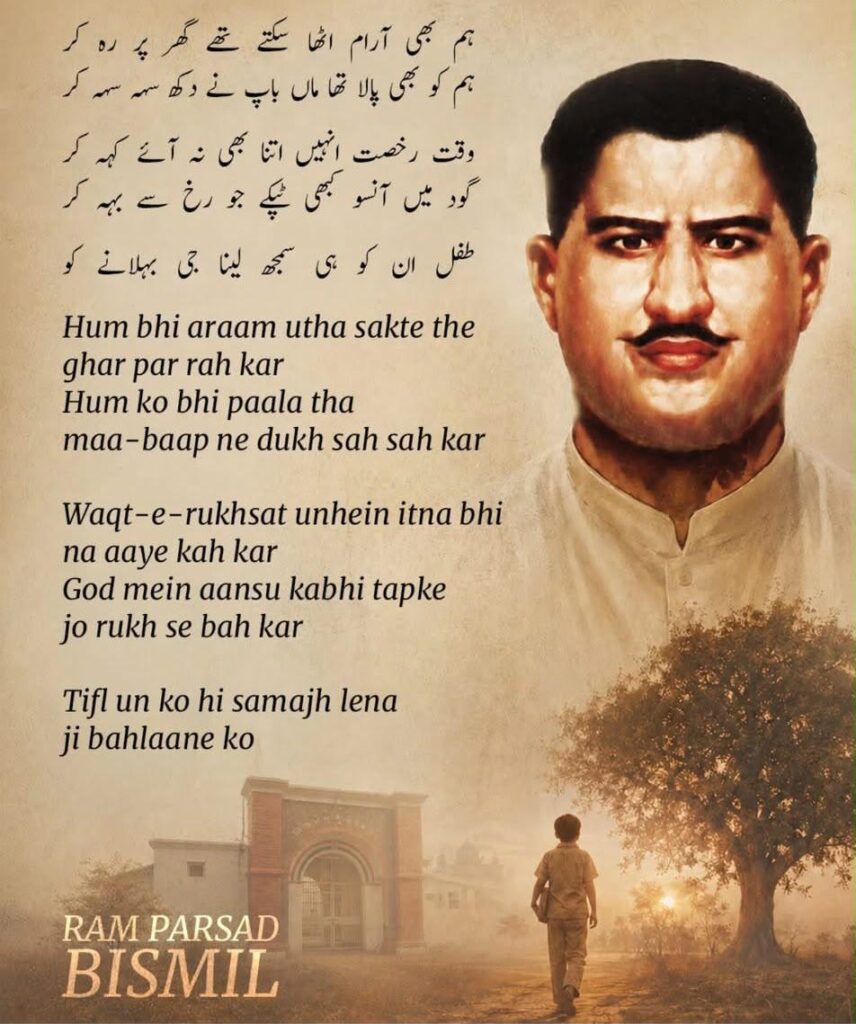
On this birth anniversary of Pandit Ram Prasad Bismil—born on 11 June 1897 in Shahjahanpur, Uttar Pradesh—the nation recalls a luminous figure whose life embodied the fierce confluence of poetic eloquence and revolutionary zeal. A true son of India, Bismil emerged as one of the most inspiring architects of the armed struggle against British colonial rule, his words igniting the hearts of countless freedom fighters long after his physical presence faded.
A Scholar-Revolutionary Forged in Patriotism
Bestowed the honorific “Pandit” for his profound mastery across languages, literature, and subjects, Bismil was far more than a fighter; he was a visionary intellectual. Deeply influenced by Arya Samaj ideals and Swami Dayananda Saraswati’s teachings, he honed his craft as a poet and translator while channeling his energies into organized resistance. Writing under pen names like Ram, Agyat, and most famously Bismil (meaning “wounded” or “one in love’s affliction”), he produced stirring works in Hindi and Urdu that blended romanticism with unyielding nationalism.
His literary contributions extended beyond original verse. Bismil translated significant texts, including works from Bengali and English, to awaken political consciousness. Collections such as *Man Ki Lahar* and *Swadeshi Rang* captured the throbbing pulse of a subjugated yet awakening nation, serving as rallying cries that transcended mere protest to become anthems of self-respect and liberty.
The Bold Architect of Resistance
Bismil’s revolutionary journey began early. As a young man moved by the injustices of colonial rule, he participated in the Mainpuri Conspiracy of 1918, demonstrating his willingness to act decisively. He co-founded the *Hindustan Republican Association* (HRA), envisioning a sovereign India free from exploitation. His strategic brilliance shone in the 1925 Kakori train action, a daring operation to seize government funds for arming the independence movement alongside comrades like Ashfaqulla Khan.
This audacious strike was not mere rebellion but a calculated assertion of sovereignty. It underscored Bismil’s belief that true independence demanded resolute action beyond non-violent appeals. Though arrested, tried in the *Kakori Conspiracy Case*, and sentenced to death, he faced the gallows with serene courage on 19 December 1927 at Gorakhpur Jail, at the young age of 30. His final moments echoed the unbowed spirit that defined his life.
Verses That Kindled a Nation’s Soul
Pandit Ram Prasad Bismil powerfully championed and popularized one of the most stirring patriotic ghazals of the era, making its opening couplet the defining anthem of revolutionary resolve:
*Sarfaroshi ki tamanna ab hamare dil mein hai
Dekhna hai zor kitna baazu-e-qatil mein hai*
(The desire for sacrifice is now in our hearts,
We shall now see what strength there is in the boughs of the enemy.)
Originally penned by the poet Bismil Azimabadi in 1921, these immortal lines gained eternal life through Bismil’s fiery recitations and sacrifice. They reflected not despair but defiant hope—the readiness to offer everything for the motherland’s freedom. Such words were not empty rhetoric but a manifesto of sacrifice, inspiring unity across communities—exemplified in Bismil’s own deep bonds with comrades like Ashfaqulla Khan, a testament to the inclusive patriotism that fuelled the movement.
An Undying Inspiration
Pandit Ram Prasad Bismil’s martyrdom at Gorakhpur did not extinguish his flame; it amplified it. His autobiography, penned in his final days, along with his poems, offers timeless lessons in courage, intellectual rigour, and selfless service. Today, as India stands tall as a vibrant democracy, Bismil’s life reminds us that freedom is a sacred trust earned through visionaries who dared to dream and act.
On this 11th of June, we salute the poet-revolutionary whose verses still stir the conscience and whose sacrifice continues to light the path of national pride.
In remembering Bismil, we reaffirm our commitment to the ideals he cherished: equality, sovereignty, and an unyielding love for the motherland. His spirit lives on—not in memorials alone, but in every heart that beats for a stronger, united India.

~Hasnain Naqvi is a former member of the history faculty at St. Xavier’s College, Mumbai….
The opinions expressed here are solely those of the author.