
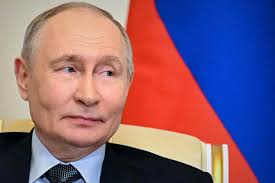
NEW DELHI: Russian President Vladimir Putin has renewed his offer regarding working jointly on manufacturing the fifth-generation Sukhoi Su-57 fighter jet, which comes with enhanced stealth capabilities. In a wide-ranging interaction with global news agencies, Putin also said Russia was ready to provide India with critical technologies for major defence platforms and weapons.
The Russian leader’s offer comes at a time when India is looking to add fifth-generation fighter jets to its arsenal amid concerns of regional neighbours advancing their aerial capabilities. India’s own project to develop an indigenous 5th-generation jet (Advanced Medium Combat Aircraft) is also under development, but it is likely to enter service only in the mid-2030s.
Addressing a gathering, Putin recalled that Moscow had previously invited India to co-develop under its Fifth Generation Fighter Aircraft (FGFA) programme before New Delhi walked away from the venture in 2018.
“At one point, we proposed to our Indian friends to work together on this technology. But back then, our Indian friends said, ‘Go ahead on your own, and then we will see — maybe we’ll join,” Putin said.
“The aircraft could have been our joint project. We built it independently, but we are ready to work with India in this field,” he added.
India reportedly pulled out of the 11-year collaborative program to develop a stealth fighter jet after investing nearly $300 million in preliminary designs over disagreements on cost-sharing plans, technology transfers, and the aircraft’s technological capabilities, among others. At the time, a few of the Indian Air Force’s (IAF’s) principal concerns were Su-57’s stealth characteristics, delays in developing next-generation engines and insufficient technology sharing.
However, since then, defence analysts have pointed out that the playing field has changed drastically, with Russia’s state-owned defence exporter, Rosoboronexport, altering its terms to heavily align with New Delhi’s “Make in India” initiative.
But perhaps India’s biggest concern was whether the aircraft truly matches the stealth standards set by American fifth-generation fighters. Some defence analysts claim that Su-57 prioritises manoeuvrability and aerodynamic performance over maximum stealth. For India, which may have to operate against increasingly sophisticated Chinese air defences, stealth remains a critical requirement.
About Su-57 Stealth Jets
The Su-57, developed by Russia’s Sukhoi Design Bureau, is designed to carry out a wide range of combat missions, including engagement of air, ground and maritime targets. It is capable of operating round the clock, in adverse weather and under electronic warfare conditions, while its low observability is intended to reduce vulnerability to modern air defence systems.
Designed to compete with aircraft such as the American F-22 Raptor and F-35 Lightning II, the Su-57 is capable of engaging air, ground, and sea targets. It combines stealth features, supersonic cruising capability, advanced sensors, electronic warfare systems and long-range strike capability to a wide range of combat missions.
The aircraft can operate around the clock, including in adverse weather conditions and under jamming. Its low observability allows it to be effective despite countermeasures from modern air defence systems.
Last year, the state-owned aerospace company United Aircraft Corporation introduced a new-generation Izdeliye 177 engine in the Su-57 aircraft system to deliver increased thrust and improved flight performance. Russia has claimed the Su-57 to be the only combat-proven fifth-generation fighter, citing its operational use in Syria and Ukraine.
A new twin-seat tandem-cockpit variant of the jet has also been introduced, in which the second seat is designed to function as a tactical command station, enabling operators to control loyal wingman drones and coordinate advanced electronic warfare missions.
However, unlike America’s F-35, which has been produced in large numbers and exported widely, the Su-57 remains a relatively limited-production aircraft.
Despite Russia’s enthusiasm, India’s hesitation is rooted in both operational and strategic calculations. While India traditionally relied on Russia for defence tech, New Delhi is trying to view its new procurements with a broader strategic lens, involving technology access, supply-chain resilience, sanctions risks and partnerships with multiple countries.
While maintaining strong ties with Russia, India is also deepening defence cooperation with Western nations, including France and the United States.

We are a multimedia news network. Website : www.7xnews.com Based in New Delhi (India)
Youtube : umakantlakheraspeaks@gmail.com