

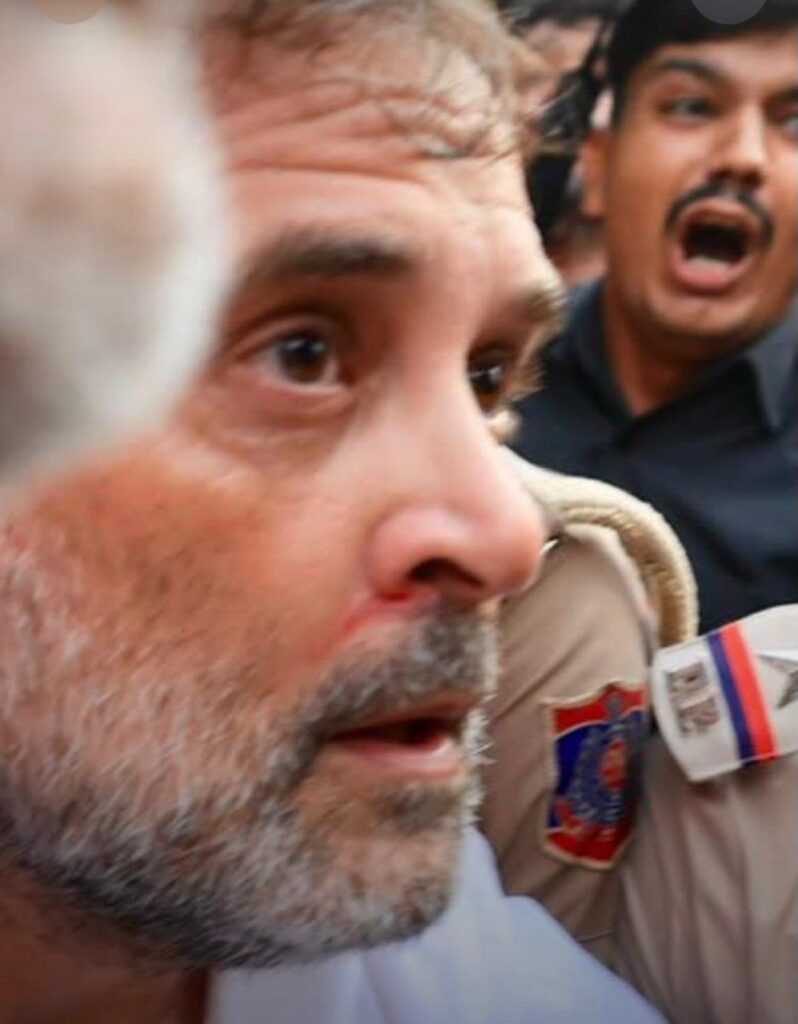
In the shadow of 10, Lok Kalyan Marg, Rahul Gandhi chose confrontation over convention.
On 21 July 2026, flanked by Priyanka Gandhi Vadra and other Congress leaders, he led an impromptu sit-in against the Delhi Police’s heavy-handed crackdown on student protesters at Jantar Mantar and Parliament Street three days earlier. The authorities responded swiftly and brutally: Rahul was dragged along the road, left with a bleeding nose, while Priyanka was pushed into a police bus and over a hundred MPs were detained. Far from diminishing the movement, this episode has infused it with fresh energy, elevating a student agitation into a broader national challenge to the Modi government’s handling of youth aspirations and institutional accountability.
A journalist noted that this marked the first time in the history of independent India that a Leader of Opposition was dragged on the road by police. Rahul’s response was characteristically focused: “How I was treated is irrelevant to me. I don’t care. Treat me 5 times worse. I don’t care. The focus has to be on what was done to the students.”
“Main bhi khaif nahin taḳhta-e-dar se / Mai bhi Mansur huun kah do aghyar se”
(“I am not afraid of gallows; I am Mansoor, tell this to my opponent.”)
Pakistani Urdu poet Habib Jalib’s verses capture the spirit of unyielding resistance. Rahul Gandhi, Leader of the Opposition, has long demanded the resignation of Education Minister Dharmendra Pradhan over the NEET-UG 2026 paper leak scandal. Through his “Chhatron Ki Goonj” rallies in Kota and Dehradun, he has spotlighted deep corruption and systemic failures in India’s examination apparatus. Lakhs of students, who invested years of effort and family resources in preparation, saw their futures undermined by leaks and irregularities. What began as online satire targeting the “Cockroach Janata Party” evolved into weeks of sustained demonstrations at Jantar Mantar, drawing credible civil society voices and highlighting generational discontent.
The police action on 20 July, which left young protesters injured, provided the immediate catalyst. Rahul’s decision to take the battle directly to the Prime Minister’s residence the following days was both strategic and symbolic. It bypassed a Parliament that had repeatedly stifled debate despite his formal request to the Prime Minister for a full discussion on the crisis. When democratic institutions fail to deliberate on issues of such magnitude, the streets inevitably become the arena. The Congress’s intervention transformed a simmering student protest into a pointed political statement demanding not only Pradhan’s ouster but also accountability from the Home Minister and the Prime Minister himself for the violence unleashed on peaceful demonstrators.
“Deep jis ka mehllaat hi mein jaley / Chand logon ki khushiyon ko le kar chaley”
(“A lamp that sheds light only on palaces; that caters to the whims of a chosen few.”)
Jalib’s indictment of a system that illuminates only the palaces of the privileged strikes at the heart of the matter. While certain critics of the government have been allowed space to protest without hindrance, students voicing genuine grievances about their stolen futures faced batons and barricades. This selective application of state force raises uncomfortable questions about whose voices are suppressed and whose are amplified. Rahul Gandhi’s physical immersion in the protest—lying on the road outside the PM’s house—signified more than optics. It represented a deliberate bridging of parliamentary opposition with street-level solidarity, mingling seamlessly with the students both in symbolism and in spirit.
The image from that day, of the Leader of the Opposition being carried away by police, will endure as a powerful emblem. It underscored the Modi regime’s discomfort with dissent, even when expressed by constitutional office-holders. Yet this very repression has paradoxically strengthened the movement. What might have remained a contained student agitation now carries the potential to spread nationwide with renewed momentum. Campuses and towns across India are witnessing heightened mobilisation, as young citizens recognise their struggles reflected in Rahul’s stand.
The NEET controversy is not an isolated administrative lapse but a symptom of deeper erosion in public trust. The government’s response—acknowledging the leak as a “grave sin” while making arrests of some perpetrators—has failed to address broader systemic accountability or the excessive force used against protesters. By evading substantive parliamentary discussion, the ruling dispensation left the opposition with little choice but to escalate. Rahul Gandhi’s march to Lok Kalyan Marg articulated this failure in unequivocal terms, shifting the narrative from policy critique to a fundamental question of democratic responsiveness.
The Arrest and Its Ripples
The swift arrest and manhandling of Congress leaders have not dampened but amplified the protests. Rahul’s willingness to endure physical discomfort and legal consequences has lent moral weight to the students’ demands for transparency, reform, and justice. In an environment where institutional avenues appear blocked, such acts of visible solidarity resonate deeply. They signal that the opposition remains willing to bear the cost of challenging power, fostering greater public engagement with the issue.
This development exposes the tensions within India’s democratic framework. A government that prides itself on decisive governance appears increasingly reliant on coercive measures to manage dissent. The contrast between the treatment of student protesters and other selective demonstrations further highlights inconsistencies in the application of law and order. As the movement gathers steam, it risks evolving from a specific grievance over examinations into a wider reckoning with governance priorities—particularly the gap between promises to the youth and the reality of their lived experiences.
Jalib’s poetry offers a fitting coda to this moment of political awakening:
“Main bhi khaif nahin takht-e-dar se…
Zulm ki baat ko, jahl ki raat ko,
Main nahin maanta, main nahin jaanta.”
(“I am not afraid of the gallows… The language of oppression, the darkness of ignorance—I refuse to accept.”)
India’s students, joined by opposition leaders who refuse to accept this “light-starved” order, are asserting their right to be heard. Rahul Gandhi’s stand at the Prime Minister’s doorstep has crystallised their anger into a more organised and visible force. Whether this translates into lasting nationwide momentum remains to be seen, but the events of recent days have undeniably altered the trajectory of the protest. In confronting power directly, Rahul has reminded the nation that true leadership sometimes requires lying on the road—bruised yet unbroken—until the demands of the people can no longer be ignored.

~Hasnain Naqvi is a former member of the history faculty at St. Xavier’s College, Mumbai….
The opinions expressed here are solely those of the author.

