
Mind thinks. Heart feels. Soul connects. A person, a book or a film; when that comes as a soulmate, the whole scenario changes. The experience becomes extraordinary. So does its outcome.
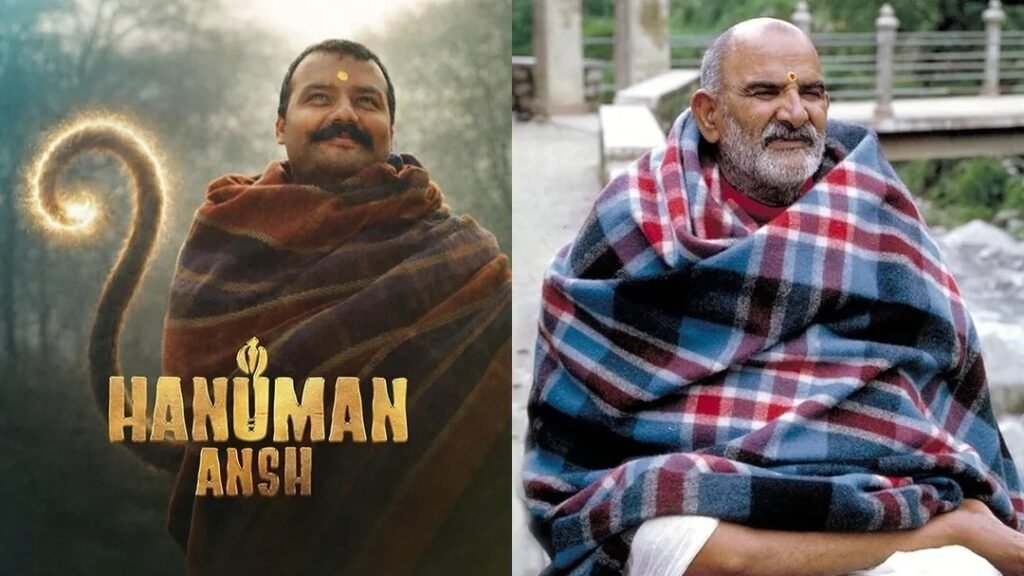
That precisely defines the journey of the film Hanuman Ansh. So rare, it may reveal something about the things we deeply seek. Beyond success, scale and spectacle
A ₹2-crore film has no business behaving like this.
Not in an industry where films cost hundreds of crores to mount, opening weekends are engineered months in advance, and attention itself has become one of the most expensive commodities.
And yet, here we are.
A film rooted in the life and teachings of Neem Karoli Baba has travelled far beyond what its initial numbers might have suggested. It didn’t arrive with the conventional machinery of a blockbuster. It travelled differently; from person to person, conversation to conversation, one recommendation at a time.
Which leaves me with a question I can’t quite shake:
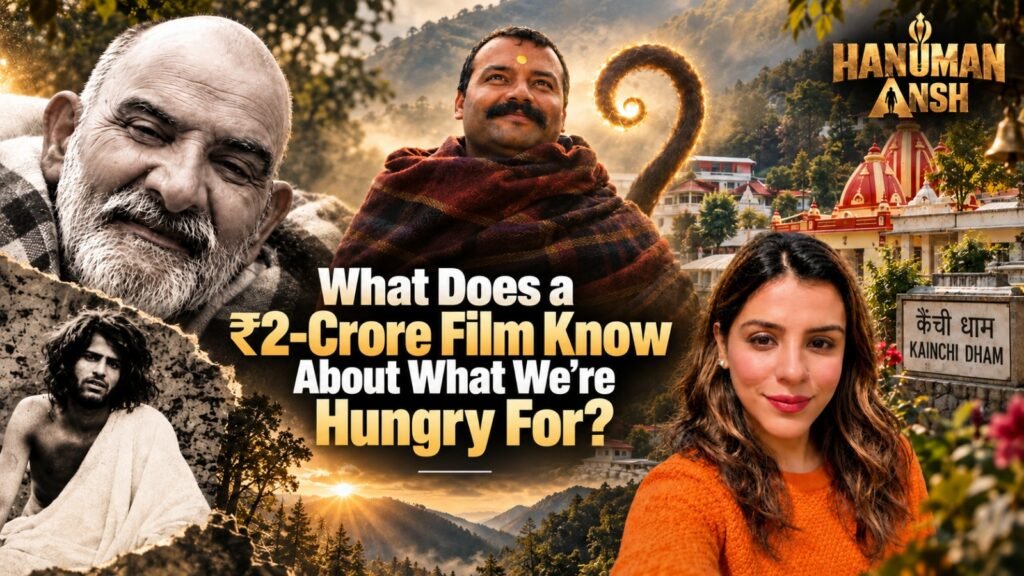
What does a ₹2-crore film know about what we’re hungry for?
We talk endlessly about what people want. Better careers. Better homes. Better bodies. Better phones. Better relationships. Better lives.
But I’m beginning to wonder if wanting and needing are two entirely different things.
Because beneath all that wanting, there seems to be another kind of hunger.
To feel that our lives mean something.
To feel that we’re not alone.
To believe that difficult things can eventually make sense.
To be useful to somebody.
To trust ourselves again.
I know something about that last one because, not very long ago, I had almost completely lost it.
My own story with Baba didn’t begin with a pilgrimage I had planned for months, or with some grand spiritual calling.
It began on a random Tuesday.
My sister told me that a friend who was supposed to accompany her had dropped out. There was one seat in the car. We were going to Kainchi.
I said yes.
That’s it.
There was no elaborate decision-making. No sign from the heavens. No particularly profound thought.
I simply went.
And perhaps that’s one of the stranger things about life. We spend so much time imagining that important moments must announce themselves. Sometimes they don’t. Sometimes they look like an empty seat in a car.
By the time I went to Kainchi in November 2025, I was not in a particularly good place.
There were things happening in my life that had left me emotionally, physically, financially and psychologically depleted. I was in the middle of an existential crisis and confronting parts of myself I had spent years avoiding.
There were moments when continuing itself had begun to feel like a question.
And yet, I don’t remember that journey as the beginning of a life in which everything suddenly became easy.
Quite the opposite.
People often say that the teacher appears when the student is ready. I don’t know whether I can explain what “ready” means. I only know that Baba seemed to enter my life at the exact moment I had run out of the certainty I thought I possessed.
What followed wasn’t a neat spiritual transformation.
Things left my life. Things I thought I needed. Things I thought defined me. And, strangely, some things returned; sometimes in completely unexpected forms, sometimes in greater measure.
But the real lesson wasn’t about getting some of these things back.
It was about who I became while they were gone.
I began to understand faith differently. Not as the assurance that nothing bad will happen, but as the ability to keep walking when you don’t know what happens next.
For me, the lesson was self-trust.
Perhaps Baba didn’t teach me to have fewer questions. Perhaps he taught me not to be frightened by them.
I thought this would remain a private chapter of my life.
Then came Hanuman Ansh.
I watched Hanuman Ansh much before it was due for release, at one of the early FOC screenings organised to create awareness around the film, gauge audience response and, hopefully, build the kind of support that an independent labour of love often needs before it finds its way to a larger audience.
There was something rather beautiful about watching it at that stage. The film was still finding its feet, and those of us sitting in that room were, in a small way, witnessing something before the rest of the world had discovered it.
For me, of course, there was another layer to it. I was already deeply connected to Baba’s story. I knew what his presence had come to mean in my own life, and so I wasn’t watching simply as an audience member evaluating a film. I was watching as someone who had lived through a chapter that made many of the film’s themes feel deeply personal.
What happened afterwards, however, was something I hadn’t expected.
People began reaching out, from those making the film to people who had spent years building legacies of their own. Different journeys, different intentions, different circles of people, all somehow beginning to converge around the same story. Looking back now, it feels like we may have been witnessing a small piece of history in the making, without quite knowing it at the time.
When the film released in August this year, the outcome was still far from certain. Some people simply wanted to know when and where they could watch it. Others wanted to bring it to their own cities. There were people looking for ways to organise screenings for communities and children who might otherwise never have had the opportunity to see it. And some simply wanted to talk about what the film had stirred in them.
Somewhere along the way, almost without my realising it, I found myself becoming a small plug between people and possibilities; connecting one person to another, one idea to an opportunity, one intention to a way forward.
And perhaps that is what has felt most beautiful about this journey. I never set out to become part of the film’s story. I certainly didn’t imagine I would have any particular role in where it went. I was simply responding, one person and one possibility at a time, to what was unfolding in front of me.
Maybe that is how grace sometimes works. Not always through grand gestures or dramatic signs, but through very ordinary things: a phone call, a conversation, an introduction, a seat at a screening, a person who happens to know another person. You don’t always know why you are being placed somewhere. You simply find yourself there, and somehow, the next dot connects.
Somewhere along that chain of connections, I happened to meet Ashok, a senior colleague, after a very long time. We spoke about the film and Baba, and he shared his own connection with him; his own perspective and his life’s journey. And then, almost as naturally as the conversation had begun, he encouraged me to write about mine, about this rare film, knowing my involvement in the project.
And here I am.
Perhaps that is how stories find their way into the world too. They don’t always arrive fully formed. Sometimes they are simply passed from one person to another, gathering meaning along the way, until eventually someone finds the words for what has been quietly unfolding.
The fascinating thing about Hanuman Ansh wasn’t simply that people went to see it. It was that people seemed to tell other people to go see it.
In an age where we have built entire industries around getting strangers to pay attention to something, there is something almost old-fashioned about one person turning to another and saying, Go watch this. I think you might need it.
That kind of word-of-mouth is difficult to manufacture. You can spend money buying visibility, but you cannot quite buy that feeling of wanting someone else to experience something because it meant something to you.
And I don’t think the success of one film permits us to declare that India has suddenly become more spiritual. That would be far too easy.
Nor do I think everyone who watched Hanuman Ansh walked away with the same belief, or even the same interpretation.
Some may have gone because they were devotees. Some because a friend recommended it. Some because they were curious. Some may simply have wanted to understand what everyone was talking about. And all of those reasons are perfectly valid.
Perhaps, then, the more interesting question isn’t whether people are becoming more religious.
Perhaps we are becoming more hungry for meaning.
And the word “hunger” has become particularly difficult for me to use casually.
Because while we’ve been asking what audiences are hungry for metaphorically, there are people for whom hunger isn’t metaphorical at all.
That has been another unexpected thread running through this journey. The film may have begun as a story about a spiritual figure, but the conversations around it kept bringing me back to something much more tangible: people, food, dignity, compassion and the simple act of showing up for someone else.
Perhaps that is what makes Baba’s message so enduring for me. It isn’t particularly complicated. It is almost disarmingly ordinary in its verbs:
Love. Serve. Feed. Remember.
None of them require you to become extraordinary.
Perhaps they simply ask you to become useful.
I’ve spent most of my professional life trying to make stories travel.
As a copywriter early in my career, and now as a marketer and an artist, that’s what you learn to do. You look for the sentence that makes somebody stop. The image that makes somebody feel. The idea that moves from one person to another and, if you’re lucky, becomes something bigger than the person who first imagined it.
What I didn’t expect was to discover that some stories don’t really need to be pushed.
They travel because, somewhere, someone is already looking for them.
And perhaps that is what I’ve understood most clearly through this journey. My role, if I have one, isn’t to take credit for where the story goes. It is simply to be available when two dots need connecting. To make the call. To introduce the person. To open the door. To pass something forward when it lands in your hands.
The rest is not always ours to decide.
So, what does a ₹2-crore film know about what we’re hungry for?
I don’t know.
I’m not sure anyone does.
Perhaps it knows nothing at all. Perhaps its journey is simply the beautiful accident of timing, storytelling, faith, curiosity and word of mouth.
Or perhaps, somewhere beneath the numbers, there is a small clue. Of a soul connection.
That despite everything we are constantly being told to chase, acquire and become, we still want to feel connected, as humans.
We still want hope.
We still want stories that make us pause long enough to remember that there is more to life than the next achievement, the next purchase, the next version of ourselves we are trying to become.
We want to be reminded that kindness is not weakness. That serving someone does not make you smaller. That feeding someone can be as meaningful as speaking about compassion. That sometimes the most important thing we can do is simply show up.
And perhaps that is why the word hunger keeps returning to me.
Because maybe we are hungry for many things at once.
For meaning. For belonging. For faith. For certainty. For love.
And more…
But then there is something unknown we deeply crave. That something; infinite and indefinite, yet so real to feel and connect with.
Sometimes, perhaps, we are hungry to become the kind of people who live all of that, and who can give these things to the outside world. And sometimes, we become a very part of it. Silently and substantially.
I’ve spent years learning how to make things visible. This journey has taught me something different: not everything meaningful needs to be made louder. Sometimes, you simply have to recognise it when it arrives, hold it gently, and help it find its way to the next person.
Perhaps that is what seva, faith and even storytelling have in common; they become meaningful when they move beyond us.
I went to Kainchi because there happened to be one empty seat in a car. I wasn’t looking for a guru, a new chapter, or any of what followed. I simply said yes.
And somewhere between that Tuesday, a film, unexpected people, shared meals, children finding their way into cinema halls, and countless small acts of connection, I learnt that perhaps we are not always meant to know where a journey is taking us.
Sometimes we are simply meant to take the next step, and trust that the next dot will reveal itself when it needs to.
So perhaps that is what a ₹2 crore film knows about what we’re hungry for. Not necessarily an answer, but a reminder. That beneath all our wanting, achieving and becoming, there remains a very human need to feel connected; to something larger than ourselves, to one another, and perhaps, most importantly, to the better parts of ourselves.
And if life occasionally gives us the opportunity to feed that hunger in someone else; with a meal, a kind word, an introduction, a story, or simply by showing up, perhaps that is enough.
Perhaps that is the journey. One person. One possibility.
One small act of service.
Passed forward.
Like Hanuman Ansh…

Sonam Sharma (popularly known as Zaffarah on social media ) is a creative entrepreneur, copywriter, artist and working across advertising, entertainment and media.

