

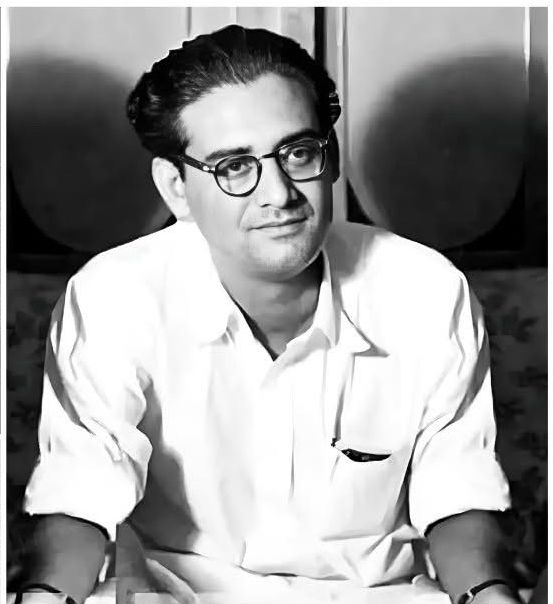
On June 16, the music world pauses to remember and celebrate one of its grandest titans, *Hemant Kumar* (born Hemanta Mukherjee). Gifted with a rich, deep baritone that could effortlessly soothe a broken heart or elevate a simple melody into a spiritual experience, he was fondly hailed as the *”Voice of God.”* The legendary composer Salil Chowdhury once famously remarked, *”If God could sing, He would sing in the voice of Hemant Mukherjee.”*
As a singer, composer, and producer, Hemant Kumar’s influence crossed linguistic boundaries, leaving an indelible mark on Hindi and Bengali cinema, as well as Marathi, Gujarati, Odia, Assamese, Tamil, Punjabi, Bhojpuri, and Sanskrit music. On his birth anniversary, we look back at the life and extraordinary journey of a musical institution.
*Ami Poth Bhola Ek Pathik* (I am a Wanderer Who Has Lost My Way) — Leaving Engineering for the Divine Call of Music
Born on June 16, 1920, in the holy city of Varanasi at his maternal grandfather’s house, Hemant Kumar’s roots traced back to the village of Baharu in West Bengal. His family later migrated to Kolkata, where he grew up attending Nasiruddin School and the Mitra Institution School in Bhawanipore.
Though he enrolled at the *Bengal Technical Institute at Jadavpur* to pursue engineering, the siren call of melodies proved too strong to resist. Defying his father’s conventional expectations, he quit his studies to pursue music. He even briefly dabbled in literature, publishing a short story in the prestigious Bengali magazine *Desh*, but by the late 1930s, his heart was entirely captured by notes and rhythms. He received his formal classical training under Phanibhusan Banerjee, a disciple of the legendary Ustad Faiyaz Khan, anchoring his future experimentation in deep-rooted tradition.
*Na Yeh Chand Hoga, Na Taare Rahenge* (Neither This Moon Will Remain, Nor the Stars) — Composing Epics and Becoming the Voice of Hindi Cinema
Hemant Kumar’s early career was a masterclass in versatility. He made his first All India Radio recording in 1935, followed by early cinematic milestones in Bengali films like *Rajkumarer Nirbbasan* (1940) and *Nimai Sanyas* (1941). His Hindi playback debut arrived with Pankaj Mullick’s *Meenakshi* (1942) with the song *”Ab Preet Ki Jeet Manayen Saajan.”*
When he shifted his base to Mumbai, his genius as a composer truly exploded. He debuted as a Hindi music director with *Anand Math (1952)*, creating a stirring, immortal rendition of *”Vande Mataram”* that remains a benchmark for patriotic compositions. However, it was *Nagin (1954)* that catapulted him into national stardom, earning him the *Filmfare Best Music Director Award*. The film’s soundtrack became an absolute sensation across the country, featuring spellbinding tracks like *”Man Dole Mera Tan Dole”* and *”Mera Dil Ye Pukare Aaja”*. The iconic snake-charmer flute theme (*been*) from the film—which became an enduring cultural phenomenon—was innovatively crafted by Hemant Kumar using a clay violin and a clavioline, played by his assistants Kalyanji (later of Kalyanji-Anandji fame) and Ravi.
The very same year saw him scoring the deeply impactful *Jagriti (1954)*, which gave Indian cinema foundational patriotic and educational anthems like *”Aao Bachchon Tumhe Dikhaye”* and the soul-stirring tribute to Mahatma Gandhi, *”Sabarmati Ke Sant Tune”*. Later, his composition work reached artistic zeniths with masterpieces like *Sahib Bibi Aur Ghulam (1962)*. In this cinematic gem, his melodies seamlessly advanced the narrative, echoing the inner turmoil and deep longing of the characters through timeless classics like *”Piya Aiso Jiya Men Samay Gayo”* and the hauntingly desperate plea, *”Na Jao Saiyan Chhuda Ke Baiyan”*.
*Ei Poth Jodi Na Sesh Hoy* (If This Journey Never Ends) — The Ultimate Voice of Bengali Cinema and Rabindra Sangeet
While Mumbai brought him pan-Indian fame, Hemant Kumar remained the beating heart of Bengal. He was arguably the greatest exponent of *Rabindra Sangeet*, bringing Rabindranath Tagore’s compositions to the masses with unparalleled emotional depth. His first recorded Rabindra Sangeet for *Priya Bandhabi* (1943), *”Pather Sesh Kothaye”*, was just the beginning of a lifelong devotion that culminated in masterpieces like *”Chorono Dhorite Diyogo Amare”* in *Dadar Kirti* (1980).
In Bengali commercial cinema, he became the definitive on-screen voice of superstar *Uttam Kumar*. Beginning with *Shap Mochan* (1955), their partnership turned into a golden era of romanticism, birthing timeless tracks like *”Ei Poth Jodi Na Sesh Hoy”* and *”Muchhe Jawa Dinguli”*. He also masterfully integrated Bengal’s rich folk traditions into light cinema through films like *Palatak* (1963), *Baghini*, and *Balika Badhu*.
*Tum Pukaar Lo… Tumhara Intezaar Hai* (Call Out to Me… I Am Waiting for You) — The Master Producer and Global Trailblazer
As a producer, Hemant Kumar had an eye for cinematic brilliance. Under his banner, he produced the haunting psychological thriller *Bees Saal Baad (1962)*, famous for the track *”Kahin Deep Jale Kaihin”*, and the emotional masterpiece *Khamoshi (1969)*, featuring the unforgettable *”Tum Pukaar Lo”* and *”Woh Shaam Kuch Ajeeb Thi”*.
His artistry knew no borders.
In 1972, he scored the music for Conrad Rooks’ Hollywood film *Siddhartha*, becoming the first Indian singer to provide playback for a Hollywood venture. In recognition of his global impact, the US government honoured him with honorary citizenship in Baltimore, Maryland.
Throughout his career, accolades followed him naturally. He won *two National Film Awards for Best Male Playback Singer*(for *Nimantran* in 1971 and *Lalan Fakir* in 1986), the *Sangeet Natak Akademi Award (1986)*, and multiple BFJA Awards.
*Ya Dil Ki Suno Duniyawalo* (O People of the World, Either Listen to the Heart) — A Lasting Symphony
Behind the grand public persona, Hemant Kumar led a warm and fulfilling family life. Married to singer Bela Mukherjee in 1945, he nurtured a musical household. His virtues of dedication and grace were passed down to his children; his youngest brother Amal Mukherjee composed music, and his daughter Ranu Mukherjee also carved out her own singing career in the late ’60s and ’70s.
Though the legendary maestro passed away on September 26, 1989, in Bombay, his voice has never truly left us. Whether it is the melancholic philosophy of *”Jane Woh Kaise Log The”*, the carefree whistle of *”Hai Apna Dil Toh Aawara”*, or the haunting romance of *”Ye Raat Ye Chandni Phir Kahan”*, Hemant Kumar remains an eternal companion to our deepest emotions.
On his birth anniversary, we look back not in mourning, but in deep gratitude for the heavenly melodies he left behind.

~Hasnain Naqvi is a former member of the history faculty at St. Xavier’s College, Mumbai….
The opinions expressed here are solely those of the author.