

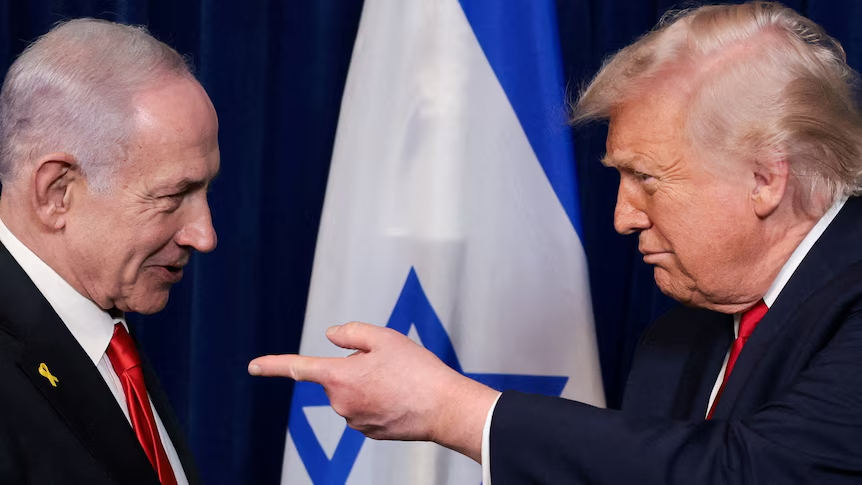
New Delhi, 09 June— Midst reports of the Washington’s warning of consequences of continuation of war to Israeli Prime Minister Bejamin Netanyahu, United States President Donald Trump has said the US was “in the final throes of what will be a very, very good deal”.
Trump said that a deal between Israel and Iran is imminent, and that the two will leave each other alone for at least a week. He told reporters late on Monday that the US was “in the final throes of what will be a very, very good deal”.
The US President rushed to add that the Strait of Hormuz would open “immediately upon signing”, which he said could be in two or three days.
Israel and Iran said on Monday they would pause attacks following their most serious escalation since a ceasefire took effect in April.
“If we go and bomb, which we can do very easily, if we want, and we spend another two or three weeks bombing, [Iran will] have nothing left whatsoever, but you won’t have the Strait open for months,” Blowing hot and cold, Trump claimed that the US naval blockade on Iran “turned out to be much stronger than bombing” in making Iran want a deal.
Trump, who has reportedly been growing frustrated with Netanyahu, told Axios that he had warned the Israeli Prime Minister about the consequences of continuing the war.
“I said, ‘Bibi, you better be careful, or you will be on your own very soon’,” Trump said.
In a post on his Truth Social platform, he demanded both sides stop “shooting”, saying that “final negotiations” towards peace would proceed “subject to ignorance or stupidity getting in its way”.
The flare-up began on Sunday, triggered by Israel’s deadly bombardment of Lebanon’s capital, Beirut. Iran – which has long said any peace deal with the US depends in part on an end to the fighting in Lebanon – responded with a wave of missiles at northern Israel.
Trump reportedly called Netanyahu on Sunday evening and asked him not to retaliate, but Israel didn’t pay any heed launching attacks on Iran early on Monday.
Israeli forces struck Iranian air defence systems and a petrochemical plant, while Iran retaliated by hitting a similar facility in Haifa and targeting two Israeli airbases. Many of the missiles were reportedly intercepted over the occupied West Bank but eyewitnesses accounts said that there was much more damage in Isreal then Tel Aviv accepted.
Israel’s aggressive move and Iran’s retaliation complicated Trump’s push to end a war that the US and Israel launched on February 28. A ceasefire announced on April 8 paused all-out warfare, but flare-ups in the Gulf have continued.
For his part, Netanyahu putting up a brave face before the public said in a televised statement that he had told Trump that “Israel has a full right to self-defence, and we are exercising it as required”.
“Right now, the fire at the front is contained, because after we hit the terrorist regime in Tehran, it stopped attacking us,” he said.
Netanyahu also warned that should Iran “make the mistake of resuming attacks against us, we will respond with full force”.
Israel’s ambassador to Washington, Yechiel Leiter, downplayed reports of tension between the US and Israeli leaders, telling Fox News that “sometimes, lovers have a spat”.
He said that while Netanyahu had “decided” to “lower the temperature” at Trump’s request, the US President understands “full well” that Israel cannot “absorb ballistic missiles into our country without responding”.
Iran’s Ministry of Foreign Affairs spokesperson, Esmaeil Baghaei, blamed Washington for the escalation.
“The US is directly responsible,” he said. “They are party to the ceasefire negotiations. Therefore, any act in violation of the ceasefire, be it through the interception of vessels [in the Strait of Hormuz], the targeting of southern Lebanon by Israel, or any other event, will cause the United States to be directly responsible for the escalation in the region.”
Iran’s First Vice President Mohammad Reza Aref said the operation against Israel, dubbed “Nasr” or victory, showcased “a new level of deterrence from mighty Iran” and that Israel had been “forced to beg once again” for a ceasefire.
Against public display of loud claims and hostile words, behind the scenes, diplomatic efforts are continuing.
Iranian President Masoud Pezeshkian posted on X that Tehran was still “at the negotiating table”, while Iran’s ambassador to the United Nations, Amir Saeid Iravani, said that Washington and Tehran, through Pakistan as an intermediary, are “presenting and exchanging views” towards an agreement.
Iravani told The Associated Press news agency he was hopeful that “very soon” the two sides would reach “a conclusion”.
Pakistan’s Prime Minister Shehbaz Sharif said efforts for a peaceful diplomatic solution was ongoing “earnestly and painstakingly” and called for restraint, “especially when the final objective is just about to be achieved”.
He also said Israel and Iran’s exchange of fire was a “reminder of the dangers associated with a tenuous ceasefire and the unbearable consequences it may lead to”.
The escalation on Monday also drew in Yemen’s Houthi rebels.
The group fired missiles at Israel early in the morning and declared a complete ban on Israeli maritime navigation in the Red Sea, warning that all Israeli movements would be considered “legitimate military targets”.
Later on Monday, air raid sirens sounded in the Israeli port city of Eilat, with the military saying a suspected aerial target was launched from Yemen.
Violence has also continued in southern Lebanon.
Veteran Journalist and Political Commentator